70-461 Exam Details
-
Exam Code
:70-461 -
Exam Name
:Querying Microsoft SQL Server 2012/2014 -
Certification
:Microsoft Certifications -
Vendor
:Microsoft -
Total Questions
:446 Q&As -
Last Updated
:Jan 17, 2022
Microsoft 70-461 Online Questions & Answers
-
Question 201:
Which of the following are T-SQL regular identifiers? (Choose all that apply.)
A. categoryname
B. category name
C. category$name
D. category_name -
Question 202:
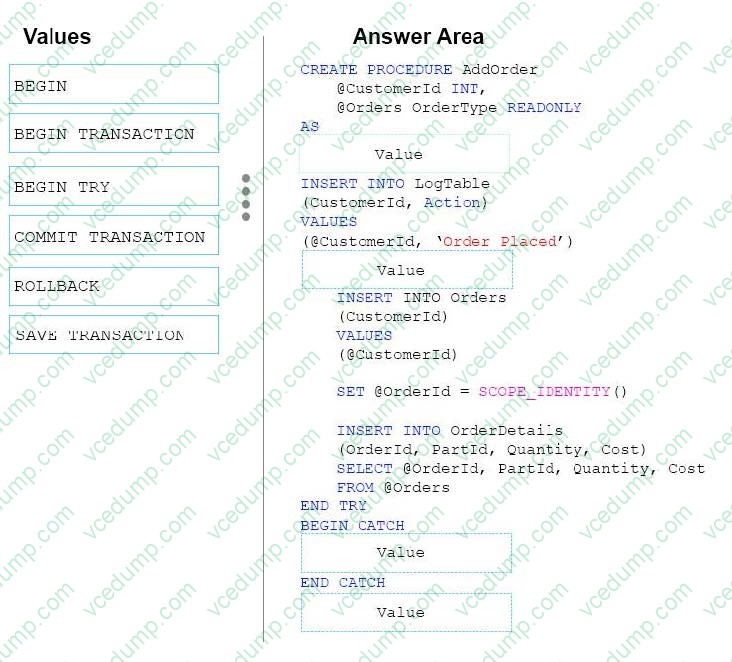
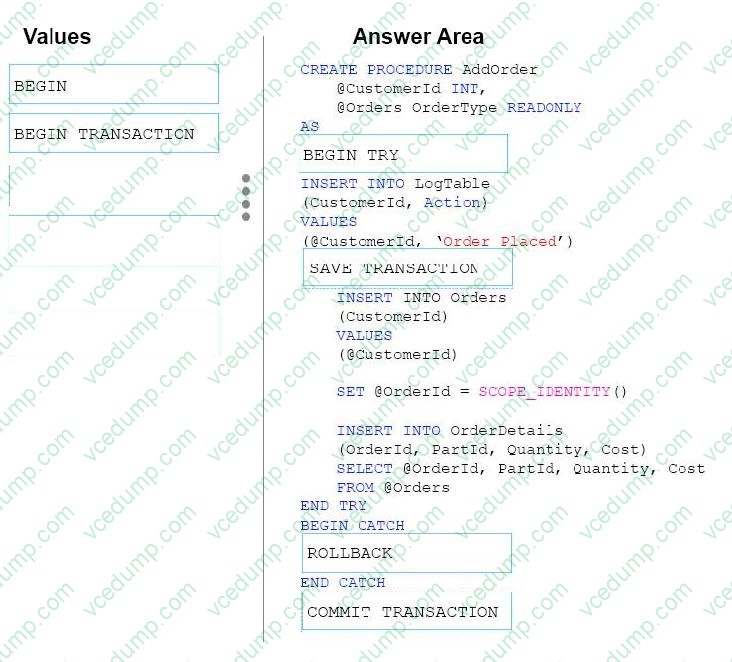
You need to create a stored procedure that enters values into multiple tables. The solution must ensure that if a single insert fails, none of the values are inserted into the tables.
How should you complete the stored procedure? To answer, drag the appropriate values to the correct locations. Each value may be used once, more than once, or not at all. You may need to drag the split bar between panes or scroll to view
content.
Select and Place:
-
Question 203:
You administer a Microsoft SQL Server database that contains a table named OrderDetail. You discover that the NCI_OrderDetail_CustomerID non-clustered index is fragmented. You need to reduce fragmentation.
You need to achieve this goal without taking the index offline. Which Transact-SQL batch should you use?
A. CREATE INDEX NCI_OrderDetail_CustomerID ON OrderDetail.CustomerID WITH DROP EXISTING
B. ALTER INDEX NCI_OrderDetail_CustomerID ON OrderDetail.CustomerID REORGANIZE
C. ALTER INDEX ALL ON OrderDetail REBUILD
D. ALTER INDEX NCI_OrderDetail_CustomerID ON OrderDetail.CustomerID REBUILD -
Question 204:
What is the advantage of using THROW in a CATCH block?
A. THROW in a CATCH block does not require parameters and so is easier to write.
B. THROW re-throws the original error so that the original error can be handled.
C. THROW causes an error severity of level 16 automatically.
D. The statement before a THROW requires a semicolon. -
Question 205:
How can you turn off nested triggers on a SQL Server instance by using T-SQL?
A. Use the sp_configure stored procedure followed by 'nested triggers' and 'OFF'.
B. Use the sp_configure stored procedure followed by 'nested triggers' and 0.
C. Use the sp_configure stored procedure followed by 'nested triggers' and 'OFF',followed by the RECONFIGURE statement.
D. Use the sp_configure stored procedure followed by 'nested triggers' and 0,followed by the RECONFIGURE statement. -
Question 206:
What are the advantages of using a sequence object instead of IDENTITY? (Choose all that apply.)
A. The IDENTITY property doesn't guarantee that there won't be gaps and the sequence object does.
B. The IDENTITY property cannot be added to or removed from an existing column; a DEFAULT constraint with a NEXT VALUE FOR function can be added to or removed from an existing column.
C. A new identity value cannot be generated before issuing an INSERT statement, whereas a sequence value can.
D. You cannot provide your own value when inserting a row into a table with an IDENTITY column without special permissions. You can specify your own value for a column that normally gets its values from a sequence object. -
Question 207:
You have a database named Sales that contains the tables shown in the exhibit. (Click the Exhibit button).
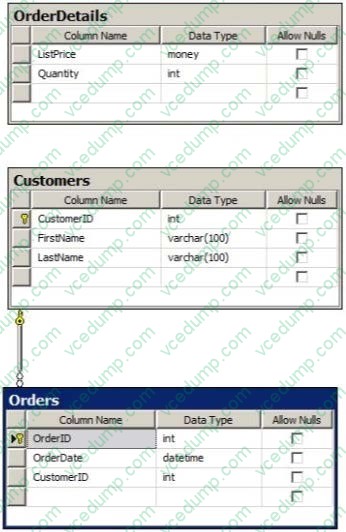
You need to create a query for a report. The query must meet the following requirements:
1. NOT use object delimiters.
2. Use the first initial of the table as an alias.
3. Return the most recent order date for each customer.
4. Retrieve the last name of the person who placed the order.
The solution must support the ANSI SQL-99 standard.
Part of the correct T-SQL statement has been provided in the answer area. Provide the complete code.

-
Question 208:
You administer a Microsoft SQL Server instance that will support several databases.
You need to ensure that the organization serial numbers can be stored in every new database created. You also need to ensure that the serial numbers are six alphanumeric characters and have the same structure across every database.
What should you do?
A. Create a user-defined data type on the master database.
B. Create a user-defined type on the master database.
C. Create a user-defined data type on the model database.
D. Create a user-defined type on the model database. -
Question 209:
DRAG DROP
You administer a Microsoft SQL Server database that contains a table named Customer defined by the following Transact-SQL statement:
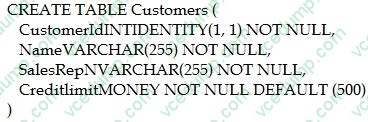
The SalesRep column contains the SQL Login name of the user designated as the customer's sales rep.
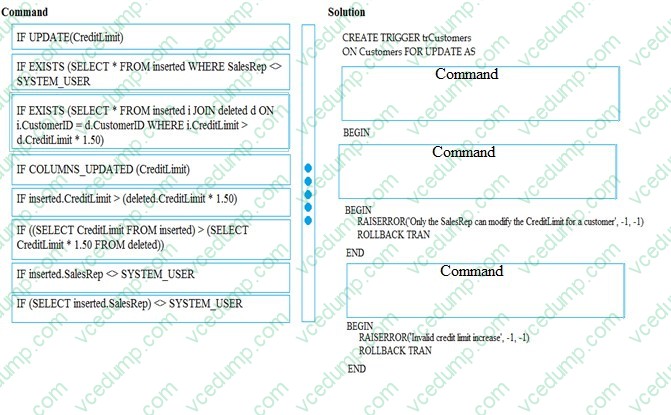
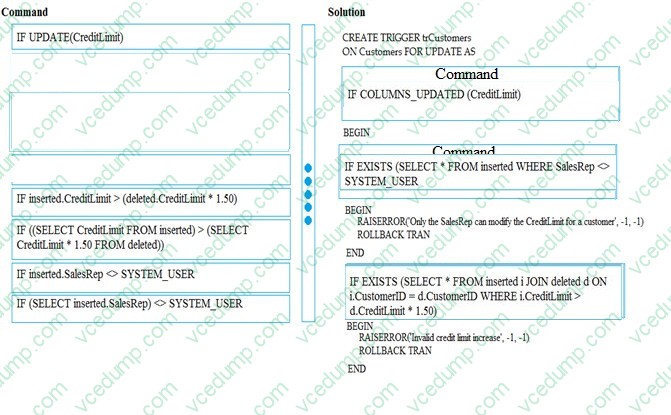
You need to create at trigger that meets the following requirements:
A customer's CreditLimit can only be changed by the customer's SalesRep.
CreditLimit cannot be increased by more than 50 percent in any single update.
If an UPDATE statement causes either of these business rules to be violated, the entire UPDATE statement should be rolled back.
In addition, the trigger must handle single-row and multi-row update statements and should execute in the most efficient manner possible.
How should you complete the trigger? To answer, drag the appropriate Transact-SQL segments to the correct locations. Each Transact-SQL segment may be used once, more than once, or not at all. You may need to drag the split bar
between panes or scroll to view content.
Select and Place:
-
Question 210:
You are developing a database application by using Microsoft SQL Server 2012. An application that uses a database begins to run slowly. Your investigation shows the root cause is a query against a read-only table that has a clustered index. The query returns the following six columns:
- One column in its WHERE clause contained in a non-clustered index.
-Four additional columns.
-
One COUNT (*) column based on a grouping of the four additional columns.
You need to optimize the statement.
What should you do?
A. Add a HASH hint to the query.
B. Add a LOOP hint to the query.
C. Add a FORCESEEK hint to the query.
D. Add an INCLUDE clause to the index.
E. Add a FORCESCAN hint to the Attach query.
F. Add a columnstore index to cover the query.
G. Enable the optimize for ad hoc workloads option.
H. Cover the unique clustered index with a columnstore index.
I. Include a SET FORCEPLAN ON statement before you run the query.
J. Include a SET STATISTICS PROFILE ON statement before you run the query.
Related Exams:
-
62-193
Technology Literacy for Educators -
70-243
Administering and Deploying System Center 2012 Configuration Manager -
70-355
Universal Windows Platform – App Data, Services, and Coding Patterns -
77-420
Excel 2013 -
77-427
Excel 2013 Expert Part One -
77-725
Word 2016 Core Document Creation, Collaboration and Communication -
77-726
Word 2016 Expert Creating Documents for Effective Communication -
77-727
Excel 2016 Core Data Analysis, Manipulation, and Presentation -
77-728
Excel 2016 Expert: Interpreting Data for Insights -
77-731
Outlook 2016 Core Communication, Collaboration and Email Skills
Tips on How to Prepare for the Exams
Nowadays, the certification exams become more and more important and required by more and more enterprises when applying for a job. But how to prepare for the exam effectively? How to prepare for the exam in a short time with less efforts? How to get a ideal result and how to find the most reliable resources? Here on Vcedump.com, you will find all the answers. Vcedump.com provide not only Microsoft exam questions, answers and explanations but also complete assistance on your exam preparation and certification application. If you are confused on your 70-461 exam preparations and Microsoft certification application, do not hesitate to visit our Vcedump.com to find your solutions here.