70-448 Exam Details
-
Exam Code
:70-448 -
Exam Name
:TS:MS SQL Server 2008.Business Intelligence Dev and Maintenan -
Certification
:Microsoft Certifications -
Vendor
:Microsoft -
Total Questions
:331 Q&As -
Last Updated
:Feb 05, 2022
Microsoft 70-448 Online Questions & Answers
-
Question 61:
You build and deploy a SQL Server 2008 Integration Services (SSIS) package.
During package development, the XML configuration is not specified.
You need to apply the configuration to the deployed package.
What should you do?
A. Use the Deployment utility.
B. Use the SETX command line utility.
C. Use the DTUTIL command line utility.
D. Use the DTEXEC command line utility. -
Question 62:
You are managing a SQL Server 2008 Analysis Services (SSAS) project for Company.com. You need to include a parent-child hierarchy for the dimension.
The child key feature is named CKUser and the parent key feature is named CKManager. As the root member you need to ensure that the top user is included.
As the root member, you should make sure that the topmost employee should be included. Which is the correct answer?
A. You should configure the IsAggregatable property of the Employee attribute to default.
B. You should configure the IsNotAggregatable property of the Employee attribute to false.
C. You should configure the IsNotAggregatable property of the Employees attribute to true.
D. You should configure the IsAggregatable property of the Employees attribute to false. -
Question 63:
You are developing a SQL Server 2008 Analysis Services (SSAS) solution which includes a time dimension called TestTime which includes a hierarchy called Year-By-Day for Company.com. You own a measure called Number from a measure group called MeasureTester.
In the previous time period for the current level of the Yer-Bet-Day hierarchy, you should make sure that you develop a calculated member to show the Number measure.
Which is the correct answer?
A. You should utilize [Measures].[ Number],OPENINGPERIOD [TestTime].[Yer-Bet- Day].FirstSibling.Level))
B. You should utilize ([Measures].[ Number],LASTPERIODS( 0,[TestTime].[Yer-Bet- Day].PrevMember))
C. You should utilize ([Measures].[ Number],LASTPERIODS( 1,[TestTime].[Yer-Bet- Day].PrevMember))
D. You should utilize ([Measures].[ Number],[ TestTime].[Yer-Bet-Day].NextSibling) -
Question 64:
You are developing a SQL Server 2008 Integration Services (SSIS) sample which includes some data flows for Company.com.
Not only you should control the data that passes by every path in the data flow through utilizing the Business Intelligence Development Studio., but also you should make sure that data flow logic is left.
Which is the correct answer?
A. You should utilize the Data Viewer tool.
B. You should utilize the Process Control tool.
C. You should utilize the Audit Control tool.
D. You should utilize Web Service. -
Question 65:
You maintain a SQL Server 2008 Integration Services (SSIS) instance.
The instance stores packages in a SQL Server 2008 instance.
You need to deploy the package of an instance of SSIS to another SSIS instance that stores its packages in a shared directory. What should you do?
A. Execute the dtutil command.
B. Execute the dtexec command.
C. Execute the dtexecui command.
D. Execute the dtswizard command. -
Question 66:
You develop a series of SQL Server 2008 Integration Services (SSIS) packages. You need to ensure that the following requirements are met:

The packages contain configurations.
The configuration information is centrally stored for all packages.
There are no dependencies among the packages.
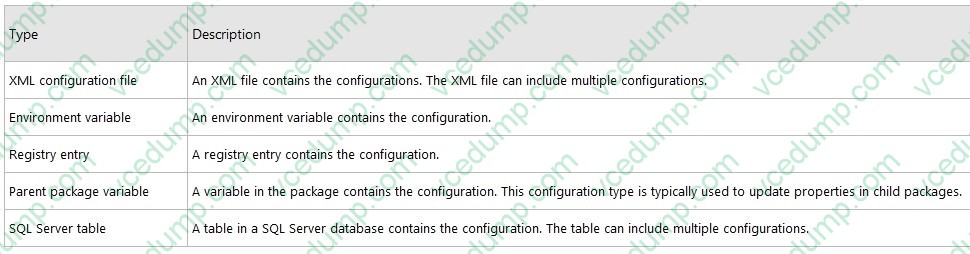
Which component should you use to configure the package? (Each correct answer presents a complete solution. Choose two.)
A. A SQL Server 2008 table
B. A parent package variable
C. A registry entry
D. An environment variable
E. An XML configuration file -
Question 67:
You are a database developer and you have about two years experience in creating business Intelligence (BI) by using SQL Server2008.
Now you are employed in a company named NaproStar which uses SQL Server2008. You work as the technical support.
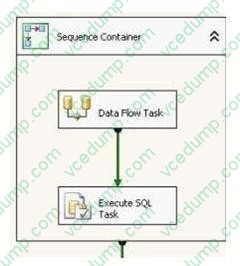
According to the requirement of the company CIO, you use SQL Server 2008 Integration Services (SSIS) to create a package. The exhibit below shows the structure of the package.
You have to define a variable. The variable contains sensitive information that can only be accessed by the Sequence Container, the Data Flow Task, and the Execute SQL Task. What action should you perform?
A. At the Data Flow Task scope, the variable should be created
B. At the package scope, the variable should be created
C. At the Sequence Container scope the variable should be created
D. At the Execute SQL Task scope, the variable should be created -
Question 68:
You create a SQL Server 2008 Analysis Services (SSAS) solution.
You enable proactive caching for a partition.
You need to ensure that SSAS can query relational data when multidimensional storage is being updated.
What should you do?
A. Set the OnlineMode property for the partition to Immediate.
B. Set the ProcessingMode property for the partition to Regular.
C. Set the OnlineMode property for the partition to OnCacheComplete.
D. Set the ProcessingMode property for the partition to LazyAggregations. -
Question 69:
You are a database developer and you have about two years experience in creating business intelligence (BI) solutions by using SQL Server2008.
Now you are employed in a company which is named NaproStar and work as a developer of a SQL Server 2008 Reporting Services (SSRS) solution for the company. You use the solution to create a report, and then write the code segment
in the report that is shown as the following:
Private Shared Function GetMFromMeters(ByVal MetersPrice As Decimal) As Decimal If
IsNothing
(MetersPrice) Then
Return Nothing
Else
Return MetersPrice * 1.78
End If
End Function
However, when you compile code segment, you will get errors. Now you get an order from your company CIO, according to his requirement, not only you should get the call of the GetMFromMeters function from other reports, but also you
should have the code segment compiled without any errors.
So what action should be performed to accomplish the tasks above?
A. The function should be declared from Private Shared to Public Shared
B. Microsoft Visual Basic .NET should be used to create a custom assembly and then have the function declared as Public Shared
C. The Public keyword should be removed from the function definition
D. The Private keyword should be removed from the function definition
E. The Shared keyword should be removed from the function definition -
Question 70:
You develop a SQL Server 2008 Integration Services (SSIS) package.
The package downloads several files from a remote FTP server by using multiple FTP tasks, and then processes data by using multiple Execute SQL tasks.
You need to configure the package to restart at the point of failure after the package downloads the files.
What should you do?
A. Configure the FTP tasks to support transactions.
B. Configure the Execute SQL tasks to support transactions.
C. Move all the FTP tasks to a sequence container.
D. Configure the package to use a checkpoint.
Related Exams:
-
62-193
Technology Literacy for Educators -
70-243
Administering and Deploying System Center 2012 Configuration Manager -
70-355
Universal Windows Platform – App Data, Services, and Coding Patterns -
77-420
Excel 2013 -
77-427
Excel 2013 Expert Part One -
77-725
Word 2016 Core Document Creation, Collaboration and Communication -
77-726
Word 2016 Expert Creating Documents for Effective Communication -
77-727
Excel 2016 Core Data Analysis, Manipulation, and Presentation -
77-728
Excel 2016 Expert: Interpreting Data for Insights -
77-731
Outlook 2016 Core Communication, Collaboration and Email Skills
Tips on How to Prepare for the Exams
Nowadays, the certification exams become more and more important and required by more and more enterprises when applying for a job. But how to prepare for the exam effectively? How to prepare for the exam in a short time with less efforts? How to get a ideal result and how to find the most reliable resources? Here on Vcedump.com, you will find all the answers. Vcedump.com provide not only Microsoft exam questions, answers and explanations but also complete assistance on your exam preparation and certification application. If you are confused on your 70-448 exam preparations and Microsoft certification application, do not hesitate to visit our Vcedump.com to find your solutions here.