70-448 Exam Details
-
Exam Code
:70-448 -
Exam Name
:TS:MS SQL Server 2008.Business Intelligence Dev and Maintenan -
Certification
:Microsoft Certifications -
Vendor
:Microsoft -
Total Questions
:331 Q&As -
Last Updated
:Feb 05, 2022
Microsoft 70-448 Online Questions & Answers
-
Question 31:
To render correctly the report with dataset for 25 column to Excel what would you use
A. Matrix
B. Rectangular
C. Table
D. Lists -
Question 32:
You are creating a SQL Server 2008 Integration Services (SSIS) data flow which increases information from a source search to a result table for Company.com. In order to increase those rows which could not include the destination table, which is the correct answer? (Select more than one)
A. You should utilize the Data Conversion Transformation.
B. You should utilize the Lookup transformation.
C. You should utilize the Character Map Transformation.
D. You should utilize the Merge Join transformation.
E. You should utilize the Data Mining Query Transformation
F. You should utilize the Term Extraction Transformation -
Question 33:
You are managing a SQL Server 2008 Reporting Services (SSRS) database server for Company.com. You find that it will cost so much time to run reports which include many execution snapshots in the instance.
You own a new production server together with SSRS fixed. You should make sure that you could save time when you move the reports and their snapshots to the production server.
In order to solve the problem, which is the correct answer?
A. You should utilize the default command.
B. You should utilize the taskrun.exe command.
C. You should publish the results through utilizing a Dynamic Management View (DMV)
D. Before setting the server through utilizing the Reporting Services Configuration tool, you should transfer the Report Server databases to the production server. -
Question 34:
You create a SQL Server 2008 Reporting Services (SSRS) report.
The report contains a table that displays a list of products. The list of products includes the three fields named ProductName, ProductCategory, and ProductPrice. The table contains a textbox named ProductCategory that displays the
ProductCategory field.
The dataset is sorted by ProductCategory.
You need to ensure that the report header displays the ProductCategory of the first product listed on each page of the report.
Which code segment should you use in the report header?
A. =Fields!ProductCategory.Value
B. =First (Fields(ProductCategory.Value )
C. =First( ReportItems ("ProductCategory ").Value)
D. =ReportItems (" ProductCategory ") .Value -
Question 35:
You are a SQL Server 2008 Reporting Services (SSRS) developer. You develop a report with two parameters named Region and City in that order. When the Region parameter is selected, the City parameter should be filtered by the Region selected.
You need to enable this functionality.
What should you do?
A. Create a distinct dataset that includes all possible values and attach it to the parameter.
B. Create a dynamic dataset that utilizes the WHERE clause to filter by the parameter.
C. Create a dynamic data source from a dataset by using the IN operator.
D. Configure the Internal Visibility option for the parameter.
E. Change the dataset from a shared dataset to an embedded dataset in the report.
F. Create a dynamic data source from a dataset that includes a list of distinct servers.
G. Create a dynamic dataset that includes a list of the different users.
H. Configure the Hidden Visibility property. -
Question 36:
You are creating a SQL Server 2008 Integration Services (SSIS) package for Company.com. You decide to utilize SQL Server 2008 Integration Services (SSIS) on a SQL Server 2008 failover cluster. You own a complex package which costs too much time
You should make sure that the package could be restored if the package runs during a failover. Which is the correct answer?
A. Before restarting the package whenever a failover happening you should run store procedure in your package.
B. You should increase the SSIS service to the SQL Server cluster resource group.
C. Before restarting the package whenever a failover happening you should run checkpoints in your package.
D. Before restarting the package whenever a failover happens you should run transactions in your package. -
Question 37:
You are creating a SQL Server 2008 Integration Services (SSIS) instance for Company.com. The package is listed below:
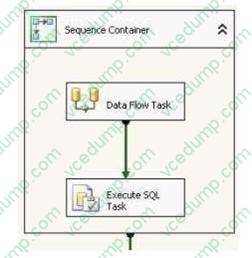
You should make sure that you create a parameter which includes important information that is only useful to the Data Flow Task and the Execute SQL Task and so on.
Which is the correct answer?
A. You should develop the parameter at the default scope.
B. You should develop the parameter at the Control Flow Job scope.
C. You should develop the parameter at the Running SQL Job scope.
D. You should develop the parameter at the Sequence Container scope. -
Question 38:
You are creating a SQL Server 2008 Integration Services (SSIS) instance which contains a Data Flow task which reproduces some million rows for Company.com.
The data flow asks a match against a reference table which includes 50,000 rows including every row would be utilized during the data flow in the reference table.
You should make sure that the data flow runs least time.
Which is the correct answer?
A. You should choose a Lookup transformation along with the half cache option
B. You should choose a Lookup transformation along with the Full cache option
C. You should choose a default Lookup transformation
D. You should choose a Lookup transformation along with the Default cache option -
Question 39:
You are creating a SQL Server 2008 Integration Services (SSIS) project for Company.com.
Your project attributes are listed below:In order to develop a deployment manifest for packages in the project.
Which is the correct answer?
A. You should develop the Integration Services project.
B. You should make the default property enable.
C. You should reset every copy with a .config file extension.
D. You should develop the Web Services project. -
Question 40:
You are developing a SQL Server 2008 Reporting Services (SSRS) sample for Company.com. You decide to publish the report which would be moved on a common basis to a list of subscribers on a report server.
You should make sure that you develop a novel subscription on the report server.
Which is the correct answer?
A. Before clicking the My Subscriptions button you should choose the developed report.
B. Before clicking the My Subscriptions page you should choose the My Subscriptions page.
C. Before clicking the Subscriptions tab you should choose the developed report and then click the New Data driven Subscription button.
D. You should choose the developed report.
Related Exams:
-
62-193
Technology Literacy for Educators -
70-243
Administering and Deploying System Center 2012 Configuration Manager -
70-355
Universal Windows Platform – App Data, Services, and Coding Patterns -
77-420
Excel 2013 -
77-427
Excel 2013 Expert Part One -
77-725
Word 2016 Core Document Creation, Collaboration and Communication -
77-726
Word 2016 Expert Creating Documents for Effective Communication -
77-727
Excel 2016 Core Data Analysis, Manipulation, and Presentation -
77-728
Excel 2016 Expert: Interpreting Data for Insights -
77-731
Outlook 2016 Core Communication, Collaboration and Email Skills
Tips on How to Prepare for the Exams
Nowadays, the certification exams become more and more important and required by more and more enterprises when applying for a job. But how to prepare for the exam effectively? How to prepare for the exam in a short time with less efforts? How to get a ideal result and how to find the most reliable resources? Here on Vcedump.com, you will find all the answers. Vcedump.com provide not only Microsoft exam questions, answers and explanations but also complete assistance on your exam preparation and certification application. If you are confused on your 70-448 exam preparations and Microsoft certification application, do not hesitate to visit our Vcedump.com to find your solutions here.