70-448 Exam Details
-
Exam Code
:70-448 -
Exam Name
:TS:MS SQL Server 2008.Business Intelligence Dev and Maintenan -
Certification
:Microsoft Certifications -
Vendor
:Microsoft -
Total Questions
:331 Q&As -
Last Updated
:Feb 05, 2022
Microsoft 70-448 Online Questions & Answers
-
Question 201:
You are creating SQL Server 2008 Integration Services (SSIS) packages which is stored in a folder on the network for Company.com.
All members of the team can view the packages but not the attribute values. Your task is to make the attribute values be protected by password.
Which is the correct answer below?
A. You should Use a batch file that runs the dtutil program to set the PackageProtectionLevel property to EncryptSensitiveWithPassword on each of the SSIS packages you have
B. You should Use a batch file that runs the dtutil program to set the PackageProtectionLevel property to ServerStorage on each of the SSIS packages you have created.
C. You should Use the SSIS package designer to set the PackageProtectionLevel property to EncryptAllWithUserKey on each of the previously saved packages.
D. You should Use the SSIS package designer to set the PackageProtectionLevel property to EncryptSensitiveWithUserKey on each of the previously saved packages. -
Question 202:
You are a database developer and you have about two years experience in creating business intelligence (BI) solutions by using SQL Server2008.
Now you are employed in a company which is named NaproStar and work as the technical support for the company which uses SQL Server2008 Analysis Services (SSAS).
To meet the business development, (SSAS) is used to create a data mining model and the Data Mining Extensions (DMX) code is used to create a mining structure.
The Data Mining Extensions (DMX) code is shown as the following:
Now you are assigned the following tasks:
Make sure that the Microsoft Decision Trees algorithm is used by the model. Have a mining model that can be processed by this mining structure created.
So of the following DMX statements, which one should be used to accomplish the tasks above?
A. INSERT INTO [Decision Tree] ( [Customer Key], [Age], [Bike Buyer], [Commute Distance], [Yearly Income]) OPENQUERY([Bike Buyer], 'Select [Customer Key], [Age], [Bike Buyer] , [Commute Distance],[Yearly Income]')
B. SELECT * INTO [Decision Tree]USING [Microsoft_Decision_Trees]FROM [Bike Buyer]
C. CREATE MINING MODEL [Decision Tree] ( [Customer Key] LONG KEY, [Age] LONG DISCRETIZED (Automatic, 10), [Bike Buyer] LONG DISCRETE, [Commute Distance] TEXT DISCRETE, [Yearly Income] DOUBLE CONTINUOUS) USING Microsoft_Decision_Trees
D. ALTER MINING STRUCTURE [Bike Buyer]ADD MINING MODEL [Decision Tree] ( [Customer Key], [Age], [Bike Buyer] PREDICT, [Commute Distance], [Yearly Income]) USING Microsoft_Decision_TreesWITH DRILLTHROUGH -
Question 203:
You develop a SQL Server 2008 Analysis Services (SSAS) database. Your database includes several measure groups.
A measure group named Sales Data requires frequent updates than other measure groups.
You need to ensure that the Sales Data measure group will automatically process on a schedule managed by SSAS.
What should you do?
A. Modify the ProactiveCaching property.
B. Modify the ProcessingPriority property.
C. Modify the ProcessingMode property.
D. Modify the DataAggregation property. -
Question 204:
You are developing a SQL Server 2008 Integration Services (SSIS) package. The package extracts data from text files and loads the data to a SQL Server 2008 database.
You configure the data flows to fail on a single error.
The control flow package is as shown in the following exhibit. (Click the Exhibit button.)
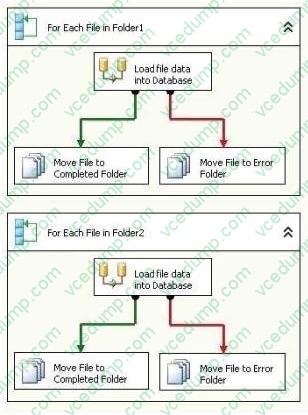
The package extracts data from files that are stored in two folders. Each folder can store a maximum of 10 files.
You need to ensure that the package runs and loads additional files even if an error occurs during the loading of a file.
What should you do?
A. Configure the MaximumErrorCount property for the package.
B. Configure the FailPackageOnFailure property for each Foreach Loop container.
C. Configure the FailPackageOnFailure property for each Data Flow task.
D. Configure an OnError event handler for each Foreach Loop container. -
Question 205:
You maintain a SQL Server 2008 Analysis Services (SSAS) database in a test environment.
You plan to deploy changes from an SSAS project in a development environment to the test environment.
You need to ensure that the roles and partitions previously deployed to the test environment are unaffected by the deployment.
What should you do?
A. Update the database by using the Deployment Wizard.
B. Update the database by using the Synchronize Database Wizard.
C. Back up the development database and restore it to the test environment.
D. Process the database by using the Business Intelligence Design Studio (BIDS). -
Question 206:
You are creating a SQL Server 2008 Integration Services (SSIS) package which gets information from a FTP server through utilizing many FTP tasks and operate information through utilizing many Execute SQL tasks for Company.com.
After the package downloads the files, you should make sure that you could set the package to restart.
In order to solve the problem, which is the correct answer?
A. You should set the HTTP tasks to hold transactions Log.
B. You should set the Execute SQL store procedure to hold transactions Log.
C. You should transfer the half HTTP job to a sequence container.
D. You should set the package to utilize a checkpoint. -
Question 207:
You create a SQL Server 2008 Analysis Services (SSAS) solution.
You add a data source view (DSV) to the solution. The DSV has a table named Employee that includes the following columns:

EmployeeKey
ManagerKey
The ManagerKey column references the manager of the employees.
You need to define the relationship between the employees and their manager in the DSV.
What should you do?
A. Create a Named Calculation that uses EmployeeKey and ManagerKey
B. Create a relationship by using EmployeeKey as the source column and ManagerKey as the destination column.
C. Create a Named Query that uses a relationship with EmployeeKey as the source column and ManagerKey as the destination column.
D. Create a relationship by using ManagerKey as the source column and EmployeeKey as the destination column. -
Question 208:
You are developing a report which is difficult and cost a lot of time to produce. You use the technology of SQL Server 2008 Reporting Services (SSRS). You should make sure that you could set the report server to cache the report for 40
minutes at the beginning of the request.
Which is the correct answer?
A. Report snapshots should be run for report.
B. You should run report execution caching for report.
C. You should set the data source to utilize a DBCC INDEXDEFRAG.
D. You should set the data source to utilize a DBCC SHRINKFILE. INDEXDEFRAG -
Question 209:
You are managing a SQL Server 2008 server instance which is use for running SQL Server 2008 Integration Services (SSIS) packages for Company.com.
You should make sure that the server runs normally.
Which is the correct answer?
A. You should configure the package protection level to AdministrativeRestriction.
B. You should configure the package protection level to SaveSensitive.
C. You should configure the package protection level to EncryptSensitiveWithPassword.
D. You should configure the BlockedSignatureStates registry enters to Block unsafe and untrusted signs and unsigned instances. -
Question 210:
You are creating a SQL Server 2008 Reporting Services (SSRS) report which utilizes a Multidimensional Expressions (MDX) query including a parameter to show products information for various product categories for Company.com.
The codes listed below:
SELECT NON EMPTY {[Measures].[Reseller Sales-Order Quantity] } ON COLUMNS, NON EMPTY {([Month.[Calendar Year].[Calendar Year].ALLMEMBERS * [Products].
[Category]. [Category].ALLMEMBERS ) } ON CHAPTERS
FROM (SELECT (STRTOSET(@Category,CONSTRAINED)) ON COLUMNS FROM [Adventure Works Cube])
You find out that the search produces an error when running.
You should make sure that the query runs normally. Which is the correct answer?
A. You should delete the NON EMPTY clauses.
B. You should select the ROWS axis
C. You should select the CHAPTERS axis
D. You should select the SECTIONS axis
Related Exams:
-
62-193
Technology Literacy for Educators -
70-243
Administering and Deploying System Center 2012 Configuration Manager -
70-355
Universal Windows Platform – App Data, Services, and Coding Patterns -
77-420
Excel 2013 -
77-427
Excel 2013 Expert Part One -
77-725
Word 2016 Core Document Creation, Collaboration and Communication -
77-726
Word 2016 Expert Creating Documents for Effective Communication -
77-727
Excel 2016 Core Data Analysis, Manipulation, and Presentation -
77-728
Excel 2016 Expert: Interpreting Data for Insights -
77-731
Outlook 2016 Core Communication, Collaboration and Email Skills
Tips on How to Prepare for the Exams
Nowadays, the certification exams become more and more important and required by more and more enterprises when applying for a job. But how to prepare for the exam effectively? How to prepare for the exam in a short time with less efforts? How to get a ideal result and how to find the most reliable resources? Here on Vcedump.com, you will find all the answers. Vcedump.com provide not only Microsoft exam questions, answers and explanations but also complete assistance on your exam preparation and certification application. If you are confused on your 70-448 exam preparations and Microsoft certification application, do not hesitate to visit our Vcedump.com to find your solutions here.