70-433 Exam Details
-
Exam Code
:70-433 -
Exam Name
:TS: Microsoft SQL Server 2008, Database Development -
Certification
:Microsoft Certifications -
Vendor
:Microsoft -
Total Questions
:202 Q&As -
Last Updated
:Dec 09, 2021
Microsoft 70-433 Online Questions & Answers
-
Question 51:
You have a table named Products.Product. The table has columns ProductID, Name, Size, and Category. You have a variable named @XML with following XML value:
You are tasked to write a query that lists the products in Products.Product that match the categories listed in the XML document.
You need to write a query to accomplish the task.
Which query should you write?
A. SELECT p.ProductID, p.Name, p.Size, p.Category FROM Production.Product p CROSS APPLY @XML.nodes('//Category') as x(s)
B. SELECT p.ProductID, p.Name, p.Size, p.Category FROM Production.Product p OUTER APPLY @XML.nodes('//Category') as x(s)
C. WITH XMLTable AS ( SELECT s.value('@Name','varchar(20)') as Category FROM @XML.nodes('//Category') as x(s) ) SELECT p.ProductID, p.Name, p.Size, p.Category FROM Production.Product p INNER JOIN XMLTable x ON p.Category = x.Category
D. WITH XMLTable AS ( SELECT s.value('@Category','varchar(20)') as Category FROM @XML.nodes('//Category') as x(s) ) SELECT p.ProductID, p.Name, p.Size, p.Category FROM Production.Product p INNER JOIN XMLTable x ON p.Category = x.Category -
Question 52:
Your database is 5GB and contains a table named SalesHistory. Sales information is frequently inserted and updated. You discover that excessive page splitting is occurring. You need to reduce the occurrence of page splitting in the SalesHistory table.
Which code segment should you use?.
A. ALTER DATABASE Sales MODIFY FILE (NAME = Salesdat3, SIZE = 10GB);
B. ALTER INDEX ALL ON Sales.SalesHistory REBUILD WITH (FILLFACTOR = 60);
C. EXEC sys.sp_configure 'fill factor (%)', '60';
D. UPDATE STATISTICS Sales.SalesHistory(Products) WITH FULLSCAN, NORECOMPUTE; -
Question 53:
Your server collation is SQL_Latin1_General_CP1_CI_AS. You have a database named Contoso that has a collation setting of SQL_Scandinavian_Cp850_CI_AS. You create and populate a temporary table #Person from table dbo.Person in
Contoso using the following statements:
use MyDB;
CREATE TABLE #Person (LastName nchar(128));
INSERT INTO #Person SELECT LastName FROM dbo.Person; You then run the following command:
SELECT * FROM dbo.Person a JOIN #Person b
ON a.LastName = b.LastName;
This command returns the following error:
Cannot resolve the collation conflict between "SQL_Latin1_General_CP1_CI_AS" and "SQL_Scandinavian_Cp850_CI_AS" in the equal to operation. You need to resolve the collation conflict.
Which Transact-SQL statement should you use?
A. CREATE TABLE #Person (LastName nvarchar(128) SPARSE);
B. CREATE TABLE #Person (LastName nvarchar(128) COLLATE database_default);
C. CREATE TABLE #Person (LastName nvarchar(128) COLLATE SQL_Latin1_General_CP1_CI_AS);
D. CREATE TABLE tmpPerson (LastName nvarchar(128) COLLATE SQL_Latin1_General_CP1_CI_AS); -
Question 54:
You are a database developer for your organization.
You create an application that uses a Transact-SQL variable to store user input data. The database collation is case-insensitive.
The variable is constructed as shown in the following statement:
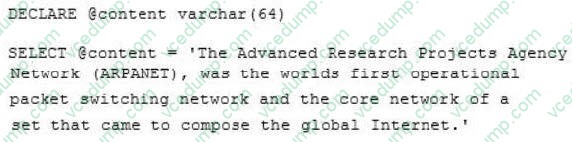
You need to implement a keyword search that meets the following requirements:
Searches for the existence of the word ARPANET within the user-entered content.
If the search term is found, the statement must return its starting position, and 0 otherwise.
Performs a case-sensitive search for the given search term.
Which Transact-SQL statement should you use?
A. Option A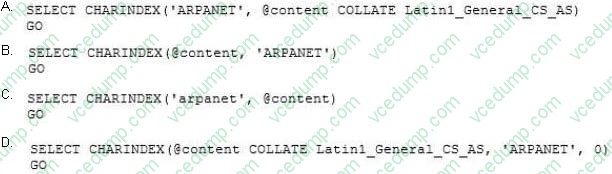
B. Option B
C. Option C
D. Option D -
Question 55:
You need to manually raise an error.
The error message that will be returned will display a message that contains parameters 1, 2, 3 sp_addmessage @msgnum = 6000,
@severity = 16,
@msgtext = N'Your message (%d), (%d), (%d)';
GO
You have to raise message to get correct message.. 'Your message (1), (2), (3).' Which statement will you use?
RAISE_ERROR(60000, 16, 1, 1, 2, 3)
-
Question 56:
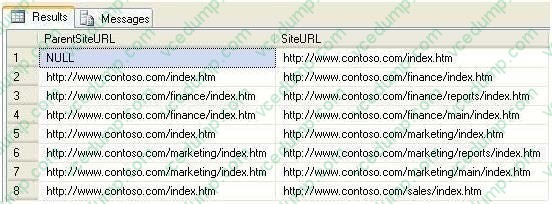
Click the Exhibit button.
You have the following XML:
You are tasked to query the sites listed in the XML by using OPENXML. The results will have two columns, ParentSiteURL and SiteURL. The ParentSiteURL column should contain the URL attribute of the parent site. The SiteURL column
should contain the URL attribute of the site itself.
The output should look like that in the exhibit.
You need to write the OPENXML query.
Which Transact-SQL statement should you use?
A. SELECT ParentSiteURL, SiteURL FROM OPENXML (@XMLDocHandle, '//@Site', 1) WITH ( ParentSiteURL nVarChar(512) '../URL', SiteURL nVarChar(512) 'URL')
B. SELECT ParentSiteURL, SiteURL FROM OPENXML (@XMLDocHandle, '//URL', 1) WITH ( ParentSiteURL nVarChar(512) '../@URL', SiteURL nVarChar(512) '@URL')
C. SELECT ParentSiteURL, SiteURL FROM OPENXML (@XMLDocHandle, '//Site', 1) WITH ( ParentSiteURL nVarChar(512) '../@URL', SiteURL nVarChar(512) '@URL')
D. SELECT ParentSiteURL, SiteURL FROM OPENXML (@XMLDocHandle, '//@URL', 1) WITH ( ParentSiteURL nVarChar(512) '../URL', SiteURL nVarChar(512) 'URL') -
Question 57:
You are a developer for a Microsoft SQL Server 2008 R2 database instance used to support a customer service application. You create tables named complaint, customer, and product as follows:
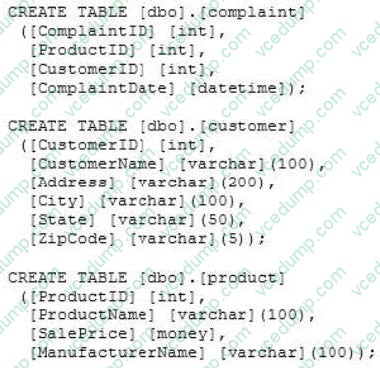
You need to write a query to return all customer names and total number of complaints for customers who have made more than 10 complaints. Which SQL query should you use?
A. B. C. D. E. F. G. H.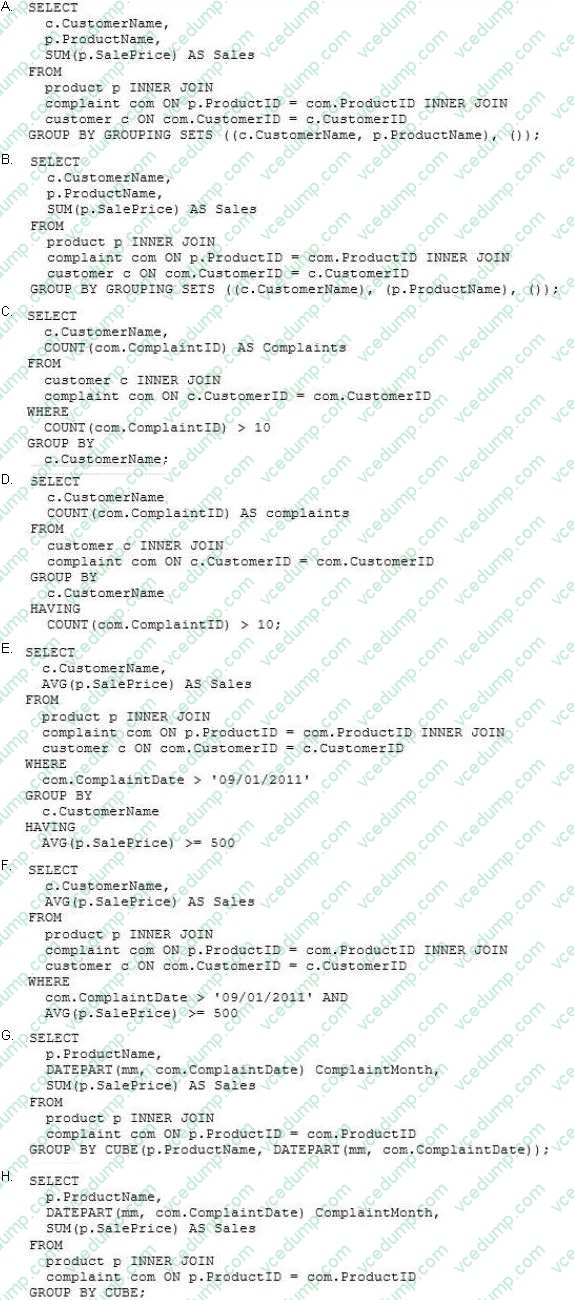
I. J. -
Question 58:
Your company's database contains Customers and Orders tables.
You have been tasked to write a SELECT statement that outputs customer and order data as a valid and well-formed XML document. You are required to mix attribute and element based XML within the document. You have determined that using the FOR XML AUTO clause will not be suitable.
You need to identify the correct FOR XML clause to meet the requirement.
Which FOR XML statement should you use? (Each correct answer represents a complete solution. Choose two.)
A. FOR BROWSE
B. FOR XML RAW
C. FOR XML PATH
D. FOR XML EXPLICIT -
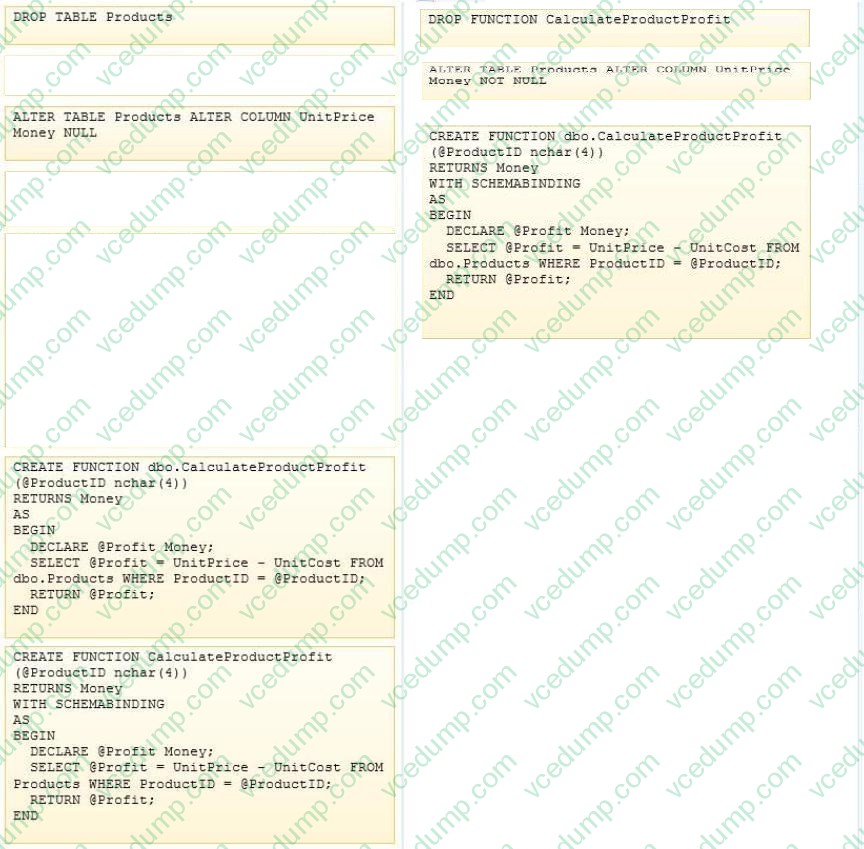
Question 59:
You administer a Microsoft SQL Server 2008 database that includes a table named Products. The Products table has the following schema:
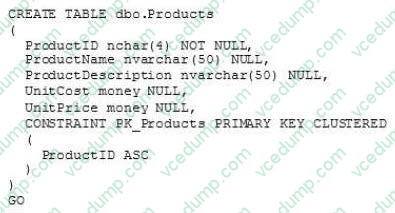
You create a User-Defined Function (UDF) in the same database. The UDF has the following schema:
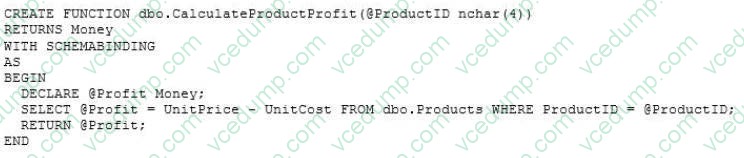
You need to meet the following requirements:
Ensure that the UnitPrice column does not accept NULL values.
Use the CalculateProductProfit() UDF.
Avoid accidental drop or change of the Product table.
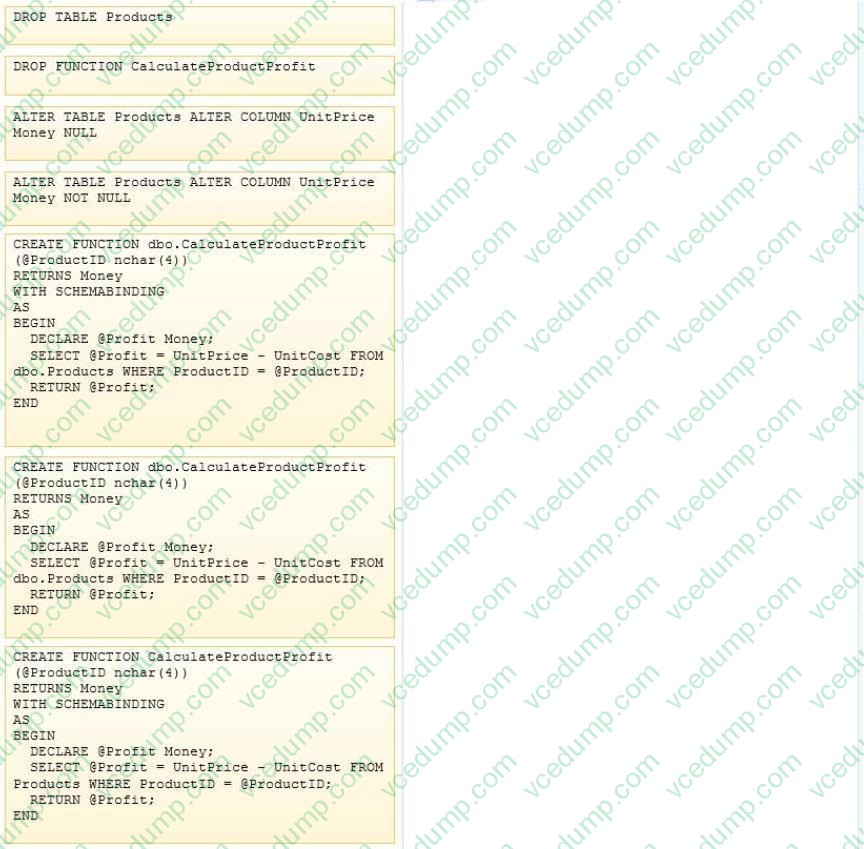
Which three Transact-SQL statements should you use? (To answer, move the appropriate statements from the list of statements to the answer area and arrange them in the correct order.)
Select and Place:
-
Question 60:
You have been tasked to delete a number of Database Mail messages that have been sent. You need to delete all the emails that were sent more than one month ago.
Which Transact-SQL statements should you run?
A. DECLARE @OneMonthAgo datetime = DATEADD(mm,-1,GETDATE()) EXEC msdb.dbo.sysmail_delete_log_sp @OneMonthAgo
B. DECLARE @OneMonthAgo datetime = DATEADD(mm,-1,GETDATE()) EXEC msdb.dbo.sysmail_delete_mailitems_sp @OneMonthAgo
C. DECLARE @OneMonthAgo datetime = DATEADD(mm,-1,GETDATE()) EXEC msdb.dbo.sysmail_delete_log_sp @OneMonthAgo,'Success'
D. DECLARE @OneMonthAgo datetime = DATEADD(mm,-1,GETDATE()) EXEC msdb.dbo.sysmail_delete_mailitems_sp @OneMonthAgo,'Sent'
Related Exams:
-
62-193
Technology Literacy for Educators -
70-243
Administering and Deploying System Center 2012 Configuration Manager -
70-355
Universal Windows Platform – App Data, Services, and Coding Patterns -
77-420
Excel 2013 -
77-427
Excel 2013 Expert Part One -
77-725
Word 2016 Core Document Creation, Collaboration and Communication -
77-726
Word 2016 Expert Creating Documents for Effective Communication -
77-727
Excel 2016 Core Data Analysis, Manipulation, and Presentation -
77-728
Excel 2016 Expert: Interpreting Data for Insights -
77-731
Outlook 2016 Core Communication, Collaboration and Email Skills
Tips on How to Prepare for the Exams
Nowadays, the certification exams become more and more important and required by more and more enterprises when applying for a job. But how to prepare for the exam effectively? How to prepare for the exam in a short time with less efforts? How to get a ideal result and how to find the most reliable resources? Here on Vcedump.com, you will find all the answers. Vcedump.com provide not only Microsoft exam questions, answers and explanations but also complete assistance on your exam preparation and certification application. If you are confused on your 70-433 exam preparations and Microsoft certification application, do not hesitate to visit our Vcedump.com to find your solutions here.