70-433 Exam Details
-
Exam Code
:70-433 -
Exam Name
:TS: Microsoft SQL Server 2008, Database Development -
Certification
:Microsoft Certifications -
Vendor
:Microsoft -
Total Questions
:202 Q&As -
Last Updated
:Dec 09, 2021
Microsoft 70-433 Online Questions & Answers
-
Question 171:
You administer a Microsoft SQL Server 2008 database named AdventureWorks that contains a table named Production.Product. The table contains a primary key named PK_Product_ProductID and a non-clustered index named AK_Product_ProductNumber. Both indexes have been created on a single primary partition.
The table has the following definition:
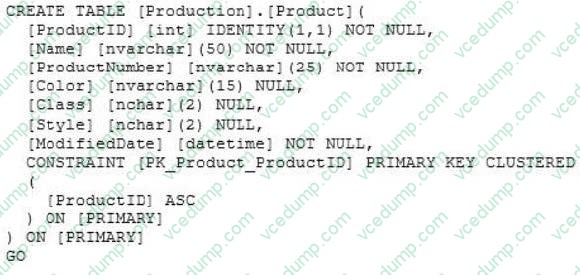
The index has the following definition:

You want to ensure that data retrieval takes the minimum amount of time when the queries executed against the Production.Product table are ordered by product number or filtered by class.
You need to refresh statistics on the Production.Product table.
Which Transact-SQL statement should you use?
A. Option A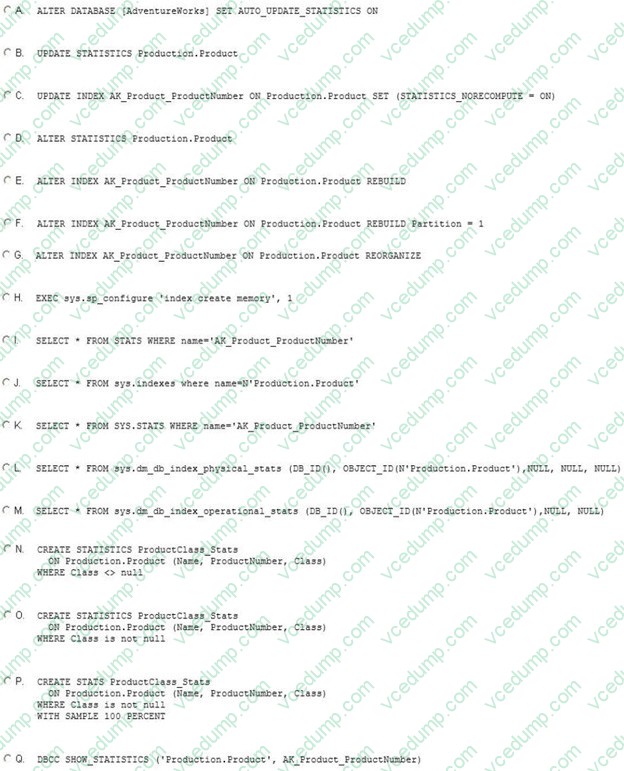
B. Option B
C. Option C
D. Option D
E. Option E
F. Option F
G. Option G
H. Option H
I. Option I
J. Option J -
Question 172:
You need to generate the following XML document.
Product1 Product2 Product3 Product4 Which query should you use?
A. SELECT Price, ProductName FROM Products AS ProductExport FOR XML PATH('Product')
B. SELECT Price, ProductName FROM Products FOR XML AUTO, ROOT('ProductExport')
C. SELECT Price [@Price], ProductName AS [*] FROM Products AS ProductExport FOR XML AUTO, ELEMENTS
D. SELECT Price [@Price], ProductName AS [*] FROM Products FOR XML PATH('Product'),ROOT('ProductExport') -
Question 173:
You have the following rows in the Customer Table:
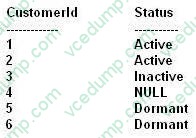
You write the following query to return all customers that do not have NULL or 'Dormant' for their status:
SELECT *
FROM Customer
WHERE Status NOT IN (NULL, 'Dormant')
You need to identify the results of the query.
Which result should you expect?
A. Option A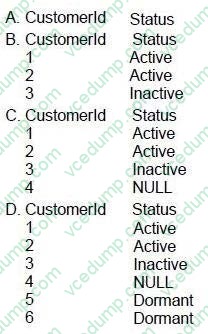
B. Option B
C. Option C
D. Option D -
Question 174:
You have a table named dbo.Customers. The table was created by using the following Transact- SQL statement:
CREATE TABLE dbo.Customers
(
CustomerID int IDENTITY(1,1) PRIMARY KEY CLUSTERED, AccountNumber nvarchar(25) NOT NULL, FirstName nvarchar(50) NOT NULL,
LastName nvarchar(50) NOT NULL,
AddressLine1 nvarchar(255) NOT NULL,
AddressLine2 nvarchar(255) NOT NULL,
City nvarchar(50) NOT NULL,
StateProvince nvarchar(50) NOT NULL,
Country nvarchar(50) NOT NULL,
PostalCode nvarchar(50) NOT NULL,
CreateDate datetime NOT NULL DEFAULT(GETDATE()),
ModifiedDate datetime NOT NULL DEFAULT(GETDATE())
)
You create a stored procedure that includes the AccountNumber, Country, and StateProvince columns from the dbo.Customers table. The stored procedure accepts a parameter to filter the output on the AccountNumber column.
You need to optimize the performance of the stored procedure. You must not change the existing structure of the table.
Which Transact-SQL statement should you use?
A. CREATE STATISTICS ST_Customer_AccountNumber ON dbo.Customer (AccountNumber) WITH FULLSCAN;
B. CREATE CLUSTERED INDEX IX_Customer_AccountNumber ON dbo.Customer (AccountNumber);
C. CREATE NONCLUSTERED INDEX IX_Customer_AccountNumber ON dbo.Customer (AccountNumber) WHERE AccountNumber = '';
D. CREATE NONCLUSTERED INDEX IX_Customer_AccountNumber ON dbo.Customer (AccountNumber) INCLUDE (Country, StateProvince); -
Question 175:
You need to create a stored procedure that accepts a table-valued parameter named @Customers.
Which code segment should you use?
A. CREATE PROCEDURE AddCustomers (@Customers varchar(max))
B. CREATE PROCEDURE AddCustomers (@Customers Customer READONLY)
C. CREATE PROCEDURE AddCustomers (@Customers CustomerType OUTPUT)
D. CREATE PROCEDURE ADDCUSTOMERS (@Customers varchar (max)) AS EXTERNAL NAME Customer.Add.NewCustomer -
Question 176:
You currently store date information in two columns. One column contains the date in local time and one column contains the difference between local time and UTC time. You need to store this data in a single column.
Which data type should you use?
A. time
B. datetime2
C. datetime2(5)
D. datetimeoffset -
Question 177:
You have a SQL Server database. The database contains two schemas named Marketing and Sales. The Marketing schema is owned by a user named MarketingManager. The Sales schema is owned by a user named SalesManager.
A user named John must be able to access the Sales.Orders table by using a stored procedure named Marketing.GetSalesSummary. John is not granted a SELECT permission on the Sales.Orders table. A user named SalesUser does have
SELECT permission on the Sales.Orders table. You need to implement appropriate permissions for John and the stored procedure Marketing.GetSalesSummary.
What should you do?
A. Marketing.GetSalesSummary should be created by using the EXECUTE AS 'SalesUser' clause. John should be granted EXECUTE permission on Marketing.GetSalesSummary.
B. Marketing.GetSalesSummary should be created by using the EXECUTE AS OWNER clause. John should be granted EXECUTE WITH GRANT OPTION on Marketing.GetSalesSummary.
C. Marketing.GetSalesSummary should be created by using the EXECUTE AS CALLER clause. John should be granted IMPERSONATE permission for the user named SalesUser.
D. Marketing.GetSalesSummary should be created without an EXECUTE AS clause. John should be granted SELECT permission on the Sales.Orders table. -
Question 178:
You manage a SQL Server 2008 database that is located at your company's corporate headquarters. The database contains a table named dbo.Sales. You need to create different views of the dbo.Sales table that will be used by each region to insert, update, and delete rows. Each regional office must only be able to insert, update, and delete rows for their respective region.
Which view should you create for Region1?
A. CREATE VIEW dbo.Region1Sales AS SELECT SalesID,OrderQty,SalespersonID,RegionID FROM dbo.Sales WHERE RegionID = 1;
B. CREATE VIEW dbo.Region1Sales AS SELECT SalesID,OrderQty,SalespersonID,RegionID FROM dbo.Sales WHERE RegionID = 1 WITH CHECK OPTION;
C. CREATE VIEW dbo.Region1Sales WITH SCHEMABINDING AS SELECT SalesID,OrderQty,SalespersonID,RegionID FROM dbo.Sales WHERE RegionID = 1;
D. CREATE VIEW dbo.Region1Sales WITH VIEW_METADATA AS SELECT SalesID,OrderQty,SalespersonID,RegionID FROM dbo.Sales WHERE RegionID = 1; -
Question 179:
You need to write a query that allows you to rank total sales for each salesperson into four groups, where the top 25 percent of results are in group 1, the next 25 percent are in group 2, the next 25 percent are in group 3, and the lowest 25 percent are in group 4.
Which Transact-SQL statement should you use?
A. NTILE(1)
B. NTILE(4)
C. NTILE(25)
D. NTILE(100) -
Question 180:
You are updating a database table.
You need to partition the table to store only the last 1000 rows of data in the table.
What should you do?
A. Create the partition function and the partition scheme, and update the table.
B. Create the partition function, the partition scheme, and the distributed partitioned view.
C. Create the partition function, update the table, and create a filtered index.
D. Add a secondary file to the primary filegroups, update the table, and create the distributed partitioned view.
Related Exams:
-
62-193
Technology Literacy for Educators -
70-243
Administering and Deploying System Center 2012 Configuration Manager -
70-355
Universal Windows Platform – App Data, Services, and Coding Patterns -
77-420
Excel 2013 -
77-427
Excel 2013 Expert Part One -
77-725
Word 2016 Core Document Creation, Collaboration and Communication -
77-726
Word 2016 Expert Creating Documents for Effective Communication -
77-727
Excel 2016 Core Data Analysis, Manipulation, and Presentation -
77-728
Excel 2016 Expert: Interpreting Data for Insights -
77-731
Outlook 2016 Core Communication, Collaboration and Email Skills
Tips on How to Prepare for the Exams
Nowadays, the certification exams become more and more important and required by more and more enterprises when applying for a job. But how to prepare for the exam effectively? How to prepare for the exam in a short time with less efforts? How to get a ideal result and how to find the most reliable resources? Here on Vcedump.com, you will find all the answers. Vcedump.com provide not only Microsoft exam questions, answers and explanations but also complete assistance on your exam preparation and certification application. If you are confused on your 70-433 exam preparations and Microsoft certification application, do not hesitate to visit our Vcedump.com to find your solutions here.