70-433 Exam Details
-
Exam Code
:70-433 -
Exam Name
:TS: Microsoft SQL Server 2008, Database Development -
Certification
:Microsoft Certifications -
Vendor
:Microsoft -
Total Questions
:202 Q&As -
Last Updated
:Dec 09, 2021
Microsoft 70-433 Online Questions & Answers
-
Question 111:
You have an application that is used by international clients. All clients connect by using Windows Authentication. You need to ensure that system and user-defined error messages are displayed in the localized language for the clients.
What should you do? (Each correct answer represents part of the solution. Choose two.)
A. Use @@LANGUAGE function
B. Use default language for each login
C. Use @lang parameter of sp_addmessage
D. Use the "set language" option of sp_configure -
Question 112:
You have been tasked with creating a table named dbo.Widgets. You need to insert five rows into the dbo.Widgets table and return WidgetID for each of the five rows that have been inserted.
Which Transact-SQL batch should you use?
A. CREATE TABLE dbo.Widgets ( WidgetID INT IDENTITY PRIMARY KEY, WidgetName VARCHAR(25)); GO INSERT dbo.Widgets (WidgetName) OUTPUT inserted.WidgetID, inserted.WidgetName VALUES ('WidgetOne'),('WidgetTwo'),('WidgetThree'),('WidgetFour'),('WidgetFive');
B. CREATE TABLE dbo.Widgets ( WidgetID INT IDENTITY PRIMARY KEY, WidgetName VARCHAR(25) ); GO INSERT dbo.Widgets (WidgetName) VALUES ('WidgetOne'),('WidgetTwo'),('WidgetThree'),('WidgetFour'),('WidgetFive'); SELECT SCOPE_IDENTITY();
C. CREATE TABLE dbo.Widgets ( WidgetID UNIQUEIDENTIFIER PRIMARY KEY, WidgetName VARCHAR(25) ); GO INSERT dbo.Widgets (WidgetName) VALUES ('WidgetOne'),('WidgetTwo'),('WidgetThree'),('WidgetFour'),('WidgetFive'); SELECT SCOPE_IDENTITY();
D. CREATE TABLE dbo.Widgets ( WidgetID UNIQUEIDENTIFIER PRIMARY KEY, WidgetName VARCHAR(25)); GO INSERT dbo.Widgets (WidgetName) OUTPUT inserted.WidgetID, inserted.WidgetName VALUES ('WidgetOne'),('WidgetTwo'),('WidgetThree'),('WidgetFour'),('WidgetFive'); -
Question 113:
You have two tables named Customer and SalesOrder. In the Customer table you have 1000 customers, of which 900 customers have orders in the SalesOrder table.
You execute the following query to list all customers that have had at least one sale.
SELECT * FROM Customer
WHERE Customer.CustomerID IN (SELECT Customer.CustomerID FROM SalesOrder)
You need to identify the results of the query.
Which results will the query return?
A. No rows
B. A warning message
C. The 1000 rows in the Customer table
D. The 900 rows in the Customer table with matching rows in the SalesOrder table -
Question 114:
You have implemented change tracking on a table named Sales.SalesOrder. You need to determine all columns that have changed since the minimum valid version.
Which function should you use?
A. CHANGE_TRACKING_CURRENT_VERSION
B. CHANGE_TRACKING_IS_COLUMN_IN_MASK
C. CHANGETABLE with the CHANGES argument
D. CHANGETABLE with the VERSION argument -
Question 115:
You administer a Microsoft SQL Server 2008 database that contains a table named Sales.SalesOrderDetail and a view named Sales.ProductOrders. The view has the following definition:
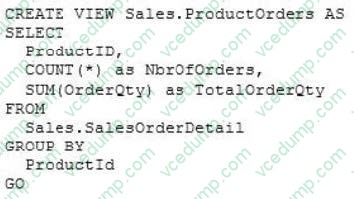
The Sales.SalesOrderDetail table contains 5 million rows. Report queries that join to this view consume excessive disk I/O.
You need to create an index on the view.
Which Transact-SQL statement or statements should you use?
A. Option A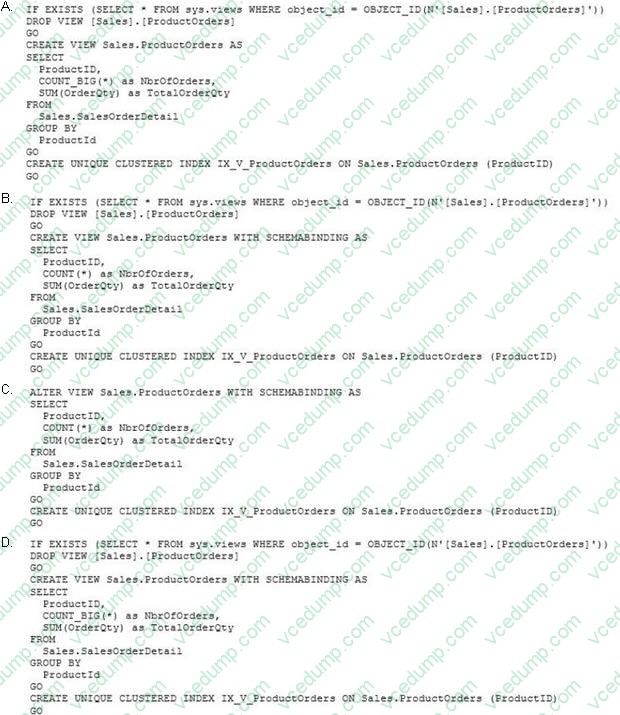
B. Option B
C. Option C
D. Option D -
Question 116:
You are using Microsoft SQL Server 2008 Enterprise Edition. You need to maintain a history of all data modifications made to a table, including the type of modification and the values modified.
Which tracking method should you use?
A. Database Audit
B. Change Tracking
C. C2 Audit Tracing
D. Change Data Capture -
Question 117:
You notice that a database server is responding slowly to queries. You run the following dynamic management views (DMV) query on the server.
SELECT TOP (10)
wait_type,
wait_time_ms
FROM sys.dm_os_wait_stats
ORDER BY wait_time_ms DESC;
The query returns a top wait type of SOS_SCHEDULER_YIELD.
You need to identify what is causing the server response issues.
Which resource should you investigate first?
A. Disk
B. CPU
C. Memory
D. Network -
Question 118:
You administer a Microsoft SQL Server 2008 R2 database that has a table named Customer. The table has the following definition:
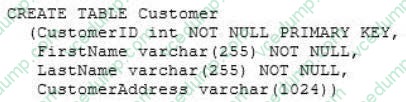
The database also has a table named PreferredCustomerList. Data will be added to the PreferredCustomerList table regularly. The PreferredCustomerList table has the following definition:

You need to create a view that returns all records and columns of the Customer table that are also present in the PreferredCustomerList table. Which Transact-SQL statement should you use?
B. C. D.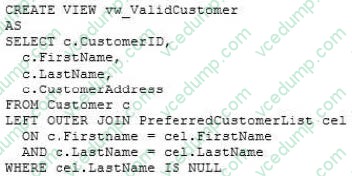
-
Question 119:
You are a database developer responsible for maintaining an application. The application has a table named Programs that has the following definition:
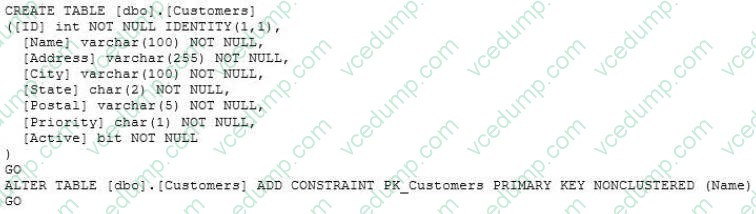
You need to modify the Customers table to meet the following requirements:
ID must be the Primary Key.
The clustered index must be on the ID column.
The Active column must have a default value of 1, and must allow values of only 0 or 1. The Priority column must have values of "a", "b", or "c" The Postal column must contain a correctly formatted five-digit numeric Postal Code.
Which Transact-SQL statement or statements should you use?
A. Option A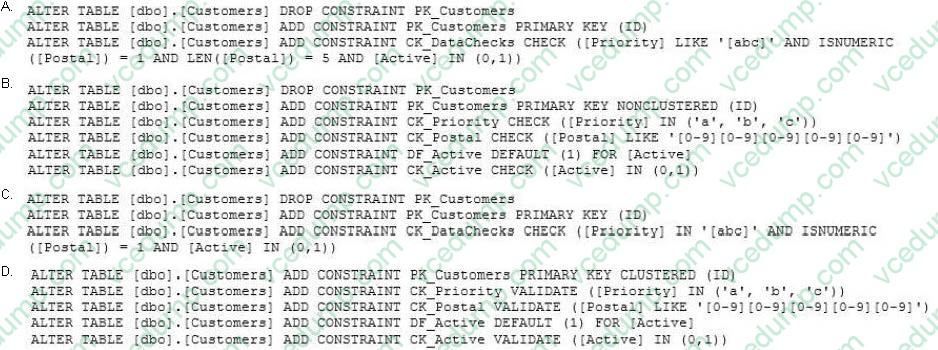
B. Option B
C. Option C
D. Option D -
Question 120:
You need to ensure that tables are not dropped from your database.
What should you do?
A. Create a DDL trigger that contains COMMIT.
B. Create a DML trigger that contains COMMIT.
C. Create a DDL trigger that contains ROLLBACK.
D. Create a DML trigger that contains ROLLBACK.
Related Exams:
-
62-193
Technology Literacy for Educators -
70-243
Administering and Deploying System Center 2012 Configuration Manager -
70-355
Universal Windows Platform – App Data, Services, and Coding Patterns -
77-420
Excel 2013 -
77-427
Excel 2013 Expert Part One -
77-725
Word 2016 Core Document Creation, Collaboration and Communication -
77-726
Word 2016 Expert Creating Documents for Effective Communication -
77-727
Excel 2016 Core Data Analysis, Manipulation, and Presentation -
77-728
Excel 2016 Expert: Interpreting Data for Insights -
77-731
Outlook 2016 Core Communication, Collaboration and Email Skills
Tips on How to Prepare for the Exams
Nowadays, the certification exams become more and more important and required by more and more enterprises when applying for a job. But how to prepare for the exam effectively? How to prepare for the exam in a short time with less efforts? How to get a ideal result and how to find the most reliable resources? Here on Vcedump.com, you will find all the answers. Vcedump.com provide not only Microsoft exam questions, answers and explanations but also complete assistance on your exam preparation and certification application. If you are confused on your 70-433 exam preparations and Microsoft certification application, do not hesitate to visit our Vcedump.com to find your solutions here.