70-432 Exam Details
-
Exam Code
:70-432 -
Exam Name
:TS:MS SQL Server 2008,Implementation and Maintenance -
Certification
:Microsoft Certifications -
Vendor
:Microsoft -
Total Questions
:199 Q&As -
Last Updated
:Jan 26, 2022
Microsoft 70-432 Online Questions & Answers
-
Question 141:
You plan to install a SQL Server 2008 instance for a new application on an existing server that contains a default SQL Server 2005 instance. You need to ensure that both database instances are available for their applications. Your solution must meet the following requirements: What should you do?
A. Configure both instances to use SQL Server 2008.
B. Configure both applications to use SQL Server 2008.
C. Configure the new application to use a SQL Server 2008 named instance.
D. Configure the new application to use the SQL Server 2008 default instance. -
Question 142:
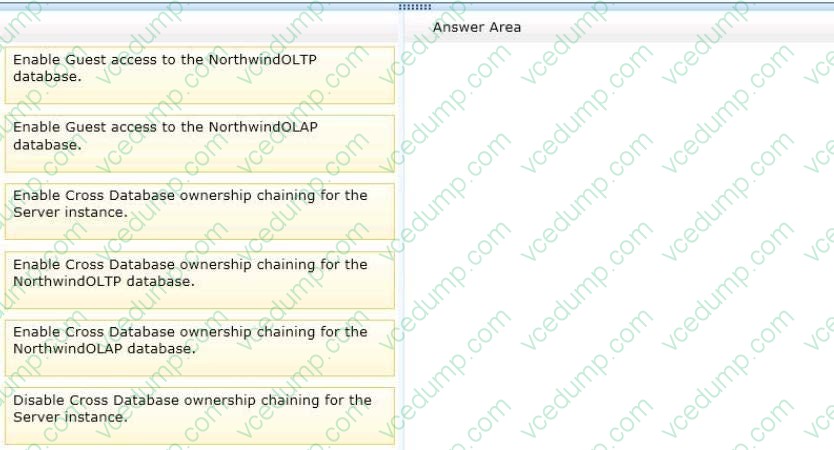
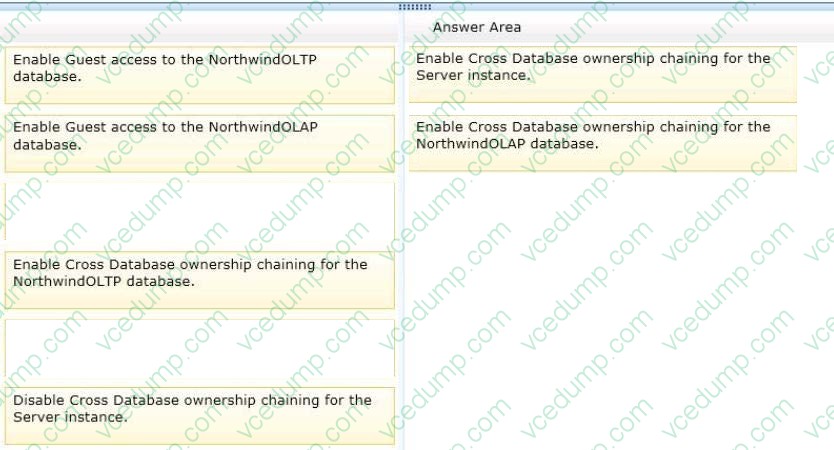
You administer a Microsoft SQL Server 2008 R2 server that hosts two databases named NorthwindOLTP and NorthwindOLAP. Cross database ownership chaining is currently disabled for all databases.
A stored procedure in the NorthwindOLTP database writes data to a table in the NorthwindOLAP database. The public role in both databases has only Read and Execute permissions assigned to all objects. All objects are located in the DBO
schema. Guest access has been disabled for all databases on the server.
You need to ensure that the stored procedure can execute successfully.
Which two actions should you perform in sequence? (To answer, move the appropriate actions from the list of actions to the answer area and arrange them in the correct order.)
Select and Place:
-
Question 143:
You administer a Microsoft SQL Server 2008 R2 instance.
You need to rectify a damaged index without losing any data.
What should you do?
A. Execute sp_helpfile.
B. Execute DBCC CHECKDB.
C. Examine the msdb..suspect_pagestable.
D. Execute DBCC CHECKDBalong with the REPAIR_FASTclause.
E. Execute DBCC CHECKDB along with the REPAIR_REBUILDcla.se
F. Restore the database from the most recent full backup. Apply any differential and log backups.
G. Use the ALTER DATABASEstatement along with the SET EMERGENCYclause.
H. Use the RESTORE DATABASEstatement along with the PAGESclause. Create a new log backup. Apply all differential and log backups, including the most recent backup.
I. Use the RESTORE DATABASEstatement along with the PAGESclause. Apply any differential and log backups. Create a new log backup and then restore the new log backup. -
Question 144:
You maintain a SQL Server 2008 instance.
You find a SQL Server Agent job is failing. When you review the job history information, you notice that the job history information is incomplete and appears to be truncated.
You need to ensure that all information produced by a job is available for viewing.
What should you do?
A. Enable write OEM file.
B. Enable all job steps to send the output to a file.
C. Include execution trace messages in the SQL Agent Error log.
D. Enable notifications to the Windows application event log when the job completes. -
Question 145:
View Exhibit
A. Execute sp_who 55.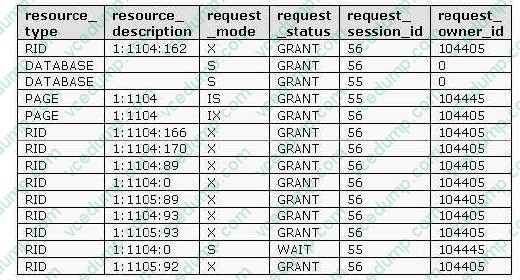
B. Execute sp_who 56.
C. Use the Activity Monitor in Microsoft SQL Management Studio and locate process 55.
D. Select from the sys.syslockinfo compatibility view and locate spid 55. -
Question 146:
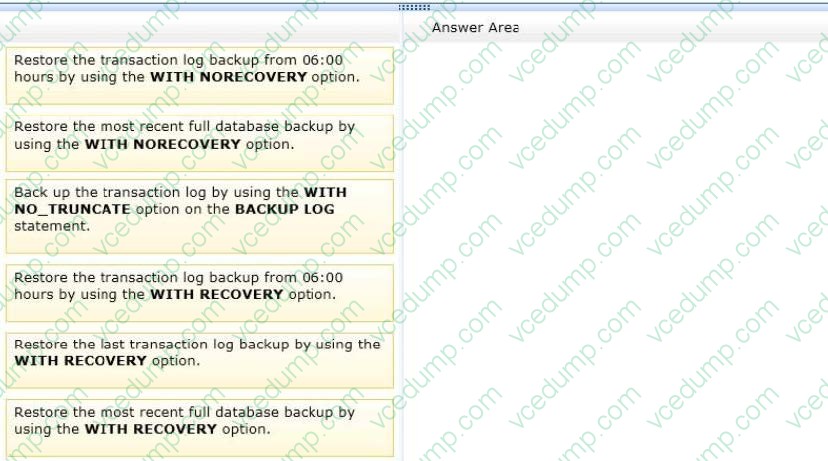
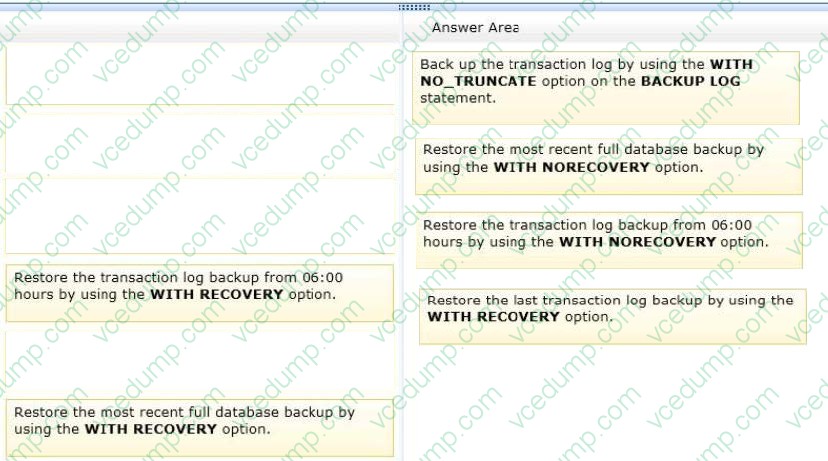
You administer a Microsoft SQL Server 2008 R2 database that contains customer invoice accounts.
Backups are performed according to the following schedule:
You discover that the database failed at 11:59 hours. You also discover that the database is no longer accessible due to a failure of the hard disk drive that contains the database data file.
You need to restore the database.
You also need to ensure that data loss is minimal.
Which four actions should you perform in sequence? (To answer, move the appropriate actions from the list of actions to the answer area and arrange them in the correct order.)
Select and Place:
-
Question 147:
You administer a Microsoft SQL Server 2008 R2 instance.
Mirroring has been configured between two servers.
You need to ensure that automatic failover will occur when the principal server fails
What should you do?
A. Create a witness server to monitor the mirroring session. On the principal server, use the ALTER DATABASE statement along with the SET WITNESS clause.
B. Create a witness server to monitor the mirroring session. On both partner servers, use the ALTER DATABASE statement along with the SET WITNESS clause.
C. Create a Microsoft SQL Server Integration Services package on the partner server to monitor the principal server.
D. Implement Policy Based Management. Enable the Server Performance management facet. -
Question 148:
You administer a SQL Server 2008 instance.
You join two tables on a column named CompanyName by using the following query:
SELECT s.*,i.*
FROM SensitiveTb1 AS s
INNER JOIN Insensitive Tb1 AS iON i. CompanyName = s.CompanyName
When you execute the query, the following error is returned:
"Msg 468, Level 16, State 9, Line 17
Cannot resolve the collation conflict between ,SQL_Latinl_General_CPl_CS_AS' and 'SQL_Latin1_General_CP1_CI_AS' in the equal to operation."
You need to modify the ON clause of the query to successfully perform a case-sensitive join.
What should you do?
A. ON UPPER(i.CompanyName) = UPPER(s.CompanyName)
B. ON LOWER(i.CompanyName) = LOWER(s.CompanyName)
C. ON i.CompanyName = s.CompanyName COLLATE SQL_Latin1_General_CP1_CI_AS
D. ON i.CompanyName = s.CompanyName COLLATE SQL_Latin1_General_CP1_CS_AS -
Question 149:
You migrate an application from Microsoft SQL Server 2000 to Microsoft SQL Server 2008.
You need to monitor the SQL Server instance to record the use of features that will be discontinued.
What should you do?
A. Use the SQL Server 2008 Upgrade Advisor.
B. Use the SQL Server Profiler that captures the SQL:BatchCompleted and Exception event classes.
C. Use a SQL server-side trace that captures the SQL:BatchCompleted and Exception event classes.
D. Use a SQL server-side trace that captures the Deprecation Announcement and Deprecation Final Support event classes. -
Question 150:
You maintain a SQL Server 2008 instance that contains a database named DB1. DB1 stores customer data for the company. The customers use a Web application to access their profile data. You need to protect the customer data such that data files, log files, and subsequent backups are as secure as possible even if the backup media is lost. Your solution must not affect the Web application or impact performance.
What should you do?
A. Encrypt the customer data at the cell level and then back up DB1.
B. Configure access to DB1 to only use stored procedures and functions.
C. Enable Transparent Database Encryption for DB1 and then back up the transaction logs.
D. Encrypt the customer data at the folder level by using Encrypted File System (EFS) and then back up the transaction logs.
Related Exams:
-
62-193
Technology Literacy for Educators -
70-243
Administering and Deploying System Center 2012 Configuration Manager -
70-355
Universal Windows Platform – App Data, Services, and Coding Patterns -
77-420
Excel 2013 -
77-427
Excel 2013 Expert Part One -
77-725
Word 2016 Core Document Creation, Collaboration and Communication -
77-726
Word 2016 Expert Creating Documents for Effective Communication -
77-727
Excel 2016 Core Data Analysis, Manipulation, and Presentation -
77-728
Excel 2016 Expert: Interpreting Data for Insights -
77-731
Outlook 2016 Core Communication, Collaboration and Email Skills
Tips on How to Prepare for the Exams
Nowadays, the certification exams become more and more important and required by more and more enterprises when applying for a job. But how to prepare for the exam effectively? How to prepare for the exam in a short time with less efforts? How to get a ideal result and how to find the most reliable resources? Here on Vcedump.com, you will find all the answers. Vcedump.com provide not only Microsoft exam questions, answers and explanations but also complete assistance on your exam preparation and certification application. If you are confused on your 70-432 exam preparations and Microsoft certification application, do not hesitate to visit our Vcedump.com to find your solutions here.