70-412 Exam Details
-
Exam Code
:70-412 -
Exam Name
:Configuring Advanced Windows Server 2012 Services -
Certification
:Microsoft Certifications -
Vendor
:Microsoft -
Total Questions
:450 Q&As -
Last Updated
:Feb 03, 2022
Microsoft 70-412 Online Questions & Answers
-
Question 141:
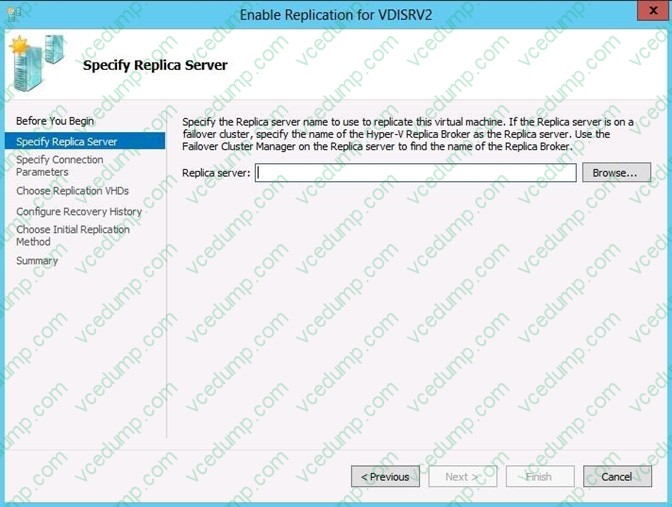
Your network contains two servers named Server1 and Server2 that run Windows Server 2012 R2.
Both servers have the Hyper-V server role installed. Server1 and Server2 are located in different offices. The offices connect to each other by using a high-latency WAN link.
Server1 hosts a virtual machine named VM1.
You need to ensure that you can start VM1 on Server2 if Server1 fails. The solution must minimize hardware costs.
What should you do?
A. On Server1, install the Multipath I/O (MPIO) feature. Modify the storage location of the VHDs for VM1.
B. From the Hyper-V Settings of Server2, modify the Replication Configuration settings. Enable replication for VM1.
C. On Server2, install the Multipath I/O (MPIO) feature. Modify the storage location of the VHDs for VM1.
D. From the Hyper-V Settings of Server1, modify the Replication Configuration settings. Enable replication for VM1. -
Question 142:
Note: This question is part of series of questions that use the same or similar answer choices. An answer choice may be correct for more than one question in the series. Each question is independent of the other questions in this series. Information and details provided in a question apply only to that question.
Your network contains one Active Directory forest named contoso.com. The forest contains two child domains and six domain controllers. The domain controllers are configured as shown in the following table.
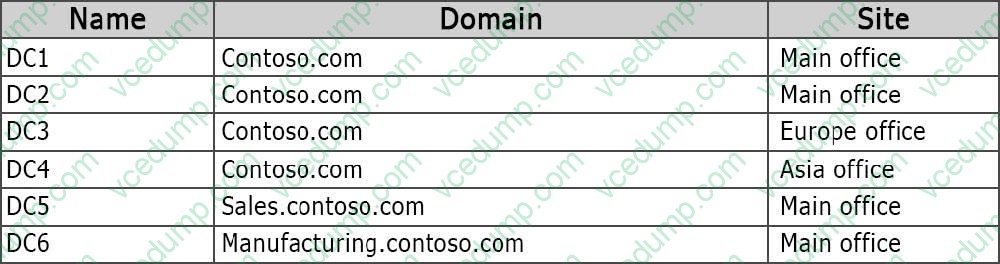
You need to prevent administrators from accidentally deleting any of the sites in the forest.
What should you use?
A. Set-ADSite
B. Set-ADReplicationSite
C. Set-ADDomain
D. Set-ADReplicationSiteLink
E. Set-ADGroup
F. Set-ADForest
G. Netdom -
Question 143:
Which of the following services would you restart on a domain controller if you wanted to trigger a reregistration of the domain controller's _ldap and _kerberos SRV records?
A. DNS Server
B. Server
C. Workstation
D. Netlogon -
Question 144:
You need to verify whether a DNS response from a DNS server is signed by DNSSEC. What should you run?
A. nslookup.exe
B. dnscmd.exe
C. Resolve-DNSName
D. Get-NetIPAddress -
Question 145:
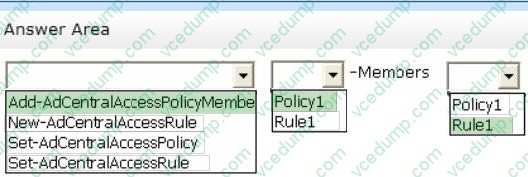
HOTSPOT
Your network contains an Active Directory domain named contoso.com.
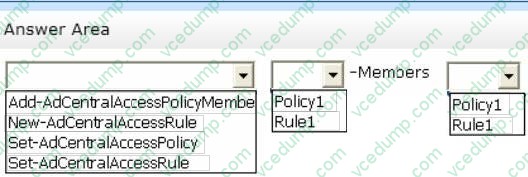
You have a Dynamic Access Control policy named Policy1.
You create a new Central Access Rule named Rule1.
You need to add Rule1 to Policy1.
What command should you run?
To answer, select the appropriate options in the answer area.
Hot Area:
-
Question 146:
Your network contains an Active Directory forest named contoso.com.
All servers run Windows Server 2012 R2.
You need to create a custom Active Directory Application partition.
Which tool should you use?
A. Netdom
B. Ntdsutil
C. Dsmod
D. Dsamain -
Question 147:
Your network contains an Active Directory domain named adatum.com. All domain controllers run Windows Server 2008 R2. The domain contains a file server named Server6 that runs Windows Server 2012 R2. Server6 contains a folder
named Folder1. Folder1 is shared as Share1.
The NTFS permissions on Folder1 are shown in the exhibit. (Click the Exhibit button.)
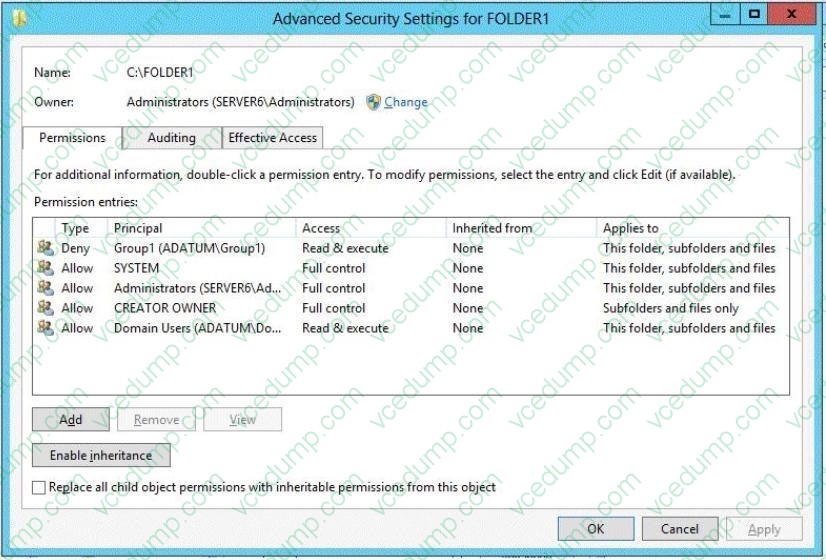
The domain contains two global groups named Group1 and Group2.
You need to ensure that only users who are members of both Group1 and Group2 are denied access to Folder1.
Which two actions should you perform? (Each correct answer presents part of the solution. (Choose two.)
A. Remove the Deny permission for Group1 from Folder1.
B. Deny Group2 permission to Folder1.
C. Install a domain controller that runs Windows Server 2012 R2.
D. Create a conditional expression.
E. Deny Group2 permission to Share1.
F. Deny Group1 permission to Share1. -
Question 148:
You have a server named Server1 that runs Windows Server 2012 R2. The storage on Server1 is configured as shown in the following table.
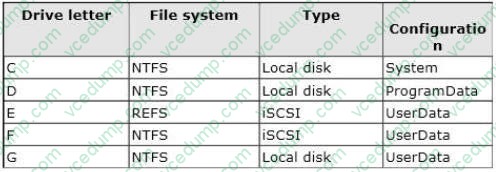
You plan to implement Data Deduplication on Server1.
You need to identify on which drives you can enable Data Deduplication.
Which three drives should you identify? (Each correct answer presents part of the solution. Choose three.)
A. C
B. D
C. E
D. F
E. G -
Question 149:
Your network contains an Active Directory domain named contoso.com. The domain contains two member servers named Server1 and Server2. All servers run Windows Server 2012 R2.
Server1 and Server2 have the Failover Clustering feature installed. The servers are configured as nodes in a failover cluster named Cluster1.
You add two additional nodes to Cluster1. You need to ensure that Cluster1 stops running if three nodes fail.
What should you configure?
A. Affinity-None
B. Affinity-Single
C. The cluster quorum settings
D. The failover settings
E. A file server for general use
F. The Handling priority
G. The host priority
H. Live migration
I. The possible owner
J. The preferred owner -
Question 150:
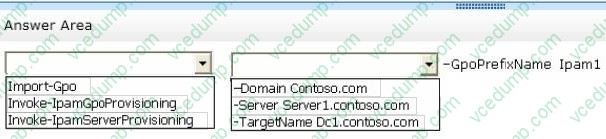
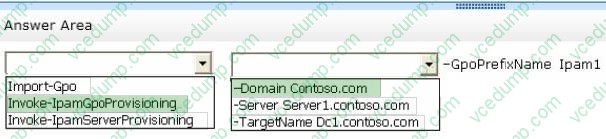
HOTSPOT
Your network contains an Active Directory domain named contoso.com. The domain contains a domain controller named DC1 and a member server named Server1. All servers run Windows Server 2012 R2.
You install the IP Address Management (IPAM) Server feature on Server1.
From the Provision IPAM wizard, you select the Group Policy Based provisioning methodand enter a GPO name prefix of IPAM1.
You need to provision IPAM by using Group Policy.
What command should you run on Server1 to complete the process?
To answer, select the appropriate options in the answer area.
Hot Area:
Related Exams:
-
62-193
Technology Literacy for Educators -
70-243
Administering and Deploying System Center 2012 Configuration Manager -
70-355
Universal Windows Platform – App Data, Services, and Coding Patterns -
77-420
Excel 2013 -
77-427
Excel 2013 Expert Part One -
77-725
Word 2016 Core Document Creation, Collaboration and Communication -
77-726
Word 2016 Expert Creating Documents for Effective Communication -
77-727
Excel 2016 Core Data Analysis, Manipulation, and Presentation -
77-728
Excel 2016 Expert: Interpreting Data for Insights -
77-731
Outlook 2016 Core Communication, Collaboration and Email Skills
Tips on How to Prepare for the Exams
Nowadays, the certification exams become more and more important and required by more and more enterprises when applying for a job. But how to prepare for the exam effectively? How to prepare for the exam in a short time with less efforts? How to get a ideal result and how to find the most reliable resources? Here on Vcedump.com, you will find all the answers. Vcedump.com provide not only Microsoft exam questions, answers and explanations but also complete assistance on your exam preparation and certification application. If you are confused on your 70-412 exam preparations and Microsoft certification application, do not hesitate to visit our Vcedump.com to find your solutions here.