70-412 Exam Details
-
Exam Code
:70-412 -
Exam Name
:Configuring Advanced Windows Server 2012 Services -
Certification
:Microsoft Certifications -
Vendor
:Microsoft -
Total Questions
:450 Q&As -
Last Updated
:Feb 03, 2022
Microsoft 70-412 Online Questions & Answers
-
Question 111:
Your network contains an Active Directory domain named contoso.com. The domain contains a main office and a branch office. An Active Directory site exists for each office. The domain contains two servers named Server1 and Server2 that run Windows Server 2012 R2.
Both servers have the DHCP Server server role installed.
Server1 is located in the main office site. Server2 is located in the branch office site.
Server1 provides IPv4 addresses to the client computers in the main office site.
Server2 provides IPv4 addresses to the client computers in the branch office site.
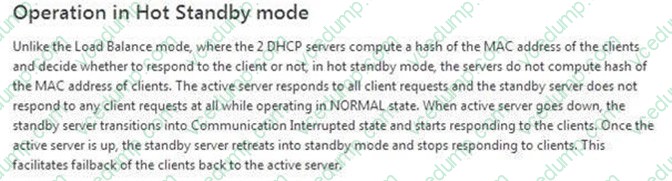
You need to ensure that if either Server1 or Server2 are offline, the client computers can still obtain IPv4 addresses.
The solution must meet the following requirements:
-
The storage location of the DHCP databases must not be a single point of failure.
-
Server1 must provide IPv4 addresses to the client computers in the branch office site only if Server2 is offline.
-
Server2 must provide IPv4 addresses to the client computers in the main office site only if Server1 is offline.
Which configuration should you use?
A. load sharing mode failover partners
B. a failover cluster
C. hot standby mode failover partners
D. a Network Load Balancing (NLB)cluster -
Question 112:
DRAG DROP
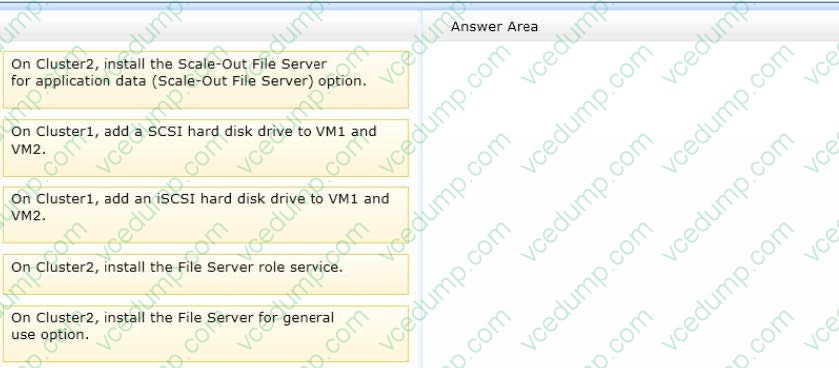
You have two failover clusters named Cluster1 and Cluster2. All of the nodes in both of the clusters run Windows Server 2012 R2.
Cluster1 hosts two virtual machines named VM1 and VM2.
You plan to configure VM1 and VM2 as nodes in a new failover cluster named Cluster3.
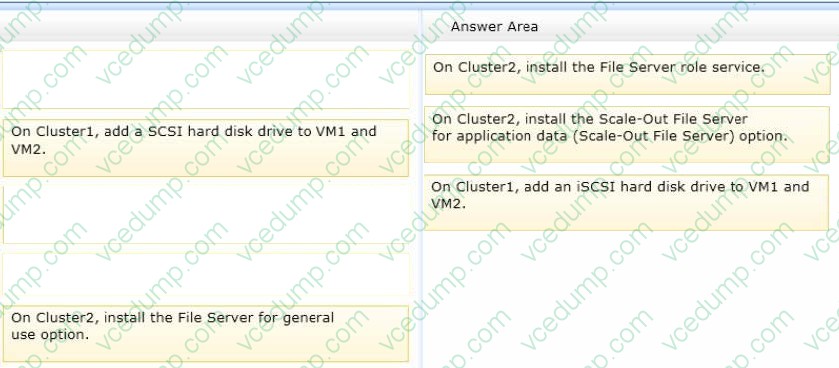
You need to configure the witness disk for Cluster3 to be hosted on Cluster2.
Which three actions should you perform in sequence?
To answer, move the appropriate three actions from the list of actions to the answer area and arrange them in the correct order.
Select and Place:
-
Question 113:
Which of the following CA types must be deployed on domain-joined computers?
A. Enterprise root
B. Enterprise subordinate
C. Standalone root
D. Standalone subordinate -
Question 114:
Note: This question is part of series of questions that use the same or similar answer choices. An answer choice may be correct for more than one question in the series. Each question is independent of the other questions in this series. Information and details provided in a question apply only to that question.
Your network contains one Active Directory forest named contoso.com.
The forest contains two child domains and six domain controllers.
The domain controllers are configured as shown in the following table.
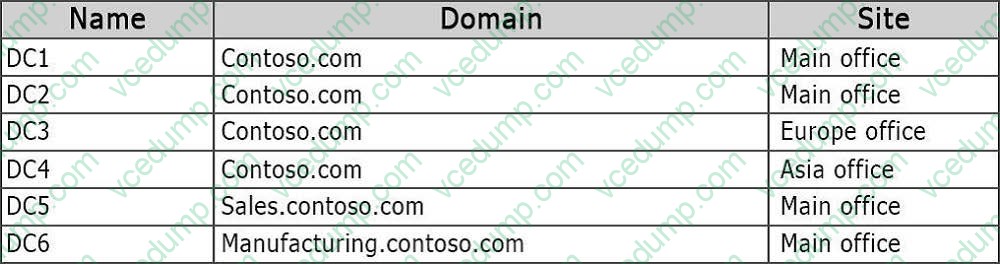
You need to prevent administrators from accidently deleting any of the site in the forest.
What should you use?
A. Set-ADSite
B. Set-ADReplicationSite
C. Set-ADDomain
D. Set-ADReplicationSiteLink
E. Set-ADGroup
F. Set-ADForest
G. Netdom -
Question 115:
You have a server named FS1 that runs Windows Server 2012 R2.
You install the File and Storage Services server role on FS1.
From Windows Explorer, you view the properties of a shared folder named Share1 and you discover that the Classification tab is missing.
You need to ensure that you can assign classifications to Share1 from Windows Explorer manually.
What should you do?
A. From Folder Options, select Show hidden files, folders, and drives.
B. From Folder Options, clear Use Sharing Wizard (Recommend).
C. Install the File Server Resource Manager role service.
D. Install the Enhanced Storage feature. -
Question 116:
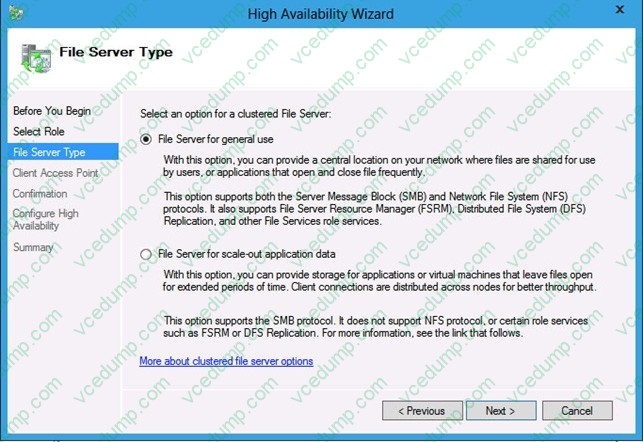
Your network contains an Active Directory domain named contoso.com. The domain contains two member servers named Server1 and Server2. All servers run Windows Server 2012 R2.
Server1 and Server2 have the Failover Clustering feature installed. The servers are configured as nodes in a failover cluster named Cluster1.
You add two additional nodes in Cluster1.
You have a folder named Folder1 on Server1 that hosts Application data. Folder1 is a folder target in a Distributed File System (DFS) namespace.
You need to provide highly available access to Folder1. The solution must support DFS Replication to Folder1.
What should you configure?
A. Affinity-None
B. Affinity-Single
C. The cluster quorum settings
D. The failover settings
E. A file server for general use
F. The Handling priority
G. The host priority
H. Live migration
I. The possible owner
J. The preferred owner -
Question 117:
The Wingtip Toys forest hosts a web application that users in the Tailspin Toys forest need to access. You are the system administrator at Tailspin Toys. A single federation server is present in each forest and you are configuring a federated trust.
Which of the following statements are true about the deployment solution? (Choose all that apply.)
A. The AD FS server in the Wingtip Toys forest will function as the claims-provider server.
B. The AD FS server in the Wingtip Toys forest willfunction as the relying-party server.
C. You need to configure a relying-party trust on the AD FS server in the Tailspin Toys forest.
D. You need to configure a claims-provider trust on the AD FS server in the Tailspin Toys forest. -
Question 118:
Your network contains an Active Directory domain named contoso.com. The domain contains two member servers named Server1 and Server2. All servers run Windows Server 2012 R2.
Server1 and Server2 have the Failover Clustering feature installed. The servers are configured as nodes in a failover cluster named Cluster1.
You configure File Services and DHCP as clustered resources for Cluster1. Server1 is the active node for both clustered resources.
You need to ensure that if two consecutive heartbeat messages are missed between Server1 and Server2, Server2 will begin responding to DHCP requests. The solution must ensure that Server1 remains the active node for the File Services
clustered resource for up to five missed heartbeat messages.
What should you configure?
A. Affinity-None
B. Affinity-Single
C. The cluster quorum settings
D. The failover settings
E. A file server for general use
F. The Handling priority
G. The host priority
H. Live migration
I. The possible owner
J. The preferred owner -
Question 119:
You have a failover cluster named Cluster1 that contains four nodes. All of the nodes run Windows Server 2012 R2.
You need to schedule the installation of Windows updates on the cluster nodes.
Which tool should you use?
A. the Add-CauClusterRole cmdlet
B. the Wusa command
C. the Wuauclt command
D. the Invoke-CauScan cmdlet -
Question 120:
You have a server named Server1 that runs Windows Server 2012 R2.
Windows Server 2012 R2 is installed on volume C.
You need to ensure that Safe Mode with Command Prompt loads the next time Server1 restarts.
Which tool should you use?
A. The Restart-Server cmdlet
B. The Bootcfg command
C. The Restart-Computer cmdlet
D. The Bcdedit command
Related Exams:
-
62-193
Technology Literacy for Educators -
70-243
Administering and Deploying System Center 2012 Configuration Manager -
70-355
Universal Windows Platform – App Data, Services, and Coding Patterns -
77-420
Excel 2013 -
77-427
Excel 2013 Expert Part One -
77-725
Word 2016 Core Document Creation, Collaboration and Communication -
77-726
Word 2016 Expert Creating Documents for Effective Communication -
77-727
Excel 2016 Core Data Analysis, Manipulation, and Presentation -
77-728
Excel 2016 Expert: Interpreting Data for Insights -
77-731
Outlook 2016 Core Communication, Collaboration and Email Skills
Tips on How to Prepare for the Exams
Nowadays, the certification exams become more and more important and required by more and more enterprises when applying for a job. But how to prepare for the exam effectively? How to prepare for the exam in a short time with less efforts? How to get a ideal result and how to find the most reliable resources? Here on Vcedump.com, you will find all the answers. Vcedump.com provide not only Microsoft exam questions, answers and explanations but also complete assistance on your exam preparation and certification application. If you are confused on your 70-412 exam preparations and Microsoft certification application, do not hesitate to visit our Vcedump.com to find your solutions here.