70-411 Exam Details
-
Exam Code
:70-411 -
Exam Name
:Administering Windows Server 2012 -
Certification
:Microsoft Certifications -
Vendor
:Microsoft -
Total Questions
:306 Q&As -
Last Updated
:Feb 03, 2022
Microsoft 70-411 Online Questions & Answers
-
Question 211:
Your network contains an Active Directory domain named contoso.com. The domain contains a server named Server1 that runs Windows Server 2012 R2.
You enable and configure Routing and Remote Access (RRAS) on Server1.
You create a user account named User1.
You need to ensure that User1 can establish VPN connections to Server1.
What should you do?
A. Create a network policy.
B. Create a connection request policy.
C. Add a RADIUS client.
D. Modify the members of the Remote Management Users group. -
Question 212:
Your network contains an Active Directory domain named contoso.com. All domain controllers run Windows Server 2012 R2. You plan to use fine-grained password policies to customize the password policy settings ofcontoso.com.
You need to identify to which Active Directory object types you can directly apply the fine- grained password policies.
Which two object types should you identify? (Each correct answer presents part of the solution. Choose two.)
A. Users
B. Global groups
C. computers
D. Universal groups
E. Domain local groups -
Question 213:
Your network contains an Active Directory forest. The forest contains two domains named contoso.com and fabrikam.com. All of the DNS servers in both of the domains run Windows Server 2012 R2. The network contains two servers named
Server1 and Server2. Server1 hosts an Active Directory-integrated zone for contoso.com. Server2 hosts an Active Directory-integrated zone for fabrikam.com. Server1 and Server2 connect to each other by using a WAN link.
Client computers that connect to Server1 for name resolution cannot resolve names in fabrikam.com.
You need to configure Server1 to resolve names in fabrikam.com. The solution must NOT require that changes be made to the fabrikam.com zone on Server2.
What should you create?
A. A trust anchor
B. A stub zone
C. A zone delegation
D. A secondary zone -
Question 214:
You have a failover cluster that contains five nodes. All of the nodes run Windows Server 2012 R2. All of the nodes have BitLocker Drive Encryption (BitLocker) enabled.
You enable BitLocker on a Cluster Shared Volume (CSV).
You need to ensure that all of the cluster nodes can access the CSV.
Which cmdlet should you run next?
A. Unblock-Tpm
B. Add-BitLockerKeyProtector
C. Remove-BitLockerKeyProtector
D. Enable BitLockerAutoUnlock -
Question 215:
Your network contains an Active Directory domain named contoso.com. All domain controllers run Windows Server 2012.
You pre-create a read-only domain controller (P.QDC) account named RODC1.
You export the settings of RODC1 to a file named Filel.txt.
You need to promote RODC1 by using File1.txt.
Which tool should you use?
A. The Install-WindowsFeature cmdlet
B. The Add-WindowsFeature cmdlet
C. The Dism command
D. The Install-ADDSDomainController cmdlet
E. the Dcpromo command -
Question 216:
Your network contains an Active Directory domain named contoso.com. Domain controllers run either Windows Server 2008 R2 Service Pack 1 (SP1) or Windows Server 2012 R2.
You have a Password Settings object (PSOs) named PSO1.
You need to view the settings of PSO1.
Which tool should you use?
A. Local Security Policy
B. Get-ADFineGrainedPasswordPolicy
C. Get-ADDomainControllerPasswordReplicationPolicy
D. Server Manager -
Question 217:
Your network contains three Network Policy Server (NPS) servers named NPS1, NPS2, and NPS3.
NP51 is configured as a RADIUS proxy that forwards connection requests to a remote RADIUS server group named Group1.
You need to ensure that NPS2 receives connection requests. NPS3 must only receive connection requests if NPS2 is unavailable.
How should you configure Group1?
A. Change the Priority of NPS3 to 10.
B. Change the Weight of NPS2 to 10.
C. Change the Weight of NPS3 to 10.
D. Change the Priority of NPS2 to 10. -
Question 218:
Your network contains an Active Directory domain named adatum.com. The domain contains a server named Server1 that runs Windows Server 2012 R2. Server1 is configured as a Network Policy Server (NPS) server and as a DHCP
server.
The network contains two subnets named Subnet1 and Subnet2. Server1 has a DHCP scope for each subnet.
You need to ensure that noncompliant computers on Subnet1 receive different network policies than noncompliant computers on Subnet2.
Which two settings should you configure? (Each correct answer presents part of the solution. Choose two.)
A. The NAP-Capable Computers conditions
B. The NAS Port Type constraints
C. The Health Policies conditions
D. The MS-Service Class conditions
E. The Called Station ID constraints -
Question 219:
Your network contains an Active Directory domain named contoso.com. The domain contains five servers. The servers are configured as shown in the following table.
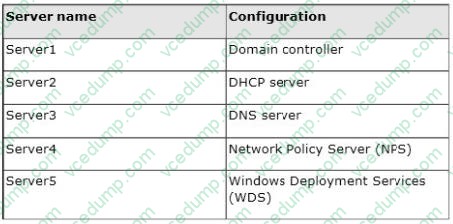
All desktop computers in contoso.com run Windows 8 and are configured to use BitLocker Drive Encryption (BitLocker) on all local disk drives. You need to deploy the Network Unlock feature. The solution must minimize the number of features and server roles installed on the network. To which server should you deploy the feature?
A. Server1
B. Server2
C. Server3
D. Server4
E. Server5 -
Question 220:
Your company has a main office and a branch office.
The network contains an Active Directory domain named contoso.com.
The main office contains a domain controller named DC1 that runs Windows Server 2012 R2. DC1 is a DNS server and hosts a primary zone for contoso.com. The branch office contains a member server named Server1 that runs Windows
Server 2012 R2. Server1 is a DNS server and hosts a secondary zone for contoso.com.
The main office connects to the branch office by using an unreliable WAN link.
You need to ensure that Server1 can resolve names in contoso.com if the WAN link in unavailable for three days.
Which setting should you modify in the start of authority (SOA) record?
A. Retry interval
B. Refresh interval
C. Expires after
D. Minimum (default) TTL
Related Exams:
-
62-193
Technology Literacy for Educators -
70-243
Administering and Deploying System Center 2012 Configuration Manager -
70-355
Universal Windows Platform – App Data, Services, and Coding Patterns -
77-420
Excel 2013 -
77-427
Excel 2013 Expert Part One -
77-725
Word 2016 Core Document Creation, Collaboration and Communication -
77-726
Word 2016 Expert Creating Documents for Effective Communication -
77-727
Excel 2016 Core Data Analysis, Manipulation, and Presentation -
77-728
Excel 2016 Expert: Interpreting Data for Insights -
77-731
Outlook 2016 Core Communication, Collaboration and Email Skills
Tips on How to Prepare for the Exams
Nowadays, the certification exams become more and more important and required by more and more enterprises when applying for a job. But how to prepare for the exam effectively? How to prepare for the exam in a short time with less efforts? How to get a ideal result and how to find the most reliable resources? Here on Vcedump.com, you will find all the answers. Vcedump.com provide not only Microsoft exam questions, answers and explanations but also complete assistance on your exam preparation and certification application. If you are confused on your 70-411 exam preparations and Microsoft certification application, do not hesitate to visit our Vcedump.com to find your solutions here.