642-902 Exam Details
-
Exam Code
:642-902 -
Exam Name
:Implementing cisco ip routing -
Certification
:Cisco Certifications -
Vendor
:Cisco -
Total Questions
:375 Q&As -
Last Updated
:Dec 09, 2021
Cisco 642-902 Online Questions & Answers
-
Question 231:
Refer to the exhibit.
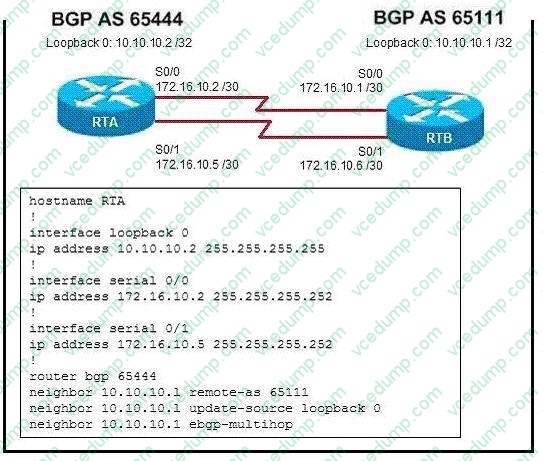
Routers RTA and RTB are running BGP but the session is active. What command needs to be added to establish the BGP session?
A. ip route 10.10.10.1 255.255.255.255 s0/0 ip route 10.10.10.1 255.255.255.255 s0/1
B. no synchronization
C. network 10.10.10.0
D. neighbor 10.10.10.1 next-hop-self -
Question 232:
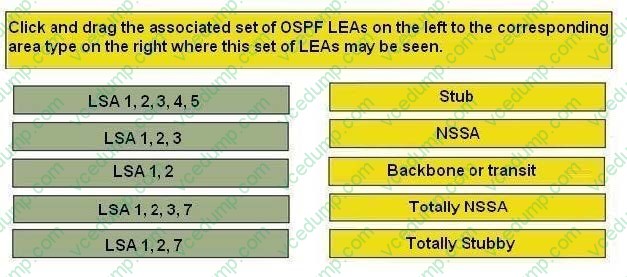
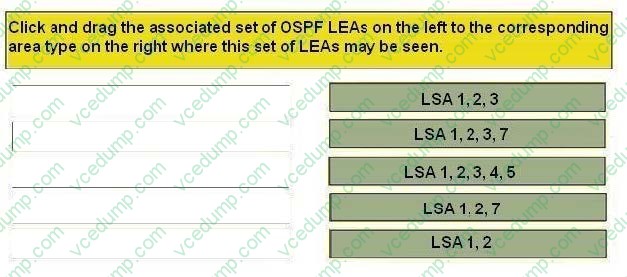
DRAG DROP
Select and Place:
-
Question 233:
OSPF is configured over a Frame Relay network as shown in the exhibit. All PVCs are active. However, R1 and R3 fail to see all OSPF routes in their routing tables. The show ip ospf neighbor command executed on R2 shows the state of the neighbors. What should be done to fix the problem?
A. The ip ospf network non-broadcast command should be configured on each Frame Relay interface.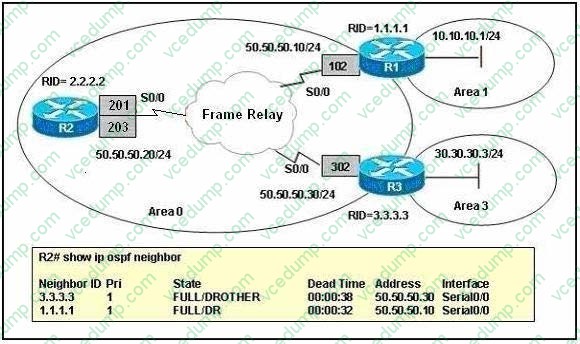
B. The ip ospf network broadcast command should be configured on each Frame Relay interface.
C. The neighbor command should be configured under the OSPF routing process on all routers.
D. The ip ospf priority value on the hub router should be set to 0.
E. The ip ospf priority value on the spoke routers should be set to 0. -
Question 234:
Which statement is true about the command ipv6 ospf 1 area 0?
A. It must be issued in router global configuration mode to enable the OSPF process for IPv6.
B. It must be issued in interface configuration mode to enable the OSPF process for IPv6.
C. It must be issued before the network command to enable the OSPF process for IPv6.
D. It must be issued after the network command to enable the OSPF process for IPv6. -
Question 235:
Which command should be added to RTB under router bgp 100 to allow only the external OSPF routes to be redistributed to RTC?
A. redistribute ospf 1
B. redistribute ospf 1 match external 1
C. redistribute ospf 1 match external 2
D. redistribute ospf 1 match external 1 external 2 -
Question 236:
After implementing EIGRP on your network, you issue the show ip eigrp traffic command on router C. The following output is shown:
RouterC#show ip eigrp traffic IF-EIGRP Traffic Statistics for process 1 Hellos sent/received: 481/444 Updates sent/received: 41/32 Queries sent/received: 5/1 Replies sent/received: 1/4 Acks sent/received: 21/25 Input queue high water mark 2, 0 drops SIA-Queries sent/received: 0/0 SIA-Replies sent/received: 0/0
Approximately 25 minutes later, you issue the same command again. The following output is shown:
RouterC#show ip eigrp traffic IP-EIGRP Traffic Statistics for process 1 Hellos sent/received: 1057/1020 Updates sent/received: 41/32 Queries sent/received: 5/1 Replies sent/received: 1/4 Acks sent/received: 21/25 Input queue high water mark 2, 0 drops SIA-Queries sent/received: 0/0 SIA-Replies sent/received: 0/0
Approximately 25 minutes later, you issue the same command a third time. The following output is shown: RouterC#show ip eigrp traffic IP-EIGRP Traffic Statistics for process 1 Hellos sent/received: 1754/1717 Updates sent/received: 41/32 Queries sent/received: 5/1 Replies sent/received: 1/4 Acks sent/received: 21/25 Input queue high water mark 2, 0 drops SIA-Queries sent/received: 0/0 SIA-Replies sent/received: 0/0
What can you conclude about this network?
A. The network has been stable for at least the last 45 minutes.
B. There is a flapping link or interface, and router C knows an alternate path to the network.
C. There is a flapping link or interface, and router A does not know an alternate path to the network.
D. EIGRP is not working correctly on router C.
E. There is not enough information to make a determination. -
Question 237:
A network administrator is managing a hub-and-spoke network with EIGRP routing that has been enabled. The hub router is trying to query a remote router. However, delays are occurring that are caused by certain paths being stuck in active (SIA). How should the administrator configure EIGRP in order to limit the scope of the query range and prevent SIA from occurring?
A. Configure the hub router with a scope limit of 1.
B. Configure the remote router with a scope limit of 1.
C. Configure the hub to indicate that the remote router is a stub router.
D. Configure the hub and remote router as stub routers.
E. Configure the remote router as a stub router.
F. Disable the SIA feature of EIGRP on the remote router. -
Question 238:
You have just completed an OSPF implementation. While executing your verification plan, you determine that R1 is not able to establish full OSPF adjacency with R2. The show ip ospf neighbor command output on R1 shows that R2 is stuck in the INIT state.
What could be the cause of this problem?
A. DR and BDR election errors between R1 and R2.
B. The R2 router has not received the OSPF hello packets from the R1 router.
C. Mismatched interface maximum transmission unit (MTU) configuration between the R1 and R2.
D. Mismatched OSPF hello interval configuration between the R1 and R2.
E. Corrupted LSAs exchanges between the R1 and R2. -
Question 239:
Refer to the exhibit.
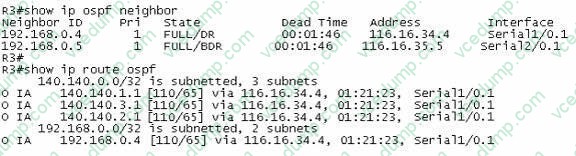
Based on the command output, what is one reason why no routes from the OSPF neighbor 192.168.0.5 are installed in the IP routing table?
A. R3 will only install routes from the neighbor with the lowest priority (Pri). If routes have the same priority, routes from the neighbor with the lowest IP address are used.
B. R3 did not receive any LSAs from 192.168.0.5.
C. Routes from backup designated routers are never installed in the IP routing table.
D. 192.168.0.5 is a redundant link to 192.168.0.4, and load balancing is not enabled. -
Question 240:
Company plans on migrating their network from IPv4 to IPv6 in the near future. Which three techniques can be used to transition from IPv4 to IPv6? (Select three)
A. Dual stack
B. NAT
C. Flow label
D. Mobile IP
E. 6to4 tunneling
F. Anycast
G. MBGP

Related Exams:
-
300-745
Designing Cisco Security Infrastructure (300-745 SDSI) v1.0 -
350-101
Implementing and Operating Cisco Wireless Core Technologies (350-101 WLCOR)v1.0 -
352-011
Cisco Certified Design Expert Practical -
500-052
Cisco Unified Contact Center Express -
500-173
Designing the FlexPod Solution (FPDESIGN) -
500-201
Deploying Cisco Service Provider Mobile Backhaul Solutions -
500-210
SP Optical Technology Field Engineer Representative -
500-220
Engineering Cisco Meraki Solutions (ECMS) v2.2 -
500-230
Cisco Service Provider Routing Field Engineer -
500-240
Cisco Mobile Backhaul for Field Engineers
Tips on How to Prepare for the Exams
Nowadays, the certification exams become more and more important and required by more and more enterprises when applying for a job. But how to prepare for the exam effectively? How to prepare for the exam in a short time with less efforts? How to get a ideal result and how to find the most reliable resources? Here on Vcedump.com, you will find all the answers. Vcedump.com provide not only Cisco exam questions, answers and explanations but also complete assistance on your exam preparation and certification application. If you are confused on your 642-902 exam preparations and Cisco certification application, do not hesitate to visit our Vcedump.com to find your solutions here.