642-902 Exam Details
-
Exam Code
:642-902 -
Exam Name
:Implementing cisco ip routing -
Certification
:Cisco Certifications -
Vendor
:Cisco -
Total Questions
:375 Q&As -
Last Updated
:Dec 09, 2021
Cisco 642-902 Online Questions & Answers
-
Question 121:
The following command was issued on R2
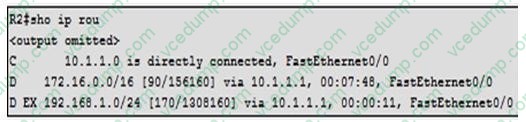
Given the above output, which statement is true?
A. 192.168.1.0 is a static route.
B. 192.168.1.0 is a summarized route.
C. 192.168.1.0 is a redistributed route into EIGRP.
D. 192.168.1.0 is equal path load balancing with 172.16.1.0. -
Question 122:
To enable BGP tunneling over an IPv4 backbone, the IPv4 address 192.168.30.1 is converted into a valid IPv6 address. Which three IPv6 addresses are acceptable formats for the IPv4 address? (Choose three.)
A. 192.168.30.1:0:0:0:0:0:0
B. 0:0:0:0:0:0:192.168.30.1
C. ::192.168.30.1
D. C0A8:1E01::
E. 192.168.30.1::
F. ::C0A8:1E01 -
Question 123:
Which statement is true about IBGP routers?
A. They must be fully meshed.
B. They can be in a different AS.
C. They must be directly connected.
D. They do not need to be directly connected. -
Question 124:
Refer to the exhibit.
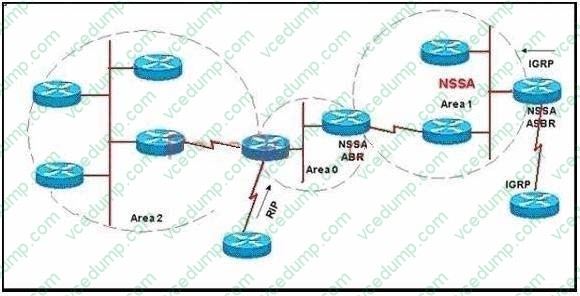
OSPF has been configured on all routers in the network and Area 1 has been configured as a NSSA. Which statement is true about the NSSA Area 1?
A. Redistributed RIP and IGRP routes will appear in Area 1. They will be advertised via type 5 LSAs.
B. Only redistributed RIP routes will appear in Area 1. They will be advertised via type 7 LSAs.
C. Only redistributed IGRP routes will appear in Area 1. They will be advertised via type 7 LSAs.
D. No redistributed routes can appear in Area 1, only summary routes. -
Question 125:
By default, which statement is correct regarding the redistribution of routes from other routing protocols into OSPF?
A. They will appear in the OSPF routing table as type E1 routes.
B. They will appear in the OSPF routing table as type E2 routes.
C. Summarized routes are not accepted.
D. All imported routes will be automatically summarized when possible.
E. Only routes with lower administrative distances will be imported. -
Question 126:
OSPF is enabled on router A. You execute the following command on router A and receive the accompanying output:
RouterA#ping 224.0.0.5 repeat 1
Type escape sequence to abort.
Sending 1, 100-byte ICMP Echos to 224.0.0.5, timeout is 2 seconds:
Reply to request 0 from 10.100.100.1, 4 ms
10.100.100.1 is the IP address of a loopback interface on router A. What can you conclude about router A?
A. Only the router A loopback interface is participating in the OSPF routing process.
B. None of the router A interfaces are participating in the OSPF routing process.
C. Router A is using the loopback interface IP address as its OSPF router ID.
D. Router A does not have any reachable OSPF neighbors. -
Question 127:
Which of the following are methods EIGRP uses to initially populate (seed) its EIGRP topology table, before learning topology data from neighbors? (Choose two.)
A. By adding all subnets listed by the show ip route connected command
B. By adding the subnets of working interfaces over which static neighbors have been defined
C. By adding subnets redistributed on the local router from another routing source
D. By adding all subnets listed by the show ip route static command -
Question 128:
Refer to the exhibit.
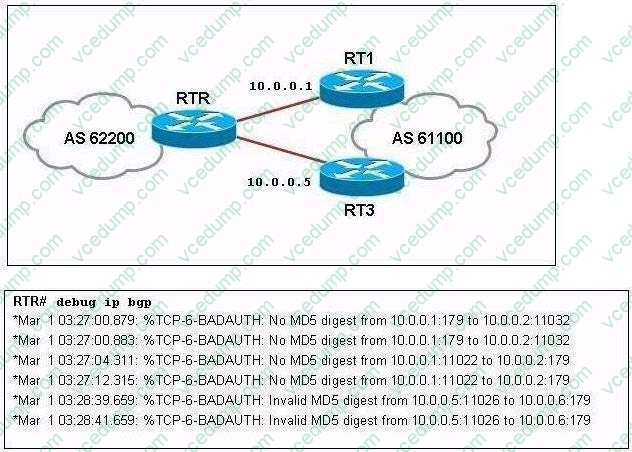
Router RTR is attempting to establish BGP neighbor relationships with routers RT1 and RT3. On the basis of the information that is presented in the exhibit, which two statements are true? (Choose two)
A. RTR has a BGP password set but neighbor 10.0.0.1 does not
B. RTR has a BGP password set but neighbor 10.0.0.5 does not
C. RTR has a BGP password set but neighbor 10.0.0.1 has an incorrect password set
D. RTR has a BGP password set but neighbor 10.0.0.5 has an incorrect password set
E. Neighbor 10.0.0.1 has a BGP password set but RTR does not
F. Neighbor 10.0.0.5 has a BGP password set but RTR does not -
Question 129:
Which BGP feature should be used to avoid high memory utilization on a router?
A. soft-reconfiguration
B. route refresh
C. BGP communities
D. full-mesh BGP peering -
Question 130:
Refer to the exhibit.
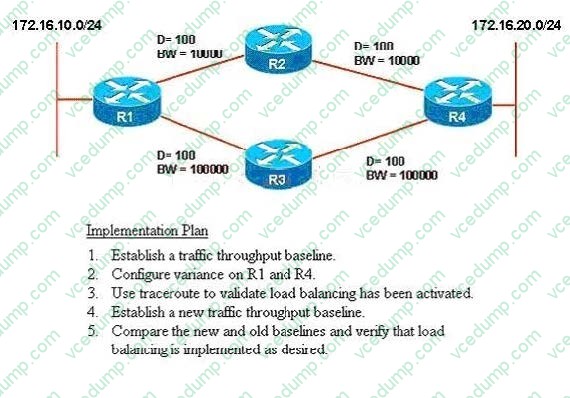
ROUTE.com is planning to implement EIGRP load balancing for traffic between hosts on the 172.16.10.0/24 and 172.16.20./24 networks. You have been asked to review the implementation plan for this project. Which statement about the plan is true?
A. It is complete as written.
B. It should include a task to configure multipath to equal a value of 2 on R1 and R4.
C. It should use a ping instead of a traceroute to validate that load balancing has been activated.
D. It should contain a task that documents the changes made to the configurations.
Related Exams:
-
300-745
Designing Cisco Security Infrastructure (300-745 SDSI) v1.0 -
350-101
Implementing and Operating Cisco Wireless Core Technologies (350-101 WLCOR)v1.0 -
352-011
Cisco Certified Design Expert Practical -
500-052
Cisco Unified Contact Center Express -
500-173
Designing the FlexPod Solution (FPDESIGN) -
500-201
Deploying Cisco Service Provider Mobile Backhaul Solutions -
500-210
SP Optical Technology Field Engineer Representative -
500-220
Engineering Cisco Meraki Solutions (ECMS) v2.2 -
500-230
Cisco Service Provider Routing Field Engineer -
500-240
Cisco Mobile Backhaul for Field Engineers
Tips on How to Prepare for the Exams
Nowadays, the certification exams become more and more important and required by more and more enterprises when applying for a job. But how to prepare for the exam effectively? How to prepare for the exam in a short time with less efforts? How to get a ideal result and how to find the most reliable resources? Here on Vcedump.com, you will find all the answers. Vcedump.com provide not only Cisco exam questions, answers and explanations but also complete assistance on your exam preparation and certification application. If you are confused on your 642-902 exam preparations and Cisco certification application, do not hesitate to visit our Vcedump.com to find your solutions here.