642-887 Exam Details
-
Exam Code
:642-887 -
Exam Name
:Implementing Cisco Service Provider Next-Generation Core Network Services -
Certification
:Cisco Certifications -
Vendor
:Cisco -
Total Questions
:184 Q&As -
Last Updated
:Dec 15, 2021
Cisco 642-887 Online Questions & Answers
-
Question 11:
Refer to the exhibit.
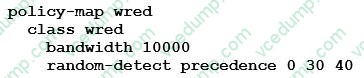
This WRED policy configuration is implemented on an IOS XR router. What is the
measurement of the numbers in the random-detect precedence command?
A. bytes
B. number of packets
C. kilobytes
D. milliseconds -
Question 12:
The network architecture team is proposing to enable Cisco MPLS TE over the entire service provider core network. Which two options are benefits of Cisco MPLS TE that affect their decision? (Choose two.)
A. Cisco MPLS TE optimizes network resources.
B. Cisco MPLS TE data flows independent from the underlying IGP.
C. Cisco MPLS TE increases the data forwarding rate.
D. Cisco MPLS TE tunneling does not require maintenance.
E. Cisco MPLS TE offers network resource reservation, which removes any need for QoS MQC policies. -
Question 13:
A service provider experiences routing issues in a customer MPLS network. The customer has two sites that are connected over its core. Which feature can be used for troubleshooting?
A. disabling of Cisco Express Forwarding, to enable the use of LSP Ping and LSP Traceroute to verify the IP routing path
B. redistribution between the BGP IPv4 and VPNv4 address families, to use labels to forward the customer packets
C. LSP Ping, to confirm that the label-switched path is used for transport
D. traceroute, to verify the label-switched path that is used for point-to-multipoint -
Question 14:
Which two considerations are important when implementing a Cisco MPLS TE NHOP or NNHOP protection? (Choose two.)
A. The head-end router requires configuring high priority for the Cisco MPLS TE tunnel.
B. The head-end router requires configuration for the NHOP or NNHOP protection request to occur.
C. The reconvergence time must be no longer than 10 seconds.
D. The Cisco MPLS TE tunnel on the Point of Local Repair implementing protection requires configuration as backup interface.
E. The tail-end router must be aware of the request for NHOP or NNHOP protection. -
Question 15:
Which four options describe the functions of the control world in an AToM environment? (Choose four.)
A. It carries generic and Layer 2 payload-specific information.
B. It prevents fragmentation and reassembly.
C. It preserves the sequence of the transported frames.
D. It is responsible for padding all packets.
E. It is responsible for padding the small packets.
F. It enables proper load balancing without packet desequencing independent of L2VPN packet content.
G. It enables an optimal path for the L2VPN packet content to follow through the MPLS backbone.
H. It carries Layer 2 payload-specific information. -
Question 16:
A service provider runs MPLS in its core. What is the relationship between FIB, LIB, and LFIB in this
environment?
A. Data from the FIB and LIB tables is used to generate the LFIB
B. The FIB, LIB, and LFIB are populated independently
C. The LIB and FIB are populated with labels and next-hop attributes in the control plane and are used to populate the LFIB
D. The LFIB is populated with information from the IP routing table and is shared with the FIB and LIB to assign labels to the path -
Question 17:
Which option describes what happens when a labelled packet with a TTL of 1 is received by an LSR?
A. The packet is forwarded on to the next router where its TTL expires and from where an ICMP "time exceeded" message is generated and routed back to the source.
B. The packet is dropped and an ICMP "time exceeded" message is IP routed back to the sender.
C. The packet is dropped and an ICMP "time exceeded" message is label-switched from the expiring router back on a new path toward the source.
D. The packet is dropped and an ICMP "time exceeded" message is label-switched from the expiring router on the same label switched path toward the destination and then back to the originating source.
E. The packet is forwarded on to the next router where its TTL expires and from where an ICMP "time exceeded" message is generated and label switched back to the source. -
Question 18:
When implementing MPLS TE tunnels on Cisco IOS XR routers, what is the tunnel setup and hold priority value range, and which value has the highest priority?
A. 0-63, where 0 is the highest priority
B. 0-63, where 63 is the highest priority
C. 0-7, where 0 is the highest priority
D. 0-7, where 7 is the highest priority -
Question 19:
Which option shows how a network engineer implements QPPB marking of incoming traffic on a router that is connected to a VoIP SP (AS62000, BGP community 60000:1) and to a data services service provider (AS61000, BGP community 61000:1) on Cisco IOS XE?
A. Option A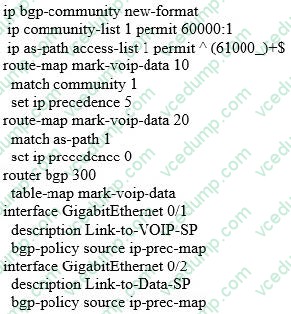
B. Option B
C. Option C
D. Option D -
Question 20:
Which two features are used to provide Cisco MPLS TE node and link protection? (Choose two.)
A. autoroute
B. fast reroute
C. backup tunnels
D. BFD
Related Exams:
-
300-745
Designing Cisco Security Infrastructure (300-745 SDSI) v1.0 -
350-101
Implementing and Operating Cisco Wireless Core Technologies (350-101 WLCOR)v1.0 -
352-011
Cisco Certified Design Expert Practical -
500-052
Cisco Unified Contact Center Express -
500-173
Designing the FlexPod Solution (FPDESIGN) -
500-201
Deploying Cisco Service Provider Mobile Backhaul Solutions -
500-210
SP Optical Technology Field Engineer Representative -
500-220
Engineering Cisco Meraki Solutions (ECMS) v2.2 -
500-230
Cisco Service Provider Routing Field Engineer -
500-240
Cisco Mobile Backhaul for Field Engineers
Tips on How to Prepare for the Exams
Nowadays, the certification exams become more and more important and required by more and more enterprises when applying for a job. But how to prepare for the exam effectively? How to prepare for the exam in a short time with less efforts? How to get a ideal result and how to find the most reliable resources? Here on Vcedump.com, you will find all the answers. Vcedump.com provide not only Cisco exam questions, answers and explanations but also complete assistance on your exam preparation and certification application. If you are confused on your 642-887 exam preparations and Cisco certification application, do not hesitate to visit our Vcedump.com to find your solutions here.