642-661 Exam Details
-
Exam Code
:642-661 -
Exam Name
:CCIP Configuring BGP on Cisco Routers (BGP) -
Certification
:Cisco Certifications -
Vendor
:Cisco -
Total Questions
:181 Q&As -
Last Updated
:Dec 15, 2021
Cisco 642-661 Online Questions & Answers
-
Question 91:
Refer to the exhibit. Which two statements are correct? (Choose two.)
A. The AS path is not manipulated when advertising a route to an IBGP peer; the local AS is added to the AS path only when advertising a route to an EBGP peer.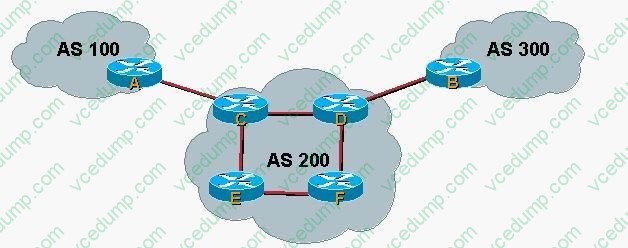
B. Routers C and D will redistribute all the BGP prefixes into an IGP to make routing more scalable within AS 200.
C. The routers within AS 200 are EBGP peers because this is not a full mesh implementation.
D. When router D announces a prefix learned from AS 100 to router B, the next-hop will be changed to the IP address of router C (the interface that connects to router D).
E. The routers within AS 200 are IBGP peers; routes learned from an IBGP peer are not generally advertised to other IBGP peers. -
Question 92:
Which condition must be met before Route Refresh messages can be sent to a BGP peer?
A. The soft reconfiguration feature must be enabled.
B. The BGP peer must advertise Route Refresh capability.
C. The Outbound Route Filter (ORF) feature must be enabled.
D. The BGP peer must have enough memory to store a copy of the original update. -
Question 93:
ip tcp path-mtu-discovery age-timer infinite
What is the result of the command in the above?
A. sets the age time to zero
B. turns off the age timer
C. allows an infinite MTU size for the default age time of 10 minutes
D. sets the age time to its default maximum value of 30 minutes. -
Question 94:
Which configuration will enable the R1 router in the AS51003 sub-AS (member-AS) as a route reflector with neighbors 10.1.1.1 and 10.2.2.2 as its route-reflector clients?
A. ! R1 routerbgp 51003 bgp confederation identifier 55111 bgp confederation peers 51001 51002 neighbor 10.1.1.1 remote-as 51001 neighbor 10.2.2.2 remote-as 51002 neighbor 10.1.1.1 route- reflector-client neighbor 10.2.2.2 route-reflector-client
B. ! R1 routerbgp 55111 bgp confederation identifier 51003 neighbor 10.1.1.1 remote-as 51003 neighbor 10.2.2.2 remote-as 51003 neighbor 10.1.1.1 route-reflector-client neighbor 10.2.2.2 route-reflector-client
C. ! R1 routerbgp 55111 bgp confederation identifier 51003 neighbor 10.1.1.1 remote-as 55111 neighbor 10.2.2.2 remote-as 55111 neighbor 10.1.1.1 route-reflector-client neighbor 10.2.2.2 route-reflector-client
D. ! R1 routerbgp 51003 bgp confederation identifier 55111 bgp confederation peers 51001 51002 neighbor 10.1.1.1 remote-as 51003 neighbor 10.2.2.2 remote-as 51003 neighbor 10.1.1.1 route- reflector-client neighbor 10.2.2.2 route-reflector-client -
Question 95:
Which command allows IBGP to scale within an AS?
A. neighbor {ip-address} route-reflector-client
B. neighbor {ip-address} next-hop-self
C. neighbor {ip-address} update-source loopback0
D. neighbor {ip-address} remote-as {confederation-id}
E. no sync
F. neighbor {ip-address}ebgp-multihop 2 -
Question 96:
The neighbor {ip-address} maximum-prefix {maximum number} command prevents which router condition?
A. route flaps
B. frequent BGP session resets
C. CPU and memory exhaustion
D. routing instability
E. asymmetric routing -
Question 97:
Which statement is true about BGP peer group configurations?
A. The use of peer group will increase the CPU load of the BGP process.
B. Peer group is used to reduce the full mesh IBGP requirements forTransit AS.
C. Peer group is used to sub-divide an AS into multiple sub-ASs to increase scalability.
D. The use of peer groups allows the router to build BGP update only once for the entire peer group. -
Question 98:
The Outbound Route Filter (ORF) capability is negotiated between BGP neighbors during the BGP____ process via the _____ message.
A. route propagation; Update
B. session establishment; Open
C. route propagation; Notification
D. route propagation; Route Refresh -
Question 99:
Refer to the exhibit. Which of these best describe why 21.0.0.0 via the next hop of 2.3.4.5 has been selected as the best path to the network?
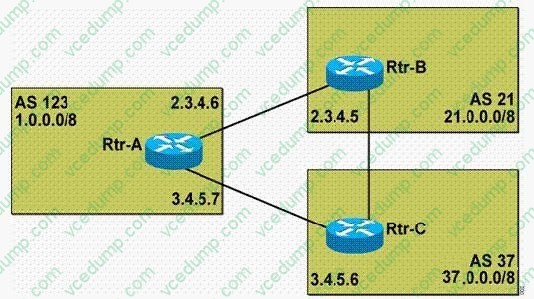
A. Because it has the higher MED.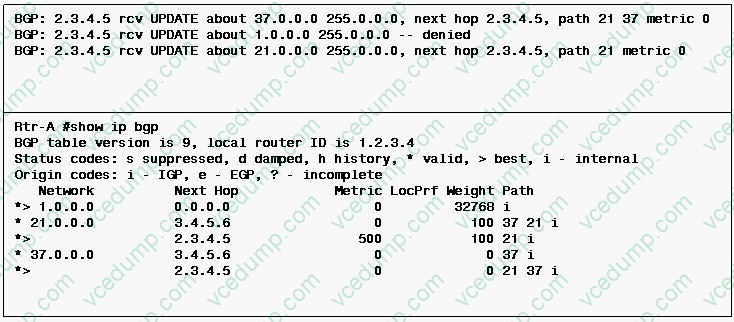
B. Because it is the oldest learned path.
C. Because it has the shortest AS path.
D. Because the BGP table has not converged. -
Question 100:
As the penalty for a flapping route decreases and falls below a certain limit, the route is nsuppressed. What is the name of that limit?
A. half-life limit
B. suppress limit
C. max-suppress-time limit
D. reuse limit
Related Exams:
-
300-745
Designing Cisco Security Infrastructure (300-745 SDSI) v1.0 -
350-101
Implementing and Operating Cisco Wireless Core Technologies (350-101 WLCOR)v1.0 -
352-011
Cisco Certified Design Expert Practical -
500-052
Cisco Unified Contact Center Express -
500-173
Designing the FlexPod Solution (FPDESIGN) -
500-201
Deploying Cisco Service Provider Mobile Backhaul Solutions -
500-210
SP Optical Technology Field Engineer Representative -
500-220
Engineering Cisco Meraki Solutions (ECMS) v2.2 -
500-230
Cisco Service Provider Routing Field Engineer -
500-240
Cisco Mobile Backhaul for Field Engineers
Tips on How to Prepare for the Exams
Nowadays, the certification exams become more and more important and required by more and more enterprises when applying for a job. But how to prepare for the exam effectively? How to prepare for the exam in a short time with less efforts? How to get a ideal result and how to find the most reliable resources? Here on Vcedump.com, you will find all the answers. Vcedump.com provide not only Cisco exam questions, answers and explanations but also complete assistance on your exam preparation and certification application. If you are confused on your 642-661 exam preparations and Cisco certification application, do not hesitate to visit our Vcedump.com to find your solutions here.