642-648 Exam Details
-
Exam Code
:642-648 -
Exam Name
:Deploying Cisco ASA VPN Solutions (VPN v2.0) -
Certification
:Cisco Certifications -
Vendor
:Cisco -
Total Questions
:121 Q&As -
Last Updated
:Nov 22, 2021
Cisco 642-648 Online Questions & Answers
-
Question 81:
Refer to the exhibit.
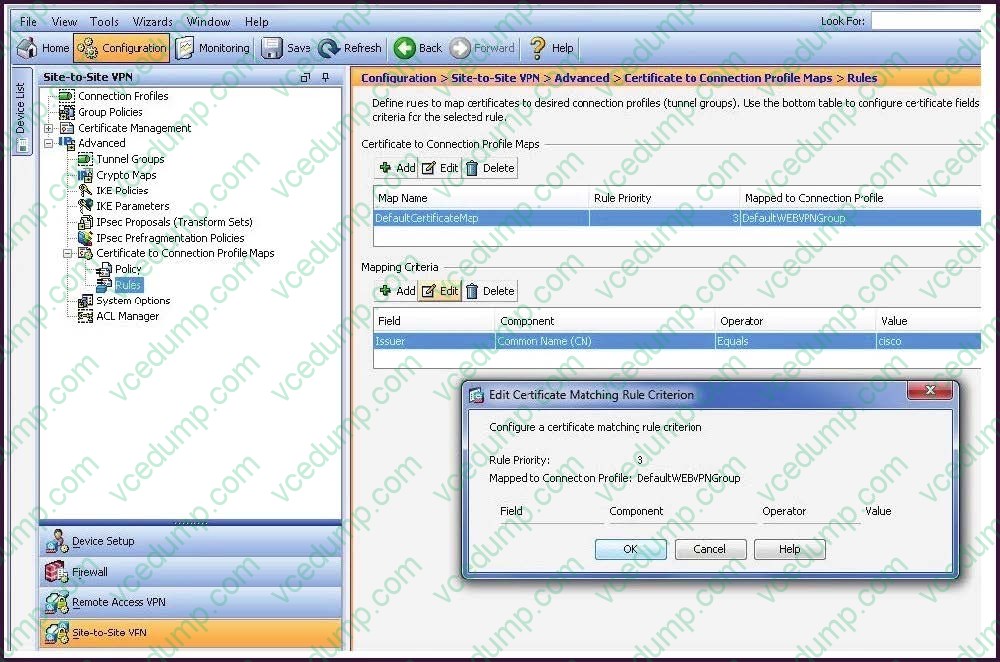
In the Edit Certificate Matching Rule Criterion window, you want to change the Mapped to Connection Profile. However, you cannot perform that action from this window.
Where should you navigate to and what should you do, in order to perform this change?
A. Edit the entry in the Certificate Management window.
B. Edit the entry in the Connection Profiles window.
C. Edit the entry in the Certificate to Connection Profile Maps window.
D. Edit the entry in IKE Policies window.
E. Delete this entry in the Mapping Criteria window, and add a new entry in the same location. -
Question 82:
Upon receiving a digital certificate, what are three steps that a Cisco ASA performs to authenticate the digital certificate? (Choose three.)
A. The identity certificate validity period is verified against the system clock of the Cisco ASA.
B. The identity certificate thumbprint is validated using the private key of the stored CA.
C. The identity certificate signature is validated by using the stored root certificate.
D. The signature is validated by using the stored identity certificate.
E. If enabled, the Cisco ASA locates the CRL and validates the identity certificate. -
Question 83:
Refer to the exhibit.
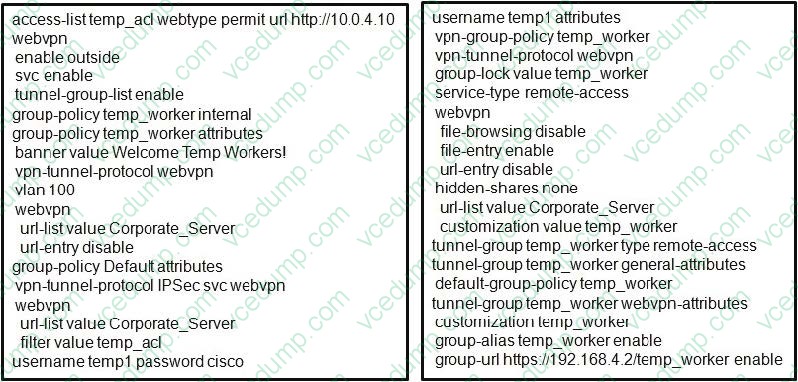
A junior network engineer configured the corporate Cisco ASA appliance to accommodate a new temporary worker. For security reasons, the IT department wants to restrict the internal network access of the new temporary worker to the corporate server, with an IP address of 10.0.4.10. After the junior network engineer finished the configuration, an IT security specialist tested the account of the temporary worker. The tester was able to access the URLs of additional secure servers from the WebVPN user account of the temporary worker.
What did the junior network engineer configure incorrectly?
A. The ACL was configured incorrectly.
B. The ACL was applied incorrectly or was not applied.
C. Network browsing was not restricted on the temporary worker group policy.
D. Network browsing was not restricted on the temporary worker user policy. -
Question 84:
Which feature is supported when implementing an IPsec VPN configuration using IKEv2?
A. IKEv2 authentication can be configured to negotiate authentication modes within the IKE policy when using Cisco ASDM.
B. IKEv2 proposals are identical to IKEv1 policies.
C. When implementing IKEv2 with a site-to-site VPN, authentication parameters should contain a fallback to to PSKs, in case certificate-based authentication fails.
D. IKEv2 peer authentication can be implemented with asymmetric authentication methods. -
Question 85:
You have been using pre-shared keys for IKE authentication on your VPN. Your network has grown rapidly, and now you need to create VPNs with numerous IPsec peers. How can you enable scaling to numerous IPsec peers?
A. Migrate to external CA-based digital certificate authentication.
B. Migrate to a load-balancing server.
C. Migrate to a shared license server.
D. Migrate from IPsec to SSL VPN client extended authentication. -
Question 86:
Refer to the exhibit.
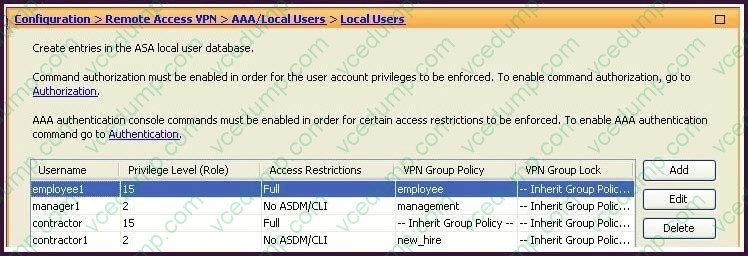
When the user "contractor" Cisco AnyConnect tunnel is established, what type of Cisco ASA user restrictions are applied to the tunnel?
A. full restrictions (no Cisco ASDM, no CLI, no console access)
B. full restrictions (no read, no write, no execute permissions)
C. full restrictions (CLI show commands and Cisco ASDM monitoring permissions only)
D. full access with no restrictions -
Question 87:
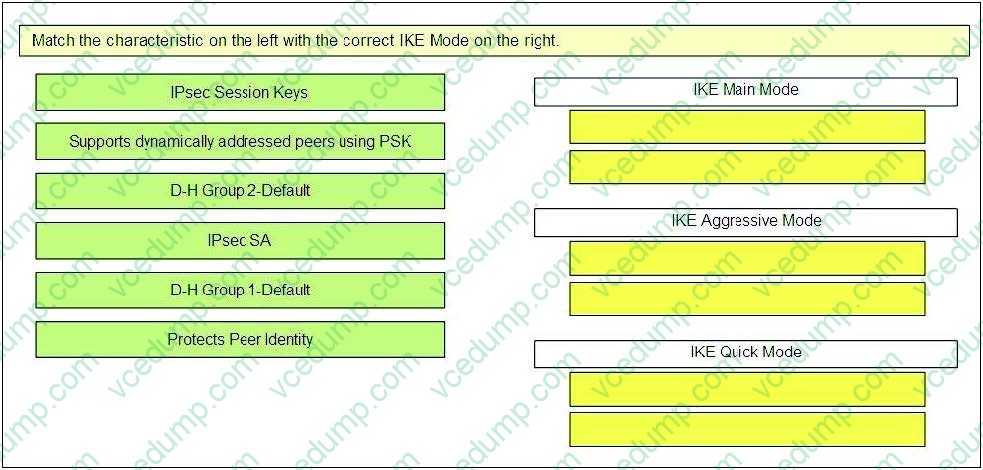
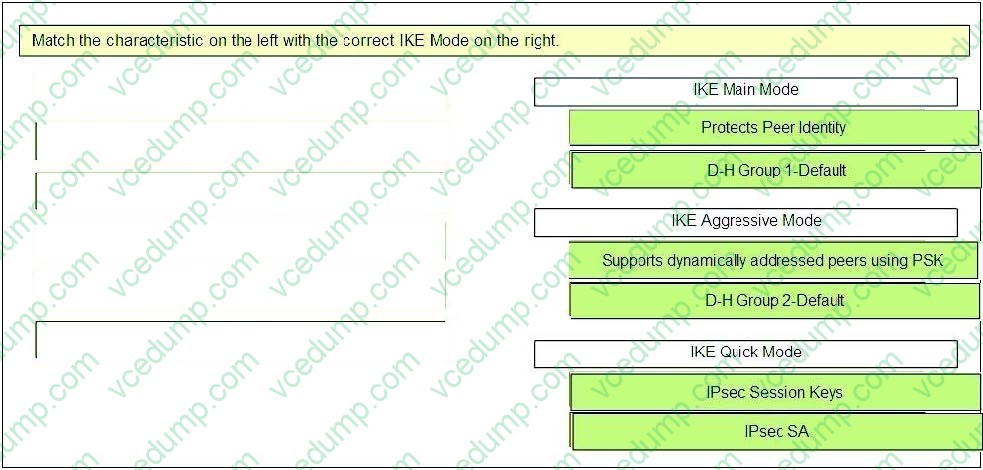
Match the characteristic on the left with the correct IKE Mode on the right.
Select and Place:
-
Question 88:
Refer to the exhibit.

In the CLI snippet that is shown, what is the function of the deny option in the access list?
A. When set in conjunction with outbound connection-type bidirectional, its function is to prevent the specified traffic from being protected by the crypto map entry.
B. When set in conjunction with connection-type originate-only, its function is to instruct the Cisco ASA to deny specific inbound traffic if it is not encrypted.
C. When set in conjunction with outbound connection-type answer-only, its function is to instruct the Cisco ASA to deny specific outbound traffic if it is not encrypted.
D. When set in conjunction with connection-type originate-only, its function is to cause all IP traffic that matches the specified conditions to be protected by the crypto map. -
Question 89:
A network architect designed a redundant site-to-site IPsec VPN. In this site-to-site IPsec VPN solution are two standalone Cisco ASA appliances that are deployed at the headquarters office site. A site-to-site VPN tunnel is established between the remote office and online peer (192.168.4.1).
To enable the remote office devices to be advertised correctly at headquarters, select the three Cisco ASA parameters and the ends in which they should be applied. R=remote end; H=headquarters end. (Choose three)
A. R-Configure Originate-Only
B. H-Configure Originate-Only
C. R-Configure Answer-Only
D. H-Configure Answer-Only
E. R-Enable RRI
F. H-Enable RRI -
Question 90:
Refer to the exhibit.
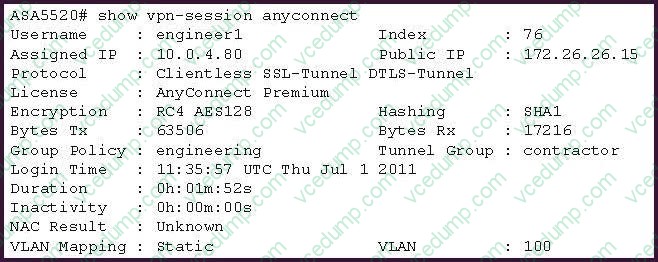
A NOC engineer needs to tune some prelogin parameters on an SSL VPN tunnel.
From the information that is shown, where should the engineer navigate to find the prelogin session attributes?
A. "engineering" Group Policy
B. "contractor" Connection Profile
C. "engineer1" AAA/Local Users
D. DfltGrpPolicy Group Policy
Related Exams:
-
300-745
Designing Cisco Security Infrastructure (300-745 SDSI) v1.0 -
350-101
Implementing and Operating Cisco Wireless Core Technologies (350-101 WLCOR)v1.0 -
352-011
Cisco Certified Design Expert Practical -
500-052
Cisco Unified Contact Center Express -
500-173
Designing the FlexPod Solution (FPDESIGN) -
500-201
Deploying Cisco Service Provider Mobile Backhaul Solutions -
500-210
SP Optical Technology Field Engineer Representative -
500-220
Engineering Cisco Meraki Solutions (ECMS) v2.2 -
500-230
Cisco Service Provider Routing Field Engineer -
500-240
Cisco Mobile Backhaul for Field Engineers
Tips on How to Prepare for the Exams
Nowadays, the certification exams become more and more important and required by more and more enterprises when applying for a job. But how to prepare for the exam effectively? How to prepare for the exam in a short time with less efforts? How to get a ideal result and how to find the most reliable resources? Here on Vcedump.com, you will find all the answers. Vcedump.com provide not only Cisco exam questions, answers and explanations but also complete assistance on your exam preparation and certification application. If you are confused on your 642-648 exam preparations and Cisco certification application, do not hesitate to visit our Vcedump.com to find your solutions here.