642-647 Exam Details
-
Exam Code
:642-647 -
Exam Name
:Deploying Cisco ASA VPN Solutions (VPN v1.0) -
Certification
:Cisco Certifications -
Vendor
:Cisco -
Total Questions
:121 Q&As -
Last Updated
:Dec 09, 2021
Cisco 642-647 Online Questions & Answers
-
Question 11:
Upon receiving a digital certificate, what are three steps that a Cisco ASA performs to authenticate the digital certificate? (Choose three.)
A. The identity certificate validity period is verified against the system clock of the Cisco ASA.
B. The identity certificate thumbprint is validated using the private key of the stored CA.
C. The identity certificate signature is validated by using the stored root certificate.
D. The signature is validated by using the stored identity certificate.
E. If enabled, the Cisco ASA locates the CRL and validates the identity certificate. -
Question 12:
Refer to the exhibit.

Given the example that is shown, what can you determine?
A. Users are required to perform RADIUS or LDAP authentication when connecting with the Cisco AnyConnect client.
B. Users are required to perform AAA authentication when connecting via WebVPN.
C. Users are required to perform double AAA authentication.
D. The user access identity is prefilled at login, requiring users to enter only their password. -
Question 13:
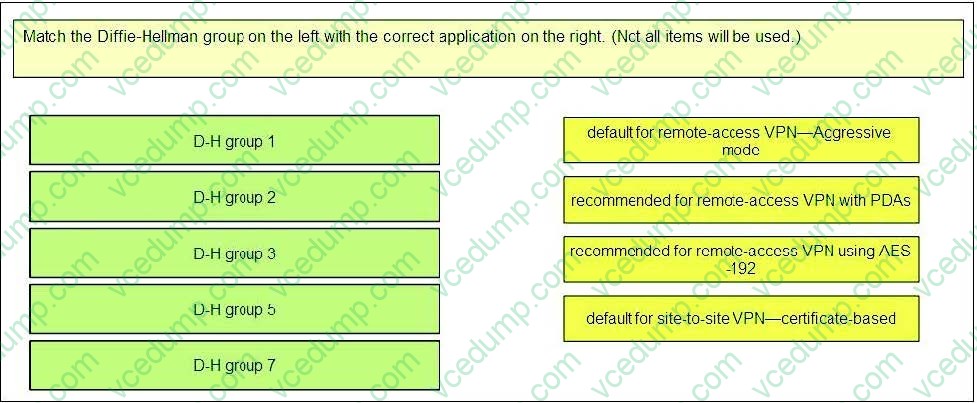
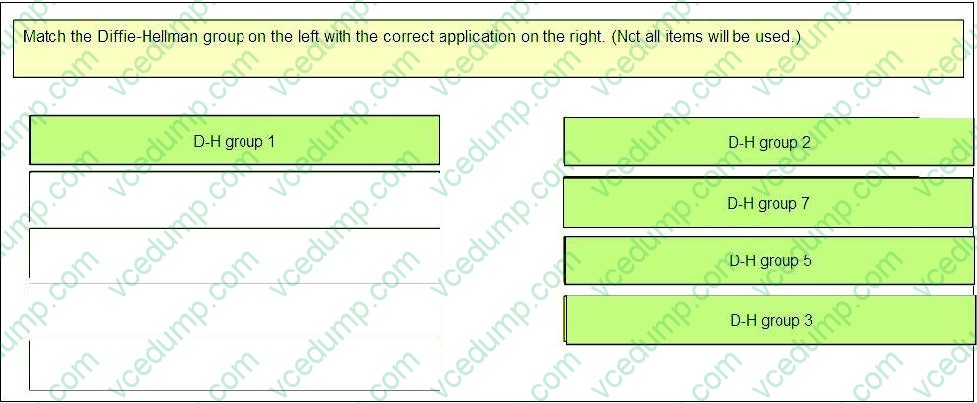
Match the Diffie-Hellman group on the left with the correct application on the right. (Not all items will be used.)
Select and Place:
-
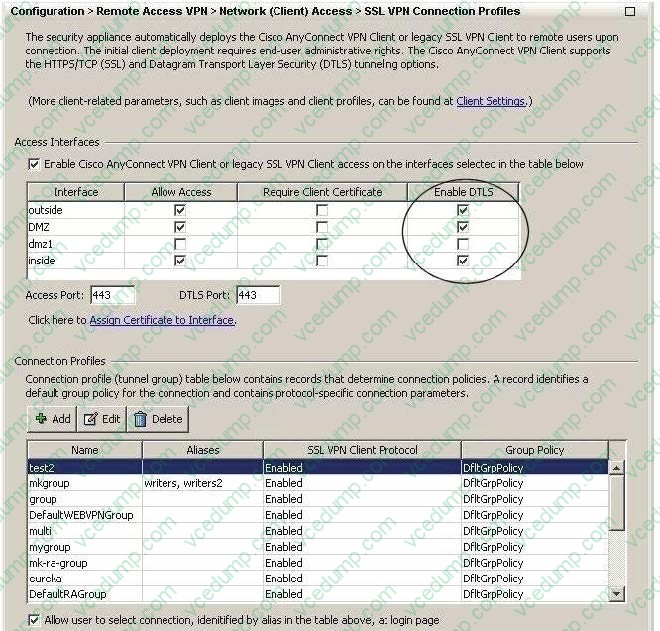
Question 14:
Datagram Transport Layer Security (DTLS) was introduced to solve performance issues. Choose three characteristics of DTLS. (Choose three.)
A. It uses TLS to negotiate and establish DTLS connections.
B. It uses DTLS to transmit datagrams.
C. It is disabled by default.
D. It uses TLS for data packet retransmission.
E. It replaces underlying transport layer with UDP 443.
F. It uses TLS to provide low-latency video application tunneling. -
Question 15:
Refer to following Exhibit and answer the following question below:
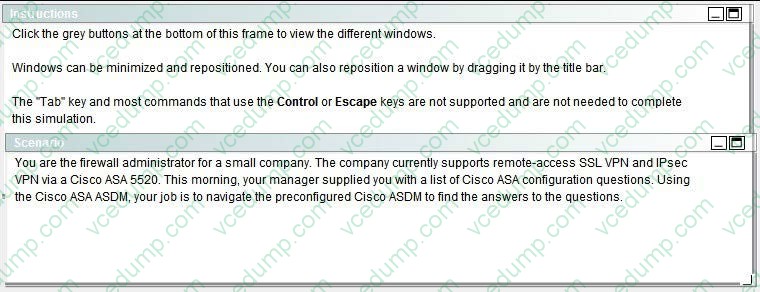
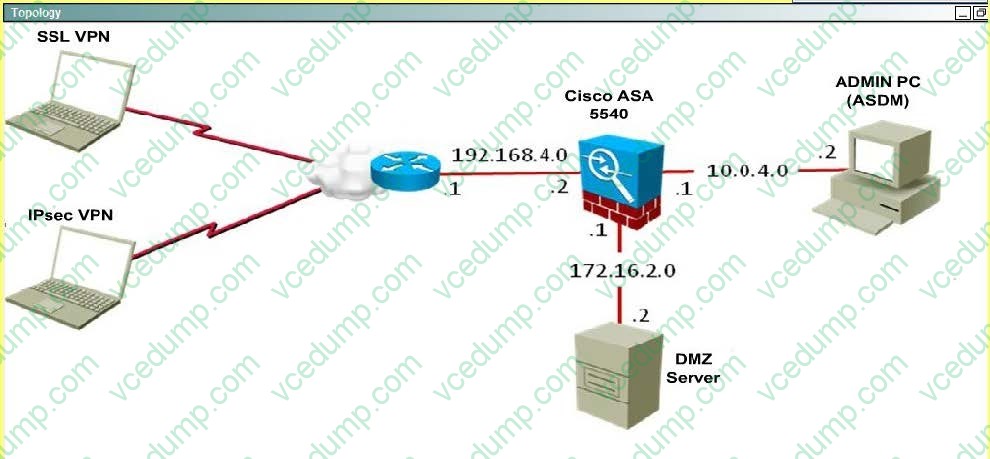
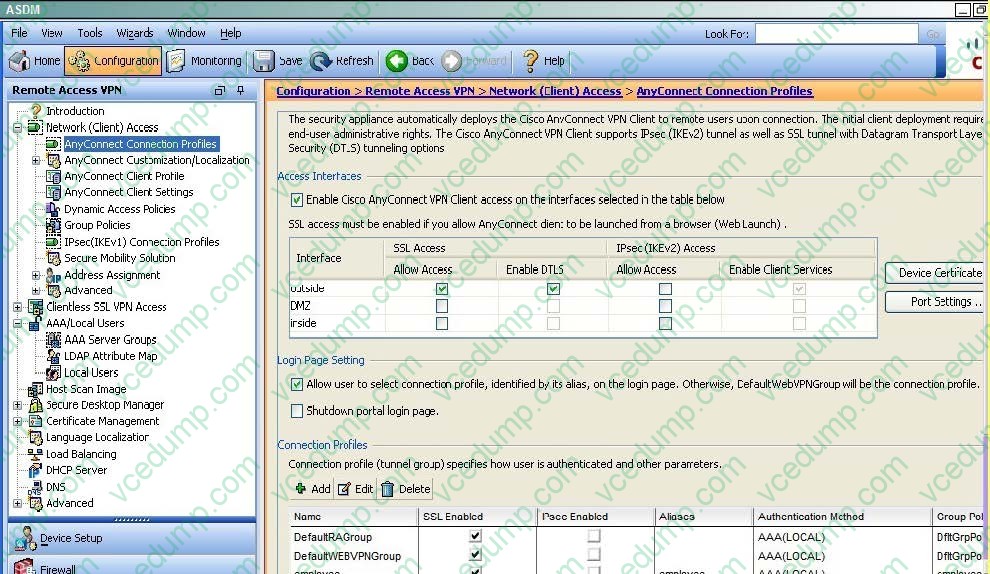
The user, contractor1, receives an IP address when the VPN connection is established. Which statement regarding the IP address is true?
A. it is sourced from the contractor pool.
B. it is sourced from the employee pool.
C. it is sourced from the engineering pool.
D. it is sourced from the management pool.
E. it is dedicated address (10.0.4.120) -
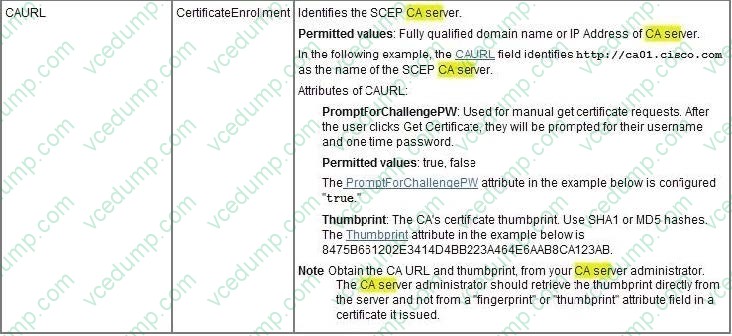
Question 16:
With SCEP enabled in a Cisco AnyConnect Connection Profile, what additional configuration step must you do when using Cisco ASA 8.4 software?
A. Configure local authentication prior to the enrollment process.
B. Configure the client to poll the CA for a response to the certificate request.
C. Configure the location of the CA server.
D. Configure the profile to inherit the SCEP forwarding URL. -
Question 17:
Refer to the exhibit.
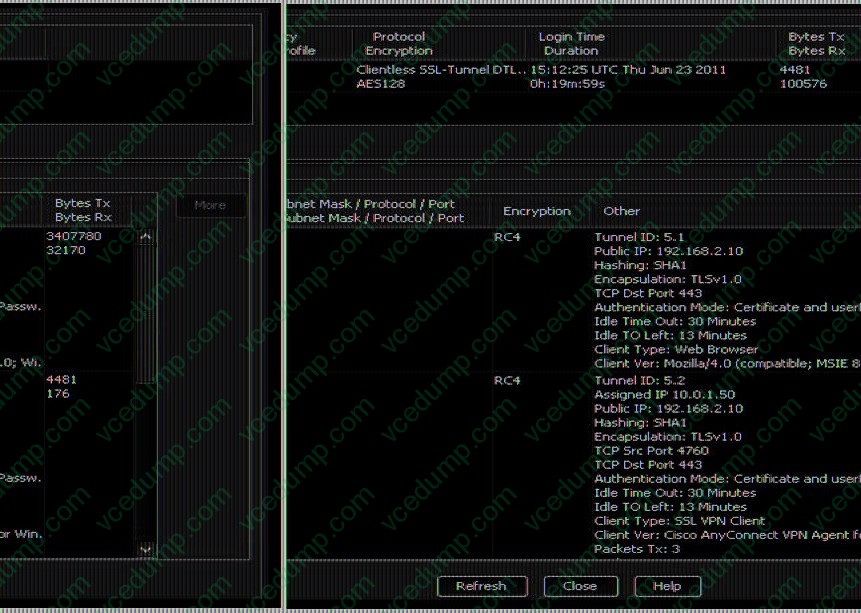
When you are testing SSL VPN in a non-production environment, certain variables in the Cisco ASDM session details can be viewed or changed under Configuration > AnyConnect Connection Profiles.
Which parameter can be viewed or changed in the AnyConnect Connection Profiles?
A. Assigned IP address 10.0.1.50
B. Client TypE. SSL VPN Client
C. Authentication ModE. Certificate and User Password
D. Client Ver: Cisco AnyConnect VPN Agent for Windows -
Question 18:
Refer to the exhibit.
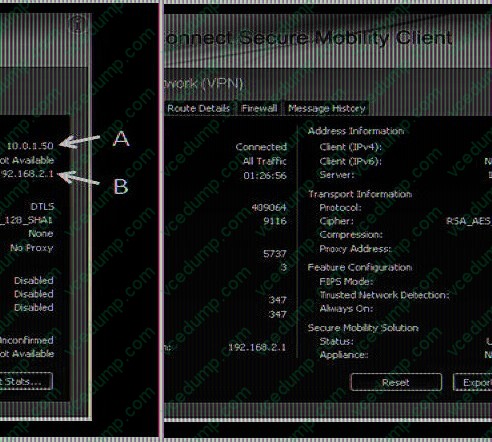
After a remote user established a Cisco AnyConnect session from a wireless card through the Cisco ASA appliance of a partner to a remote server, the user opened the Cisco AnyConnect VPN Client Statistics Details screen.
What are the two sources of the IP addresses that are marked A and B? (Choose two.)
A. IP address that is assigned to the wireless Ethernet adapter of the remote user
B. IP address that is assigned to the remote user from the Cisco ASA address pool
C. IP address of the Cisco ASA physical interface of the partner
D. IP address of the Cisco ASA virtual HTTP server of the partner
E. IP address of the default gateway router of the remote user
F. IP address of the default gateway router of the partner -
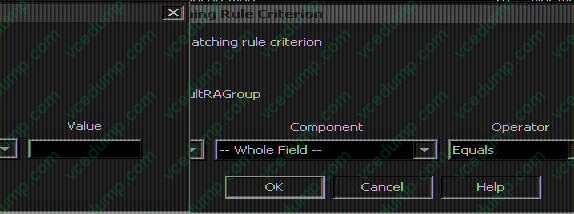
Question 19:
Refer to the exhibit.
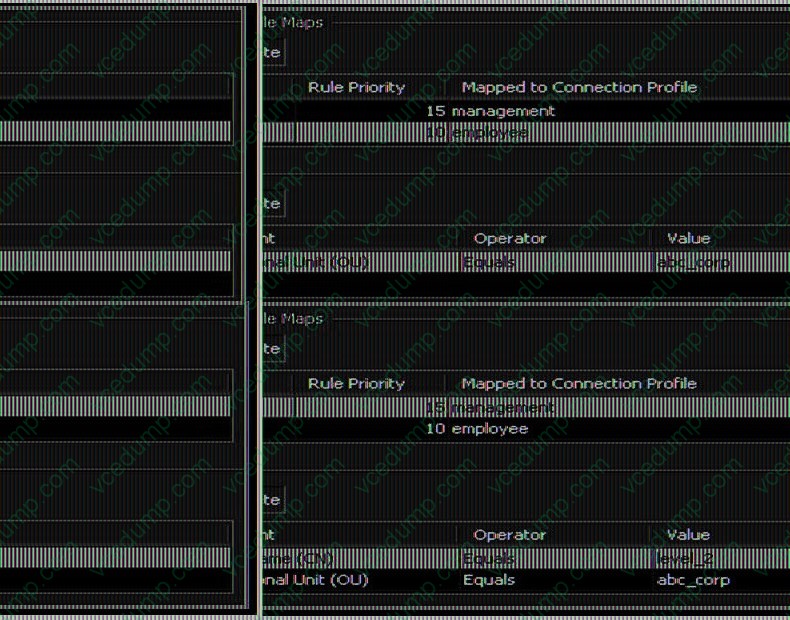
You have configured two SSL VPN Certificate to Connection Profile Maps for all employee and management users. The Connection Profiles for the management users are not being applied when the "management" users connect.
Based on the configuration that is shown, what is the most likely cause of this issue?
A. The rule priority of the employee mapping is not low enough, and it needs to be lowered to 1.
B. The priority of the employee mapping is too low, and it needs to be increased, but not higher than the rule priority of the management mapping.
C. The priority of the management mapping is too high, and it needs to be lower than the rule priority of the employee mapping.
D. The matching criteria for the management mapping is too specific, and the CN matching parameter should be removed. -
Question 20:
You have just configured new clientless SSL VPN access parameters.
However, when users connect, they are not getting the expected access that was configured.
What is one possible reason this is occurring?
A. The correct Tunnel Group Lock is not properly set.
B. The corresponding Cisco ASA interface is not enabled for SSL VPN access.
C. The Connection Alias is not enabled.
D. Portal features are disabled.
Related Exams:
-
300-745
Designing Cisco Security Infrastructure (300-745 SDSI) v1.0 -
350-101
Implementing and Operating Cisco Wireless Core Technologies (350-101 WLCOR)v1.0 -
352-011
Cisco Certified Design Expert Practical -
500-052
Cisco Unified Contact Center Express -
500-173
Designing the FlexPod Solution (FPDESIGN) -
500-201
Deploying Cisco Service Provider Mobile Backhaul Solutions -
500-210
SP Optical Technology Field Engineer Representative -
500-220
Engineering Cisco Meraki Solutions (ECMS) v2.2 -
500-230
Cisco Service Provider Routing Field Engineer -
500-240
Cisco Mobile Backhaul for Field Engineers
Tips on How to Prepare for the Exams
Nowadays, the certification exams become more and more important and required by more and more enterprises when applying for a job. But how to prepare for the exam effectively? How to prepare for the exam in a short time with less efforts? How to get a ideal result and how to find the most reliable resources? Here on Vcedump.com, you will find all the answers. Vcedump.com provide not only Cisco exam questions, answers and explanations but also complete assistance on your exam preparation and certification application. If you are confused on your 642-647 exam preparations and Cisco certification application, do not hesitate to visit our Vcedump.com to find your solutions here.