642-437 Exam Details
-
Exam Code
:642-437 -
Exam Name
:Implementing Cisco Unified Communications Voice over IP and QoS v8.0 (CVOICE v8.0) -
Certification
:Cisco Certifications -
Vendor
:Cisco -
Total Questions
:256 Q&As -
Last Updated
:Dec 08, 2021
Cisco 642-437 Online Questions & Answers
-
Question 151:
Which codec complexity type will offer the greatest number of voice channels, provided that the complexity type is compatible with the particular codecs that are in use?
A. low complexity
B. medium complexity
C. high complexity
D. flex complexity -
Question 152:
If a centralized solution has to be implemented on multiple-equipment vendors devices, which signaling protocol should be used?
A. Session Initiation Protocol
B. Media Gateway Control Protocol
C. Skinny Client Control Protocol
D. H.323 protocol -
Question 153:
Refer to the exhibit.
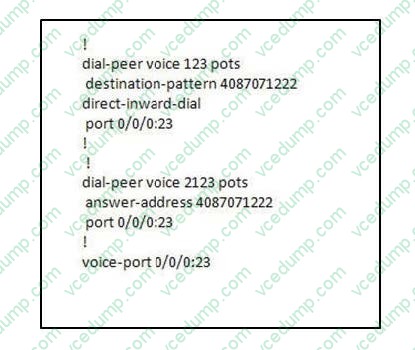
When an inbound PSTN call from 4087071222 arrives at the ISDN port that is shown in the exhibit, which dial peer will be matched for the inbound leg?
A. Dial-peer 123, because destination-pattern takes precedence over answer-address.
B. Dial-peer 2123, because answer-address takes precedence over destination-pattern.
C. The matching inbound dial peer will be selected at random.
D. Although dial-peer 2123 takes precedence, it will not be matched because the command direct-inward- dial is missing.
E. Dial-peer 123 will be matched because dial-peer 2123 will strip all the digits. -
Question 154:
Which version of Cisco Unified Communications Manager Express is recommended that is supported on endpoints running Cisco IOS 15.0(1)M?
A. 8
B. 7
C. 7.1
D. 8.5 -
Question 155:
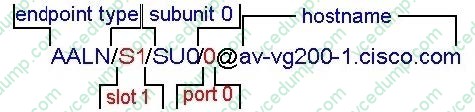
You are configuring a network to support voice to the PSTN. One important aspect to the configuration is to be able to determine the individual slot, subunit, and port number from the gateway endpoint identifier. Which signaling protocol is appropriate for this situation?
A. H.323
B. SIP
C. SCCP
D. MGCP -
Question 156:
In a voice gateway, the configured codec complexity of the DSPs on a voice card can be changed. What is the impact on the DSPs if high codec complexity is configured?
A. The codec complexity affects call density, which is the number of calls that are reconciled on the DSPs. This results in lower call density when high complexity is configured.
B. With higher codec complexity, more calls can be processed.
C. Lower codec complexity supports the fewest number of voice channels, provided that the lower complexity is compatible with the particular codecs that are in use.
D. The DSP will process codecs that support high complexity transparently and shift to flex mode for those codecs that are not high complexity. -
Question 157:
Refer to the exhibit. When an inbound PSTN call to 4087071222 is received by the router that is shown in the exhibit, what is the resulting called number?
A. 14087071222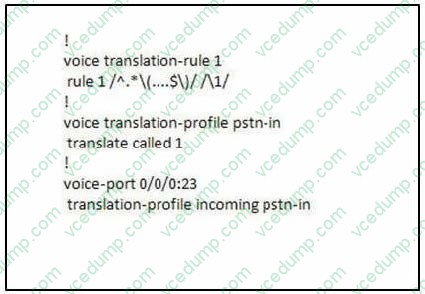
B. 11222
C. 14081222
D. 1222
E. 4087071222 -
Question 158:
How does a Cisco Unified Border Element support codec filtering?
A. The Cisco Unified Border Element relies on the endpoint that initiates the call to determine which codes the call will use.
B. The Cisco Unified Border Element can be configured to support codec filtering by adding a list of supported codecs in global configuration mode.
C. The Cisco Unified Border Element can be configured to support codec filtering by adding one or more codec types to each dial peer that is configured in the device.
D. The Cisco Unified Border Element will only support codec filtering in media flow-around mode so that endpoints can negotiate a specific codec independently. -
Question 159:
Which statement is true for an ephone-dn that has no COR applied?
A. Calls can be made from this ephone-dn to all possible numbers from the local router.
B. Calls cannot be made from this ephone-dn.
C. Calls can be made from this ephone-dn only to another ephone-dn on the local router.
D. Calls can be made from this ephone-dn only to external numbers. -
Question 160:
Which command is used to assign 20% of the bandwidth of an interface to a traffic class with priority?
A. router(config-cmap)#priority percent 20
B. router(config-pmap-c)#bandwidth percent 20
C. router(config-pmap-c)#priority percent 20
D. router(config-cmap)#bandwidth percent 20
Related Exams:
-
300-745
Designing Cisco Security Infrastructure (300-745 SDSI) v1.0 -
350-101
Implementing and Operating Cisco Wireless Core Technologies (350-101 WLCOR)v1.0 -
352-011
Cisco Certified Design Expert Practical -
500-052
Cisco Unified Contact Center Express -
500-173
Designing the FlexPod Solution (FPDESIGN) -
500-201
Deploying Cisco Service Provider Mobile Backhaul Solutions -
500-210
SP Optical Technology Field Engineer Representative -
500-220
Engineering Cisco Meraki Solutions (ECMS) v2.2 -
500-230
Cisco Service Provider Routing Field Engineer -
500-240
Cisco Mobile Backhaul for Field Engineers
Tips on How to Prepare for the Exams
Nowadays, the certification exams become more and more important and required by more and more enterprises when applying for a job. But how to prepare for the exam effectively? How to prepare for the exam in a short time with less efforts? How to get a ideal result and how to find the most reliable resources? Here on Vcedump.com, you will find all the answers. Vcedump.com provide not only Cisco exam questions, answers and explanations but also complete assistance on your exam preparation and certification application. If you are confused on your 642-437 exam preparations and Cisco certification application, do not hesitate to visit our Vcedump.com to find your solutions here.