Cisco 640-802 Online Practice
Questions and Exam Preparation
640-802 Exam Details
Exam Code
:640-802
Exam Name
:Cisco Certified Network Associate(CCNA)
Certification
:Cisco Certifications
Vendor
:Cisco
Total Questions
:364 Q&As
Last Updated
:Dec 13, 2021
Cisco 640-802 Online Questions &
Answers
Question 41:
A network administrator is trying to add a new router into an established OSPF network. The networks attached to the new router do not appear in the routing tables of the other OSPF routers. Given the information in the partial configuration shown below, what configuration error is causing this problem?
Router(config)# router ospf 1 Router(config-router)# network 10.0.0.0 255.0.0.0 area 0
A. The process id is configured improperly. B. The OSPF area is configured improperly. C. The network wildcard mask is configured improperly. D. The network number is configured improperly. E. The AS is configured improperly. F. The network subnet mask is configured improperly.
C. The network wildcard mask is configured improperly.
When configuring OSPF, the mask used for the network statement is a wildcard mask similar to an access list. In this specific example, the correct syntax would have been "network 10.0.0.0 0.0.0.255 area 0."
Question 42:
A Cisco router is booting and has just completed the POST process. It is now ready to find and load an IOS image. What function does the router perform next?
A. It checks the configuration register. B. It attempts to boot from a TFTP server. C. It loads the first image file in flash memory. D. It inspects the configuration file in NVRAM for boot instructions.
A. It checks the configuration register.
Default (normal) Boot Sequence Power on Router - Router does POST - Bootstrap starts IOS load - Check configuration register to see what mode the router should boot up in (usually 0x2102 to read startup-config in NVRAM / or 0x2142 to start in "setup-mode") - check the startup-config file in NVRAM for boot-system commands - load IOS from Flash.
Question 43:
You are working in a data center environment and are assigned the address range 10.188.31.0/23. You are asked to develop an IP addressing plan to allow the maximum number of subnets with as many as 30 hosts each. Which IP address range meets these requirements?
A. 10.188.31.0/26 B. 10.188.31.0/25 C. 10.188.31.0/28 D. 10.188.31.0/27 E. 10.188.31.0/29
D. 10.188.31.0/27
Each subnet has 30 hosts < 32 = 25 so we need a subnet mask which has at least 5 bit 0s -> /27. Also the question requires the maximum number of subnets (which minimum the number of hosts-per-subnet) so /27 is the best choice.
Question 44:
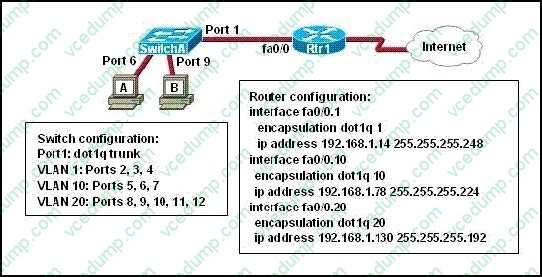
Refer to the exhibit.
A network administrator is adding two new hosts to SwitchA. Which three values could be used for the configuration of these hosts? (Choose three.)
A. host A IP address: 192.168.1.79 B. host A IP address: 192.168.1.64 C. host A default gateway: 192.168.1.78 D. host B IP address: 192.168.1.128 E. host B default gateway: 192.168.1.129 F. host B IP address: 192.168.1.190
A. host A IP address: 192.168.1.79 C. host A default gateway: 192.168.1.78 F. host B IP address: 192.168.1.190
It's a "router-on-a-stick" configuration. Which means each host in the VLAN must corresponds with the VLAN configured on the sub-interfaces. VLAN 10 is configured on fa0/0.10 and VLAN 20 on fa0/0.20. So each hosts in VLAN 10 must use
fa0/0.10 IP address as their default gateway, each hosts must also be in the same subnet as fa0/0.10 IP ?same with hosts in VLAN 20. So find out the usable IP addresses on each sub-interfaces ?for 192.168.1.78 /27: 192.168.1.65 ?.94 and
for 192.168.1.130 /26: 192.168.1.128 ?.190.
Host A (using port 6 ?VLAN 10) must use IP 192.168.1.79, default gateway 192.168.1.78.
Host B (using port 9 ?VLAN 20) must use IP 192.168.1.190, default gateway 192.168.1.130.
Question 45:
What are three reasons that an organization with multiple branch offices and roaming users might implement a Cisco VPN solution instead of point-to-point WAN links? (Choose three.)
A. reduced cost B. better throughput C. broadband incompatibility D. increased security E. scalability F. reduced latency
A. reduced cost D. increased security E. scalability
IPsec offer a number of advantages over point to point WAN links, particularly when multiple locations are involved. These include reduced cost, increased security since all traffic is encrypted, and increased scalability as s single WAN link can be used to connect to all locations in a VPN, where as a point to point link would need to be provisioned to each location.
Question 46:
Refer to the exhibit.
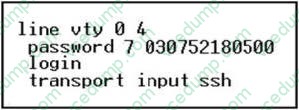
What is the effect of the configuration that is shown?
A. It configures SSH globally for all logins. B. It tells the router or switch to try to establish an SSh connection first and if that fails to use Telnet. C. It configures the virtual terminal lines with the password 030752180500. D. It configures a Cisco network device to use the SSH protocol on incoming communications via the virtual terminal ports. E. It allows seven failed login attempts before the VTY lines are temporarily shutdown.
D. It configures a Cisco network device to use the SSH protocol on incoming communications via the virtual terminal ports.
Secure Shell (SSH) is a protocol which provides a secure remote access connection to network devices. Communication between the client and server is encrypted in both SSH version 1 and SSH version 2. If you want to prevent non-SSH connections, add the "transport input ssh" command under the lines to limit the router to SSH connections only. Straight (non-SSH) Telnets are refused.
Which of the following correctly describe steps in the OSI data encapsulation process? (Choose two.)
A. The transport layer divides a data stream into segments and may add reliability and flow control information. B. The data link layer adds physical source and destination addresses and an FCS to the segment. C. Packets are created when the network layer encapsulates a frame with source and destination host addresses and protocol-related control information. D. Packets are created when the network layer adds Layer 3 addresses and control information to a segment. E. The presentation layer translates bits into voltages for transmission across the physical link.
A. The transport layer divides a data stream into segments and may add reliability and flow control information. D. Packets are created when the network layer adds Layer 3 addresses and control information to a segment.
The transport layer segments data into smaller pieces for transport. Each segment is assigned a sequence number, so that the receiving device can reassemble the data on arrival.
The transport layer also use flow control to maximize the transfer rate while minimizing the requirements to retransmit. For example, in TCP, basic flow control is implemented by acknowledgment by the receiver of the receipt of data; the
sender waits for this acknowledgment before sending the next part.
The Network layer (Layer 3) has two key responsibilities. First, this layer controls the logical addressing of devices. Second, the network layer determines the best path to a particular destination network, and routes the data appropriately.
Question 48:
SIMULATION
A corporation wants to add security to its network. The requirements are:
Host B should be able to use a web browser (HTTP) to access the Finance Web Server.
Other types of access from host B to the Finance Web Server should be blocked.
All access from hosts in the Core or local LAN to the Finance Web Server should be blocked.
All hosts in the Core and on local LAN should be able to access the Public Web Server.
You have been tasked to create and apply a numbered access list to a single outbound interface. This access list can contain no more than three statements that meet these requirements.
Access to the router CLI can be gained by clicking on the appropriate host.
All passwords have been temporarily set to “cisco”.
The Core connection uses an IP address of 198.18.132.65.
The computers in the Hosts LAN have been assigned addresses of 192.168.201.1 – 192.168.201.254.
-
host A 192.168.201.1
-
host B 192.168.201.2
-
host C 192.168.201.3
-
host D 192.168.201.4
The Finance Web Server has been assigned an address of 172.22.237.17.
The Public Web Server in the Server LAN has been assigned an address of 172.22.237.18.
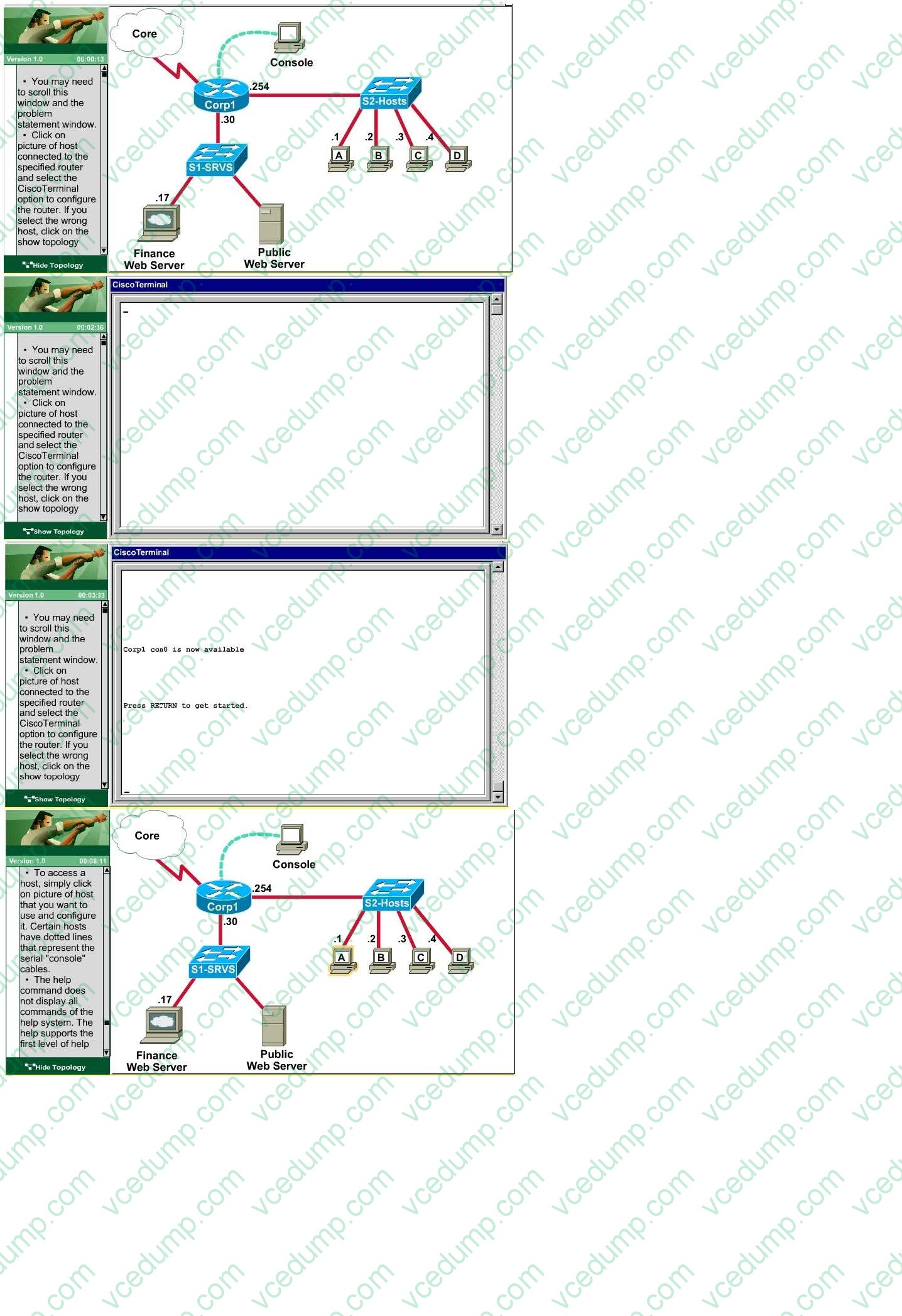
From this, we know that the servers are located on the fa0/1 interface, so we will place our numbered access list here in the outbound direction.
We should create an access-list and apply it to the interface that is connected to the Server LAN because it can filter out traffic from both S2 and Core networks. To see which interface this is, use the “show ip interface brief” command:
Corp1#configure terminal
Our access-list needs to allow host B – 192.168125.2 to the Finance Web Server 172.22.109.17 via HTTP (port 80), so our first line is this:
Then, our next two instructions are these:
Other types of access from host B to the Finance Web Server should be blocked.
All access from hosts in the Core or local LAN to the Finance Web Server should be blocked.
This can be accomplished with one command (which we need to do as our ACL needs to be no more than 3 lines long), blocking all other access to the finance web server:
Corp1(config)#access-list 100 deny ip any host 172.22.109.17
Our last instruction is to allow all hosts in the Core and on the local LAN access to the Public Web Server (172.22.109.18)
Corp1(config)#access-list 100 permit ip host 172.22.109.18 any
Finally, apply this access-list to Fa0/1 interface (outbound direction)
Corp1(config)#interface fa0/1Corp1(config-if)#ip access-group 100 out
Notice: We have to apply the access-list to Fa0/1 interface (not Fa0/0 interface) so that the access-list can filter traffic coming from both the LAN and the Core networks.
To verify, just click on host B to open its web browser. In the address box type http://172.22.109.17 to check if you are allowed to access Finance Web Server or not. If your configuration is correct then you can access it.
Click on other hosts (A, C and D) and check to make sure you can't access Finance Web Server from these hosts. Then, repeat to make sure they can reach the public server at 172.22.109.18. Finally, save the configuration
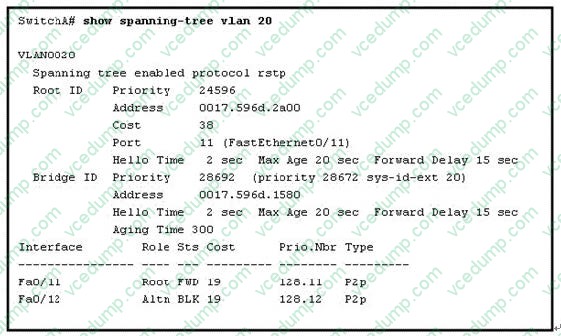
A. The Fa0/11 role confirms that SwitchA is the root bridge for VLAN 20. B. VLAN 20 is running the Per VLAN Spanning Tree Protocol. C. The MAC address of the root bridge is 0017.596d.1580. D. SwitchA is not the root bridge, because not all of the interface roles are designated.
D. SwitchA is not the root bridge, because not all of the interface roles are designated.
Only non-root bridge can have root port. Fa0/11 is the root port so we can confirm this switch is not the root bridge ->.
From the output we learn this switch is running Rapid STP, not PVST ->.
0017.596d.1580 is the MAC address of this switch, not of the root bridge. The MAC address of the root bridge is 0017.596d.2a00 ->. All of the interface roles of the root bridge are designated. SwitchA has one Root port and 1 Alternative port
so it is not the root bridge.
Question 50:
Refer to the exhibit.
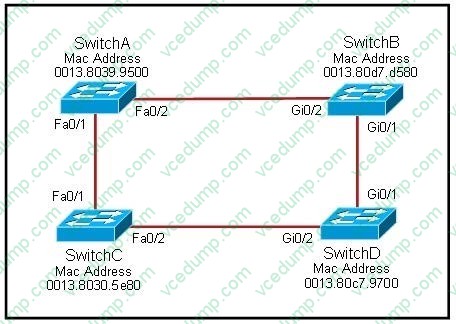
Each of these four switches has been configured with a hostname, as well as being configured to run RSTP. No other configuration changes have been made. Which three of these show the correct RSTP port roles for the indicated switches and interfaces? (Choose three.)
A. SwitchA, Fa0/2, designated B. SwitchA, Fa0/1, root C. SwitchB, Gi0/2, root D. SwitchB, Gi0/1, designated E. SwitchC, Fa0/2, root F. SwitchD, Gi0/2, root
A. SwitchA, Fa0/2, designated B. SwitchA, Fa0/1, root F. SwitchD, Gi0/2, root
The question says "no other configuration changes have been made" so we can understand these switches have the same bridge priority. Switch C has lowest MAC address so it will become root bridge and 2 of its ports (Fa0/1 and Fa0/2) will
be designated ports.
Because SwitchC is the root bridge so the 2 ports nearest SwitchC on SwitchA (Fa0/1) and SwitchD (Gi0/2) will be root ports.
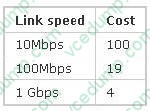
Now we come to the most difficult part of this question: SwitchB must have a root port so which port will it choose? To answer this question we need to know about STP cost and port cost. In general, "cost" is calculated based on bandwidth of
the link. The higher the bandwidth on a link, the lower the value of its cost. Below are the cost values you should memorize:
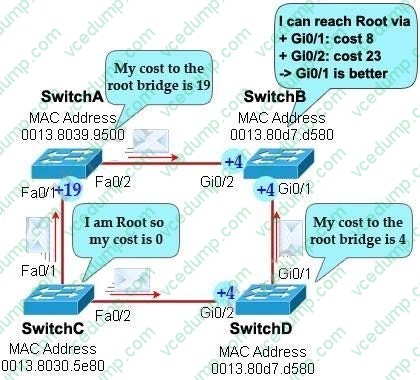
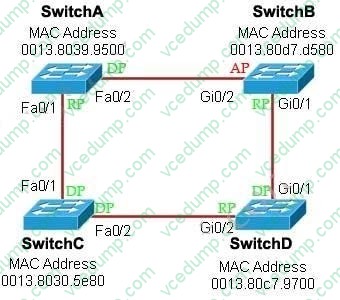
SwitchB will choose the interface with lower cost to the root bridge as the root port so we must calculate the cost on interface Gi0/1 and Gi0/2 of SwitchB to the root bridge. This can be calculated from the "cost to the root bridge" of each switch because a switch always advertises its cost to the root bridge in its BPDU. The receiving switch will add its local port cost value to the cost in the BPDU. One more thing to notice is that a root bridge always advertises the cost to the root bridge (itself) with an initial value of 0. Now let's have a look at the topology again SwitchC advertises its cost to the root bridge with a value of 0. Switch D adds 4 (the cost value of 1Gbps link) and advertises this value (4) to SwitchB. SwitchB adds another 4 and learns that it can reach SwitchC via Gi0/1 port with a total cost of 8. The same process happens for SwitchA and SwitchB learns that it can reach SwitchC via Gi0/2 with a total cost of 23 -> Switch B chooses Gi0/1 as its root port ->. Now our last task is to identify the port roles of the ports between SwitchA and SwitchB. It is rather easy as the MAC address of SwitchA is lower than that of SwitchB so Fa0/2 of SwitchA will be designated port while Gi0/2 of SwitchB will be alternative port.
Below summaries all the port roles of these switches:
Nowadays, the certification exams become more and more important and required by more and more
enterprises when applying for a job. But how to prepare for the exam effectively? How to prepare
for the exam in a short time with less efforts? How to get a ideal result and how to find the
most reliable resources? Here on Vcedump.com, you will find all the answers.
Vcedump.com provide not only Cisco exam questions,
answers and explanations but also complete assistance on your exam preparation and certification
application. If you are confused on your 640-802 exam preparations
and Cisco certification application, do not hesitate to visit our
Vcedump.com to find your solutions here.