4A0-107 Exam Details
-
Exam Code
:4A0-107 -
Exam Name
:Nokia Quality of Service -
Certification
:Nokia Certifications -
Vendor
:Nokia -
Total Questions
:212 Q&As -
Last Updated
:Jul 11, 2026
Nokia 4A0-107 Online Questions & Answers
-
Question 151:
Which of the following are categories of forwarding classes on the Nokia 7750 SR? (Choose two)
A. Real-time
B. Assured
C. Non-conforming
D. High priority
E. In-profile -
Question 152:
When deploying a Nokia MPLS network with QoS, how are the EXP bits set?
A. The first 3 bits of the DSCP value are copied directly into the EXP field on the first network egress.
B. The EXP bits are set on the first network egress, based on a combination of the SAP-ingress classification and the network policy applied.
C. The 3 priority bits are copied directly from the dot1p header into the EXP field of the first MPLS header.
D. The EXP bits are set based on a default map that translates DSCP codes into internal forwarding classes on SAP-ingress. -
Question 153:
According to the SAP-egress policy configured and applied, which queue will forwarding class AF's traffic use?
A. Policer 2 on the queue-group Q-Group1 instance 1.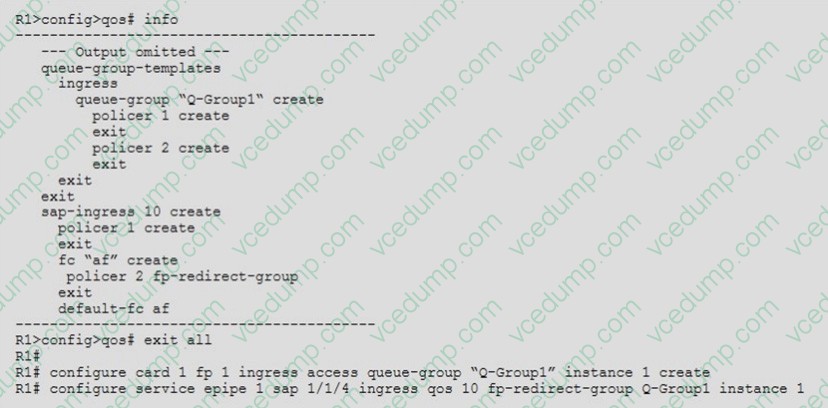
B. Policer 1 on the queue-group Q-Group1 instance 1.
C. The default policer 1.
D. AF traffic is dropped. -
Question 154:
A hierarchical scheduler policy with the shown parameters is configured at a service ingress. If the offered rate of each queue is 10Mbps, what is the operational PIR and CIR for queue 3?
A. PIR = 5 Mbps, CIR = 0 Mbps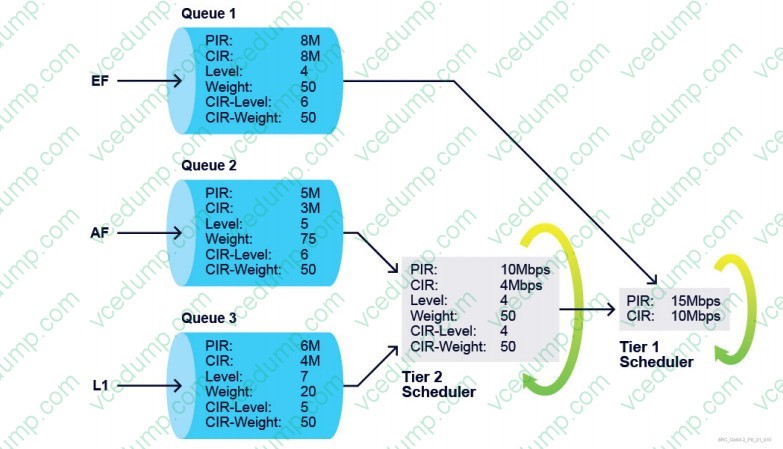
B. PIR= 4 Mbps, CIR = 1 Mbps
C. PIR= 6 Mbps, CIR = 4 Mbps
D. PIR= 6 Mbps, CIR = 1 Mbps -
Question 155:
Which of the following is an example of something that CAN be done with hierarchical policing (CFHP) but CANNOT be done with standalone policers?
A. Limiting the maximum forwarding rate of each individual policer and, at the same time, marking, packets as in-profile or out-of-profile.
B. Putting packets in a buffer as they are received, and marking packets as in-profile or out-of-profile as they are removed from the buffer.
C. Rate-limiting the collective output of several policers, and to reallocate bandwidth that is not utilized by some policers to other policers that need to use it.
D. Rate-limiting the collective output of several policers towards each egress FFPC, while maintaining control of the maximum overall forwarding rate. -
Question 156:
On a Nokia IOM 3, how is buffer memory allocated per forwarding complex?
A. 512 MB ingress, 512 MB egress
B. 256 MB ingress, 256 MB egress
C. 1 GB dynamically allocated between ingress and egress.
D. 768 MB dynamically allocated between ingress and egress.
E. 768 MB, with a minimum of 256 MB ingress and egress, and an additional 256 MB dynamically allocated. -
Question 157:
Which of the following statements about marking packets is TRUE?
A. Packets corresponding to a layer-2 service can be pre-marked on SAP-ingress.
B. Packets corresponding to a layer-2 service can be pre-marked on network-ingress.
C. Packets corresponding to a layer-3 service can be pre-marked on SAP-ingress.
D. Packets corresponding to a layer-3 service can be pre-marked on network-ingress. -
Question 158:
Which of the following are characteristics of DSCP? (Choose two)
A. DSCP is part of the Layer 3 header.
B. DSCP is a 6-bit field.
C. DSCP specifies eight different priorities.
D. DSCP specifies four precedence levels.
E. DSCP is part of the Layer 2 header
F. DSCP specifies 128 different per-hop behaviors. -
Question 159:
Click the exhibit button below. Given the SAP-ingress policy, which of the following statements are FALSE? (Choose three)
A. Queue 5 is using priority mode.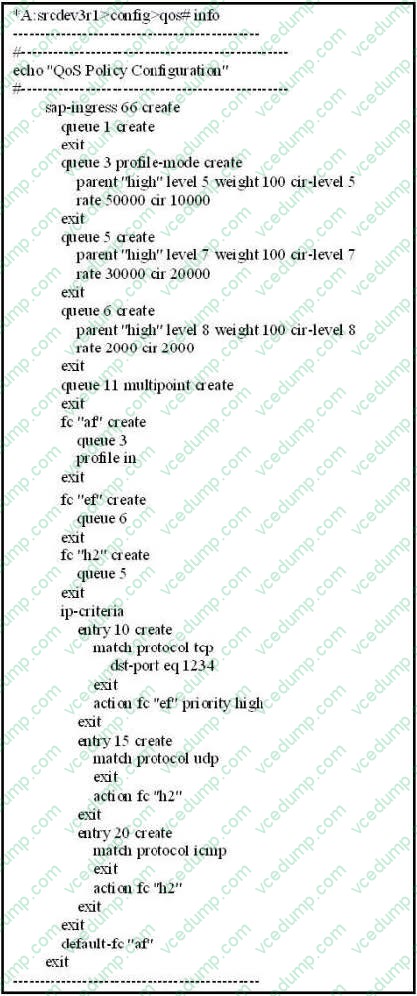
B. UDP traffic can be serviced at a maximum rate of 20 Mbps.
C. Ping traffic is place in queue 5.
D. Queues 5 and 6 will receive equal portions of any remaining available bandwidth to meet their above-CIR bandwidth requirements.
E. Queue 3 is scheduled before queue 5. -
Question 160:
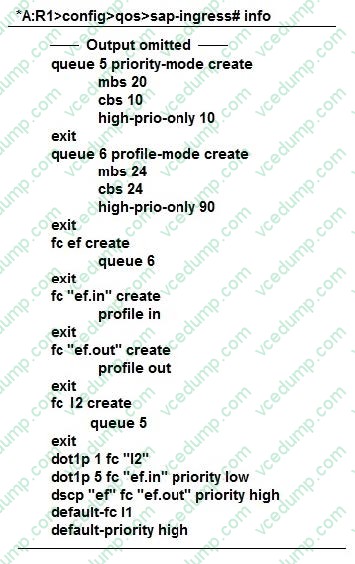
According to the SAP-ingress QoS policy shown, what is the maximum amount of memory that queue 5 can use from the shared buffer pool?
A. 1 kilobyte
B. 2 kilobytes
C. 10 kilobytes
D. 20 kilobytes
Related Exams:
-
4A0-100
Nokia IP Networks and Services Fundamentals -
4A0-101
Nokia Interior Routing Protocols -
4A0-102
Nokia Border Gateway Protocol for Internet Routing -
4A0-103
Nokia Multiprotocol Label Switching -
4A0-104
Nokia Services Architecture -
4A0-105
Nokia Virtual Private LAN Services -
4A0-106
Nokia Virtual Private Routed Networks -
4A0-107
Nokia Quality of Service -
4A0-108
Nokia Multicast Protocols -
4A0-109
Alcatel-Lucent Triple Play Services
Tips on How to Prepare for the Exams
Nowadays, the certification exams become more and more important and required by more and more enterprises when applying for a job. But how to prepare for the exam effectively? How to prepare for the exam in a short time with less efforts? How to get a ideal result and how to find the most reliable resources? Here on Vcedump.com, you will find all the answers. Vcedump.com provide not only Nokia exam questions, answers and explanations but also complete assistance on your exam preparation and certification application. If you are confused on your 4A0-107 exam preparations and Nokia certification application, do not hesitate to visit our Vcedump.com to find your solutions here.