4A0-107 Exam Details
-
Exam Code
:4A0-107 -
Exam Name
:Nokia Quality of Service -
Certification
:Nokia Certifications -
Vendor
:Nokia -
Total Questions
:212 Q&As -
Last Updated
:Jul 11, 2026
Nokia 4A0-107 Online Questions & Answers
-
Question 121:
WRED can be used to help avoid TCP slow-start synch problems.
A. TRUE
B. FALSE -
Question 122:
A queue-group template can contain both queues and policers when applied under which conditions?
A. When applied at the port level for access ingress.
B. When applied at the FP (Forwarding Pass) level for access ingress.
C. When applied at the FP (Forwarding Pass) level for network ingress.
D. When applied at the port level for network egress. -
Question 123:
Click the exhibit button below. A network operator has configured the SAP-ingress policy below. Ping traffic is expected in queue 3. However, the network operator notices that all traffic is placed in queue 1. What is the most probable reason for this?
A. The default forwarding class for all traffic, including ICMP, is BE, which is placed in queue 1.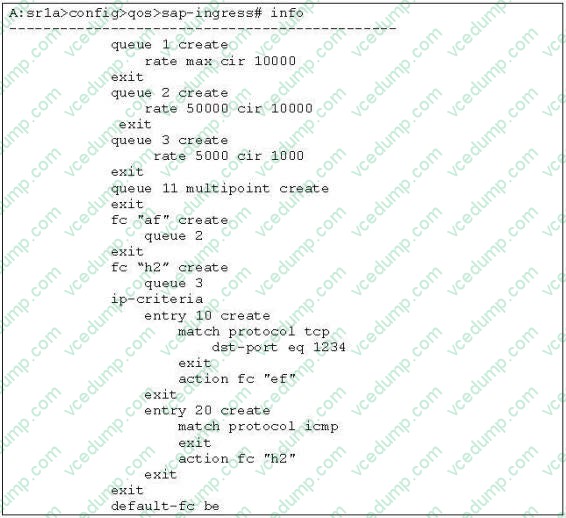
B. The SAP has been shut down.
C. The IP-match criteria has been misconfigured for ICMP traffic.
D. Queue 3 has no rate or CIR configured and thus cannot hold any packets.
E. The SAP-ingress policy has not been applied to the SAP. -
Question 124:
Which of the following statements are TRUE when discussing self-generated traffic QoS? (Choose two)
A. In order to mark Layer 2 traffic, sgt-qos will set various ToS bits.
B. DSCP bits can be set per application, per routing instance.
C. The DSCP marking stays nc1 for all applications. Only the internal FC is manipulated across different applications.
D. In order to mark Layer 2 self-generated traffic, network interfaces must be set to dot1Q.
E. The internal forwarding class for self-generated traffic is set once and applied to the base router and all VPRN instances. -
Question 125:
According to the SAP-ingress QoS policy shown, which of the following statements about packets processed by policer 6 is TRUE?
A. All forwarded packets will be in-profile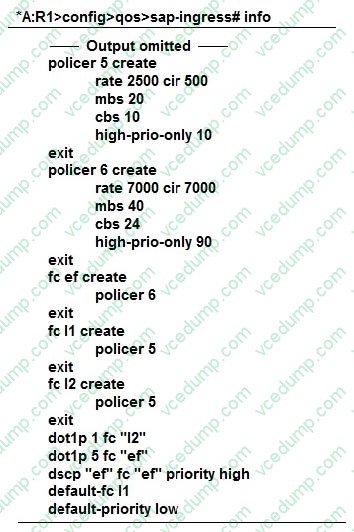
B. Packets forwarded above CIR will be marked out-of-profile and the rest will be in-profile
C. Excess packets that arrive within a burst larger than CBS will be forwarded as out-of-profile
D. All forwarded packets will be out-of-profile -
Question 126:
Click the exhibit button below.
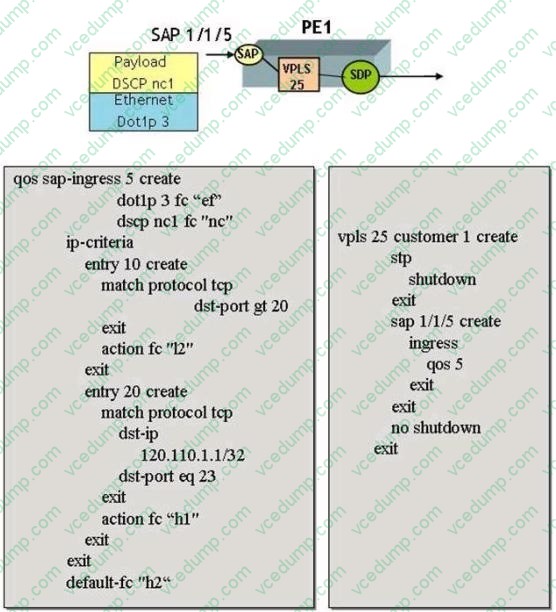
Based on the configuration shown below, name the forwarding class to be associated with a TCP packet encapsulated inside an Ethernet frame that arrives on SAP 1/1/5 with the following characteristics: Destination IP address = 120.110.1.1 TCP port number = 23 DSCP value = nc1 Dot1pvalue = 3
A. H2
B. NC
C. L2
D. EF
E. H1
F. BE -
Question 127:
Which of the following are the minimum requirements needed to classify traffic marked with DSCP AF11, AF12, and AF13 into the AF forwarding class and provide fair treatment to the drop precedence settings? (Choose three)
A. Profile mode queues
B. Priority mode queues
C. 1 queue
D. 3 queues
E. 3 forwarding classes
F. 1 forwarding class, with 2 subclasses
G. 1 forwarding class, with 3 subclasses -
Question 128:
Click the exhibit button below. Given the output of the #show pools 1/2/2 network-egress command on a GigE port, what can the service provider deduce? (Choose two)
A. QoS is not configured on the router.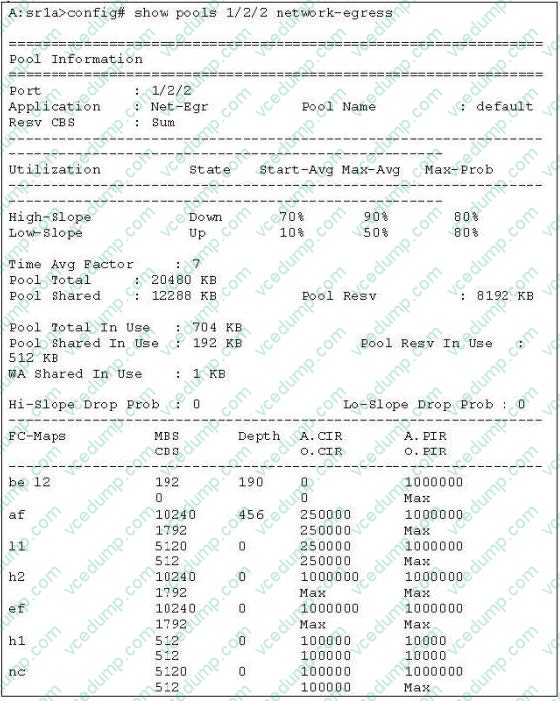
B. Packets in forwarding classes "be" and "12" are being queued.
C. Traffic belonging to forwarding class "ef" is not experiencing queuing delays.
D. Traffic belonging to forwarding class "11 "will never make use of the shared buffer pool.
E. Out-of-profile traffic in the shared buffer pool is being dropped. -
Question 129:
On the Nokia 7750 SR, what is a slope policy used for?
A. Defining the slope of the TCP slow-start mechanism for self generated traffic.
B. Defining the slope of the scheduling rate per forwarding class when using HQoS.
C. Defining the high and low slope values when deploying buffer admission control for UDP traffic in the committed buffer pool.
D. Defining the high and low slope values when deploying buffer admission control for TCP traffic in the shared buffer pool.
E. Defining the high and low slope values when deploying buffer admission control for TCP traffic in the committed buffer pool. -
Question 130:
To implement Hierarchical-QoS (Multi-tiered scheduling), which of the following actions must be undertaken? (Choose three)
A. H-QoS capabilities must be enabled globally on the router
B. A scheduler-policy must be configured.
C. The queues in the SAP-ingress and SAP-egress policies do not require additional configuration attributes to make use of the hierarchical schedulers.
D. The network queue policy must be configured to make use of the scheduler-policy.
E. The scheduler-policy must be referenced in the SAP-ingress and SAP-egress policies.
F. The scheduler-policy must be applied on the service SAP.
Related Exams:
-
4A0-100
Nokia IP Networks and Services Fundamentals -
4A0-101
Nokia Interior Routing Protocols -
4A0-102
Nokia Border Gateway Protocol for Internet Routing -
4A0-103
Nokia Multiprotocol Label Switching -
4A0-104
Nokia Services Architecture -
4A0-105
Nokia Virtual Private LAN Services -
4A0-106
Nokia Virtual Private Routed Networks -
4A0-107
Nokia Quality of Service -
4A0-108
Nokia Multicast Protocols -
4A0-109
Alcatel-Lucent Triple Play Services
Tips on How to Prepare for the Exams
Nowadays, the certification exams become more and more important and required by more and more enterprises when applying for a job. But how to prepare for the exam effectively? How to prepare for the exam in a short time with less efforts? How to get a ideal result and how to find the most reliable resources? Here on Vcedump.com, you will find all the answers. Vcedump.com provide not only Nokia exam questions, answers and explanations but also complete assistance on your exam preparation and certification application. If you are confused on your 4A0-107 exam preparations and Nokia certification application, do not hesitate to visit our Vcedump.com to find your solutions here.