4A0-104 Exam Details
-
Exam Code
:4A0-104 -
Exam Name
:Nokia Services Architecture -
Certification
:Nokia Certifications -
Vendor
:Nokia -
Total Questions
:293 Q&As -
Last Updated
:May 30, 2026
Nokia 4A0-104 Online Questions & Answers
-
Question 231:
Which of the following statements best describes the purpose of an MP-BGP in a VPRN?
A. Routes from different customers with the same IPv4 address prefix are treated as equivalents by MP-BGP.
B. Nokia 7750 SR routers support MP-BGP for VPN label signaling in a VPRN service only if LDP is used for LSP signaling.
C. The multi-protocol nature of MP-BGP allows VPRN routes to be distributed within the provider core network as IPv4 routes.
D. MP-BGP is an enhanced version of BGP that can carry a service label, a tranpot label, and customer route prefixes.
E. None of the above statements describe the use of an MP-BGP in a VPRN.
F. All of the above statements describe the use of an MP-BGP in a VPRN. -
Question 232:
Click on the exhibit button below.
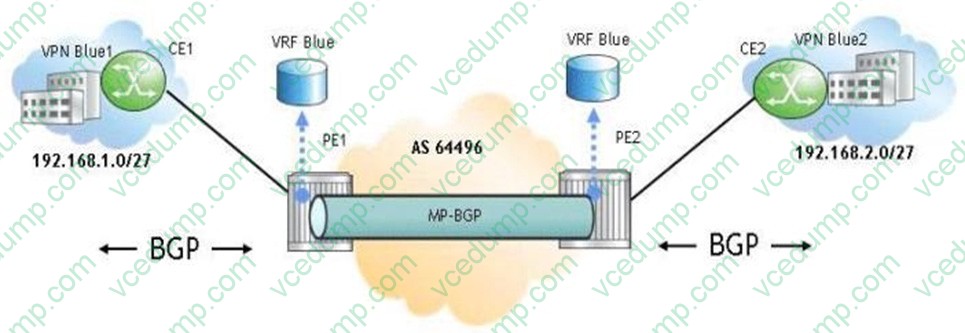
Is a routing policy required on PE1 to advertise a CE1's system interface to PE2?
A. Yes. A routing policy is required to advertise routes between PE routers in a VPRN
B. No. A routing policy is not required; the default behavior on the Nokia 7750 SR is to advertise all VPRN routes between PE routers.
C. A routing policy is required only when BGP is used as the PE-CE routing protocol, as shown in the exhibit.
D. A CE1 system interface can not be advertised to PE2 since the CE routers are not aware of the VPRN. -
Question 233:
Which of the following statements are TRUE about configuring a SDP between an IES and a VPLS? (Choose two.)
A. The SDP must be a mesh
B. The SDP must be a spoke.
C. Once the SDP is configured on both PE routers, both the services will be operationally up without further configuration changes.
D. The Layer 2 MTUs must match between the IES and the VPLS
E. The Layer 2 MTU must be 14 bytes smaller on the VPLS than it is on the IES. -
Question 234:
Click the exhibit.
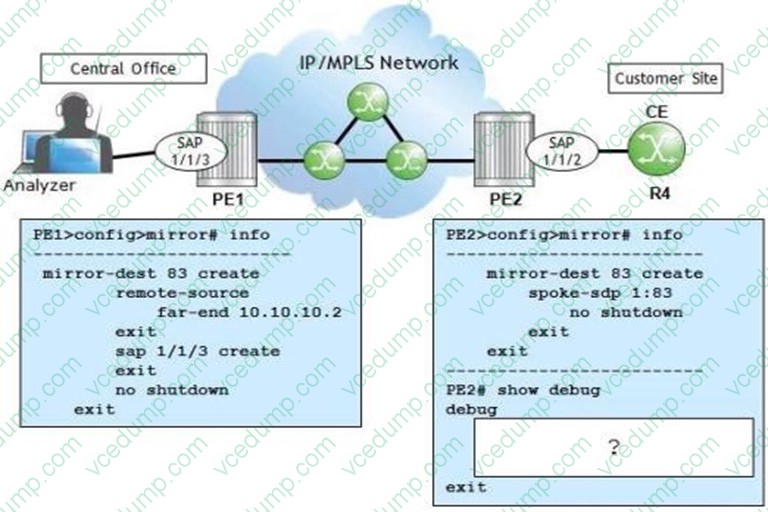
PE1 and PE2 are Nokia 7750 SRs. Which of the following is the missing configuration required on PE2 to complete the mirror?
A. Option A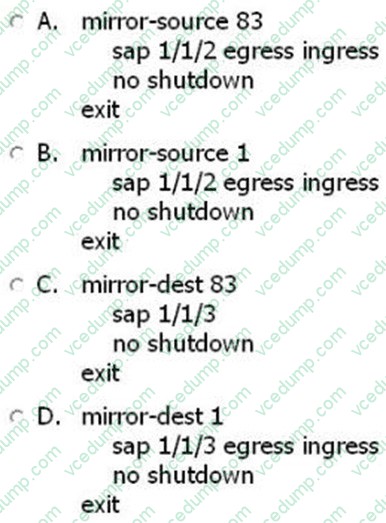
B. Option B
C. Option C
D. Option D -
Question 235:
Which of the following statements are FALSE regarding the VPN-IPv4 address family? (Choose two.)
A. When a PE router receives an IPv4 prefix from its local CE it creates a VPN-IPv4 prefix.
B. The route distinguisher (RD) is appended to the IPv4 prefix to form a 16 byte VPN-IPv4 prefix.
C. VPN-IPv4 allows BGP to distinguish multiple routes with the same prefixes originated from distinct customers
D. VPN-IPv4 addresses are only present within the service provider network.
E. In VPRN, data traffic is carried in VPN-IPv4 packets. -
Question 236:
Which of the following best describes the flooding of traffic on a PE when unknown traffic is received on a SAP of a VPLS?
A. Traffic is flooded to all SAPs in the service.
B. Traffic is flooded to all SAPs and spoke SDPs in the service.
C. Traffic is flooded to all SAPs and mesh SDPs in the service.
D. Traffic is flooded to all SAPs, spoke SDPs, and mesh SDPs in the service.
E. The traffic is not flooded. -
Question 237:
Which of the following comparisons between E-pipes and VPLSes is FALSE?
A. They both function as a Layer 2 switch from the service provider's perspective.
B. They both support SAP encapsulations of null, dot1Q and Q-in-Q.
C. They both use SAPs as the demarcation point between the customer and the provider.
D. MAC addresses are learned by VPLSes, but not by E-pipes. -
Question 238:
What is the minimum Ethernet physical network MTU required for a Layer 2 service on a GRE encapsulated SDP with a service MTU of 1514?
A. 1514
B. 1526
C. 1548
D. 1556
E. 1536 -
Question 239:
Which of the following about VPRN labels is TRUE?
A. The core P routers will swap the service label at each hop.
B. The CE pushes the VPRN service label on to the packet and then forwards it to the ingress PE.
C. The PE swaps the transport label from the CE and then forwards the packet.
D. At the egress PE, the transport and service labels are popped. -
Question 240:
Which of the following best describes an IES?
A. Layer 3 direct Internet access service.
B. Layer 2 point-to-point service.
C. Layer 2 multipoint-to-multipoint service.
D. Layer 3 IP multipoint-to-multipoint VPN service.
Related Exams:
-
4A0-100
Nokia IP Networks and Services Fundamentals -
4A0-101
Nokia Interior Routing Protocols -
4A0-102
Nokia Border Gateway Protocol for Internet Routing -
4A0-103
Nokia Multiprotocol Label Switching -
4A0-104
Nokia Services Architecture -
4A0-105
Nokia Virtual Private LAN Services -
4A0-106
Nokia Virtual Private Routed Networks -
4A0-107
Nokia Quality of Service -
4A0-108
Nokia Multicast Protocols -
4A0-109
Alcatel-Lucent Triple Play Services
Tips on How to Prepare for the Exams
Nowadays, the certification exams become more and more important and required by more and more enterprises when applying for a job. But how to prepare for the exam effectively? How to prepare for the exam in a short time with less efforts? How to get a ideal result and how to find the most reliable resources? Here on Vcedump.com, you will find all the answers. Vcedump.com provide not only Nokia exam questions, answers and explanations but also complete assistance on your exam preparation and certification application. If you are confused on your 4A0-104 exam preparations and Nokia certification application, do not hesitate to visit our Vcedump.com to find your solutions here.