4A0-101 Exam Details
-
Exam Code
:4A0-101 -
Exam Name
:Nokia Interior Routing Protocols -
Certification
:Nokia Certifications -
Vendor
:Nokia -
Total Questions
:315 Q&As -
Last Updated
:May 26, 2026
Nokia 4A0-101 Online Questions & Answers
-
Question 151:
Which of the following describes the method used to resolve an IPv6 address to a MAC address?
A. IPv6 uses the Address Resolution Protocol to resolve the address to a MAC address.
B. A Neighbor Discovery message is sent to the broadcast MAC address. The host with the IPv6 address responds with a Neighbor Advertisement message.
C. A Neighbor Discovery message is sent to the solicited-node multicast address. The host with the IPv6 address responds with a Neighbor Advertisement message.
D. A Neighbor Discovery message is sent to the anycast address for the LAN. The host with the IPv6 address responds with a Neighbor Advertisement message.
E. IPv6 addresses do not need to be resolved to a MAC address. -
Question 152:
What are the three databases maintained by a Link State Protocol?
A. Neighbor, adjacency, route table
B. Neighbor, topology, forwarding
C. Topology, routing, forwarding
D. There are only two databases: adjacency and topology -
Question 153:
An operator configures an Alcatel-Lucent 7750 SR with a loopback interface and IPv6 address. The operator then configures a routing policy to redistribute the loopback prefix into OSPFv3. What type of LSA is used to advertise the route to other OSPFv3 routers in the same area?
A. Router LSA
B. AS External LSA
C. Intra-Area Prefix LSA
D. Inter-Area Prefix LSA
E. Network LSA
F. None of the statements are correct. -
Question 154:
Which of the following statements regarding OSPF routing updates on a multi-access network segment is true?
A. In multi-access networks, a DR and BDR are elected only if there are more than two routers connected to the network segment.
B. In multi-access networks, a DR and BDR are elected only if the subnet masks on the router interfaces are less than /30
C. In multi-access networks, a DR and BDR are elected. To ensure resiliency, both the DR and BDR send link-state advertisements describing the network.
D. In multi-access networks, a DR and BDR are elected. The DR sends link-state advertisements describing the network. -
Question 155:
Click on the exhibit.
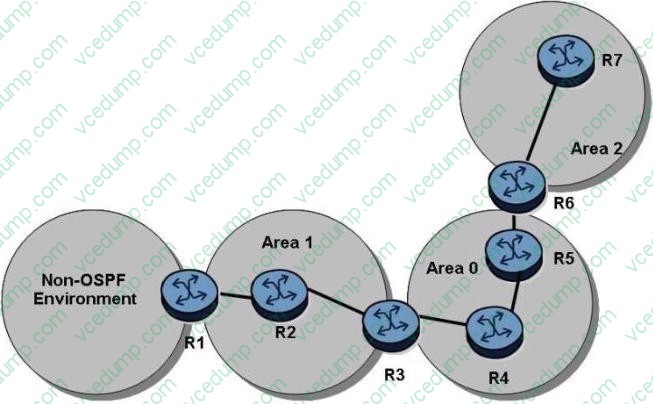
In the topology shown, router R1 is an ASBR configured to export external routes to OSPF. Assuming that there are no stub or NSSA networks, which of the following regarding LSAs is TRUE?
A. Only router R1 will generate Type 4 LSAs.
B. Only router R3 will generate Type 4 LSAs.
C. Routers R3 and R6 will generate Type 4 LSAs.
D. Routers R1.R3 and R6 will generate Type 4 LSAs. -
Question 156:
Which of the following statements regarding IS-IS Hello packets are true? Choose two answers.
A. Different types of Hello packets are exchanged on point-to-point networks than on broadcast networks.
B. L1/L2 Hello packets are exchanged on broadcast links.
C. Different L1 and L2 Hello packets are exchanged on broadcast links.
D. By default, Hello packets are sent every 5 seconds, and the timeout to declare a neighbor down is 15 seconds. -
Question 157:
Which of the following is FALSE about the databases used by a link-state routing protocol in a single area routing domain?
A. The link-state database has local topology information from all the routers.
B. The adjacency database contains all the links between all the routers.
C. The forwarding database contains the next hop for all known prefixes.
D. The link-state database is the same for all routers. -
Question 158:
In IS-IS, which of the following regarding an L1/L2 router is FALSE?
A. An L1/L2 router can have adjacencies with routers in different areas.
B. An L1/L2 router calculates separate SPF trees for the Level 1 and Level 2 topology.
C. An L1/L2 router advertises its L2 routes to other L1 routers in the same area.
D. An L1/L2 router sets the ATT bit in L1 LSPs to indicate that it has routes to other areas. -
Question 159:
Click on the exhibit.
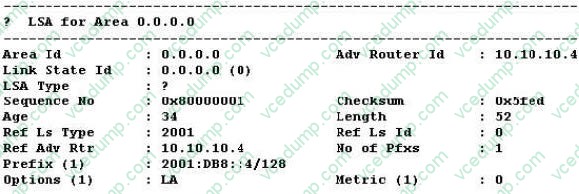
What type of OSPFv3 LSA is shown?
A. Router LSA
B. Network LSA
C. Intra-Area Prefix LSA
D. Link LSA -
Question 160:
What is the value of the protocol discriminator used to denote IS-IS protocol information?
A. 89
B. 87
C. 85
D. 83
Related Exams:
-
4A0-100
Nokia IP Networks and Services Fundamentals -
4A0-101
Nokia Interior Routing Protocols -
4A0-102
Nokia Border Gateway Protocol for Internet Routing -
4A0-103
Nokia Multiprotocol Label Switching -
4A0-104
Nokia Services Architecture -
4A0-105
Nokia Virtual Private LAN Services -
4A0-106
Nokia Virtual Private Routed Networks -
4A0-107
Nokia Quality of Service -
4A0-108
Nokia Multicast Protocols -
4A0-109
Alcatel-Lucent Triple Play Services
Tips on How to Prepare for the Exams
Nowadays, the certification exams become more and more important and required by more and more enterprises when applying for a job. But how to prepare for the exam effectively? How to prepare for the exam in a short time with less efforts? How to get a ideal result and how to find the most reliable resources? Here on Vcedump.com, you will find all the answers. Vcedump.com provide not only Nokia exam questions, answers and explanations but also complete assistance on your exam preparation and certification application. If you are confused on your 4A0-101 exam preparations and Nokia certification application, do not hesitate to visit our Vcedump.com to find your solutions here.