400-201 Exam Details
-
Exam Code
:400-201 -
Exam Name
:CCIE Service Provider Written -
Certification
:Cisco Certifications -
Vendor
:Cisco -
Total Questions
:920 Q&As -
Last Updated
:Dec 14, 2021
Cisco 400-201 Online Questions & Answers
-
Question 671:
What are the three operating modes of HDLC? (Choose three.)
A. Normal Peer Mode
B. Asynchronous Balanced Mode
C. Asynchronous Client Mode
D. Normal Response Mode
E. Asynchronous Response Mode
F. Normal Balanced Mode -
Question 672:
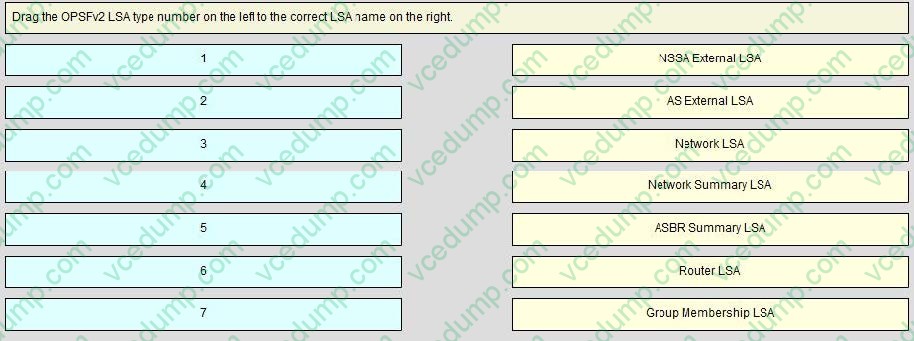
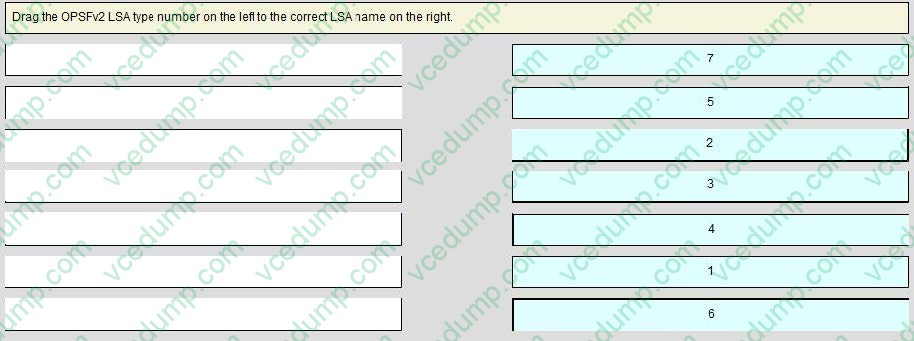
Drag the OSPFv2 LAS type number on the left to the correct lSA name on the right.
Select and Place:
-
Question 673:
When the default MDT is configured, a multicast tunnel interface is created dynamically.
Which statement about MTI is true?
A. The MTI takes on the interface characteristics of same interface.
B. The MTI is the interface that connects the PE multicast environment to the service provider global environment.
C. The MTI is the interface that connects the customer multicast environment to the service provider global environment.
D. Unicast packets are forwarded over the MTI because this interface does not appear in the unicast routing table of the associated VRF. -
Question 674:
Refer to the exhibit.
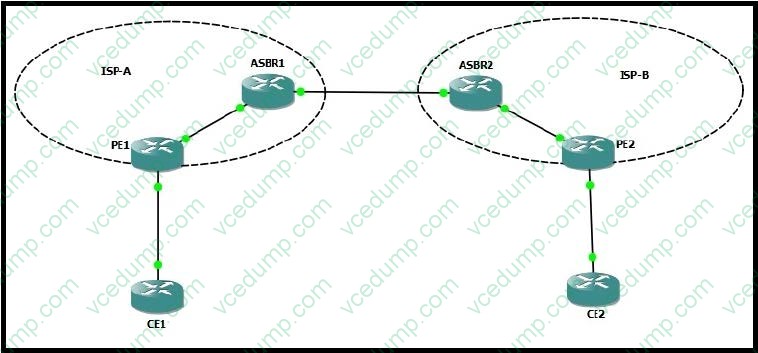
Customer ABC uses RFC 1918 addresses within its network. Customer ABC wants the Internet access for all the branch offices to transit through the head office for security and NAT purposes. The PE routers in the service provider network contain Internet routes in the global routing table. Which option describes the router or routers that should be configured to accomplish the administrative goal of the customer?
A. all the PE routers and the P router
B. both PE2 and PE3 routers
C. only the PE1 router
D. only the P router -
Question 675:
Refer to the exhibit. Which statement about this scenario is true?
A. NetFlow records originating AS numbers, not peer AS numbers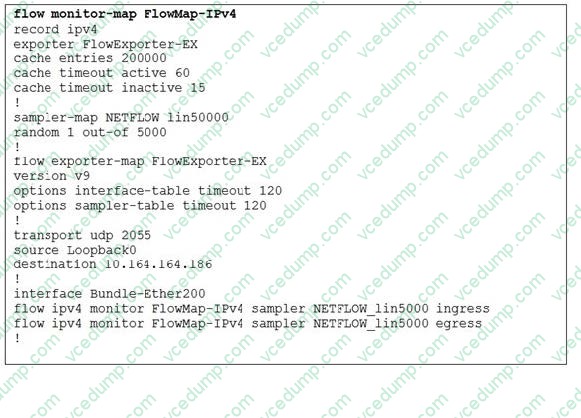
B. NetFlow provides jitter information to other destinations
C. NetFlow captures only native IPv4 and Ipv6 packets, not MPLS labeled packets
D. NetFlow captures only the first 5000 packets and nothing else until the interface is reset
E. NetFlow captures native IPv4 packets and MPLS labeled packets -
Question 676:
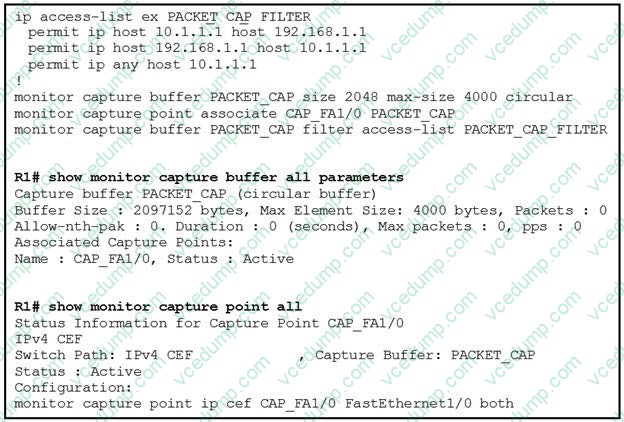
Refer to the exhibit. Ping is successful from R1 with source IP 10.1.1.1 to the destination 192.168.1.1. It is routed via the Fast Ethernet 1/0 interface. It is noticed that the ICMP echo request packets are not logged to the captured file. Which issue is possible?
A. Capture from Fast 1/0 interface are only for inbound traffic.
B. The access list PACKET_CAP_FILTER has no match.
C. These ping packets are process switched.
D. Capture point CAP_FA1/0 is inactive. -
Question 677:
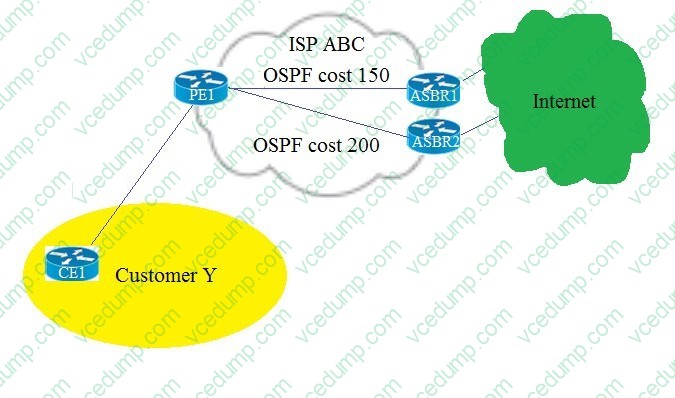
Refer to the exhibit.
Customer Y reported that Internet traffic stopped working for a few minutes. The ISP ABC operations engineer identified that this occurred when ASBR1 router reloaded and OSPF converged faster than BGP. Which command prevents this
from happening?
A. max-metric router-lsa on-startup 300
B. bfd min_rx 100 max_rx 100 multiplier 3
C. graceful restart
D. set-overload-bit on-startup wait-for-bgp -
Question 678:
Which IOS features are used to avoid Routing loops when dynamic Routing protocols are used between PE and CE in MPLS-VPN networks? (Choose two)
A. BGP cost community
B. BGP feature allow-as in
C. Access-list Control in Distance Vector protocol like RIP and EIGRP.
D. SHAM links with OSPF
E. RPF Reverse Path forwarding.
F. Site Of Origin SOO. -
Question 679:
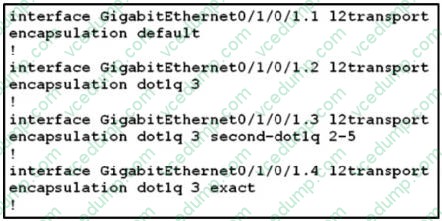
Refer to the exhibit. Which subinterface receives the QinQ frame with an outer VLAN tag 2 and inner tag 3 and 4?
A. GigabitEthernet0/1/0/1.3
B. GigabitEthernet0/1/0/1.1
C. GigabitEthernet0/1/0/1.4
D. GigabitEthernet0/1/0/1.2 -
Question 680:
Which main difference between lean core and hollow core architectures is true?
A. The hollow core model defines two models of operation peering and overlay. The lean core model adapts only the peering operation.
B. Hollow core addresses challenges associated with isolated packet, optical TDM, and DWDM layer control planes. Lean core ignores these challenges.
C. In the lean core model, switches create a dense mesh of circuits between each of the edge and peering nodes. The hollow core model uses less-sophisticated NPUs.
D. Hollow core uses a transport switching function, whereas lean core adapts full IP architectures by using MPLS to forward subscriber traffic instead of IP.
Related Exams:
-
300-745
Designing Cisco Security Infrastructure (300-745 SDSI) v1.0 -
350-101
Implementing and Operating Cisco Wireless Core Technologies (350-101 WLCOR)v1.0 -
352-011
Cisco Certified Design Expert Practical -
500-052
Cisco Unified Contact Center Express -
500-173
Designing the FlexPod Solution (FPDESIGN) -
500-201
Deploying Cisco Service Provider Mobile Backhaul Solutions -
500-210
SP Optical Technology Field Engineer Representative -
500-220
Engineering Cisco Meraki Solutions (ECMS) v2.2 -
500-230
Cisco Service Provider Routing Field Engineer -
500-240
Cisco Mobile Backhaul for Field Engineers
Tips on How to Prepare for the Exams
Nowadays, the certification exams become more and more important and required by more and more enterprises when applying for a job. But how to prepare for the exam effectively? How to prepare for the exam in a short time with less efforts? How to get a ideal result and how to find the most reliable resources? Here on Vcedump.com, you will find all the answers. Vcedump.com provide not only Cisco exam questions, answers and explanations but also complete assistance on your exam preparation and certification application. If you are confused on your 400-201 exam preparations and Cisco certification application, do not hesitate to visit our Vcedump.com to find your solutions here.