3V0-25.25 Exam Details
-
Exam Code
:3V0-25.25 -
Exam Name
:VMware Certified Advanced Professional - VMware Cloud Foundation 9.0 Networking -
Certification
:VMware Certifications -
Vendor
:VMware -
Total Questions
:70 Q&As -
Last Updated
:Jul 14, 2026
VMware 3V0-25.25 Online Questions & Answers
-
Question 51:
An architect is designing a VMware Cloud Foundation (VCF) solution.
The following information was gathered during the assessment phase:
- There is a critical application used by the Finance Team.
- The critical application has an availability and recoverability SLA of 99.999%.
- The critical application is sensitive to network changes.
Which two configurations should the architect include in their design? (Choose two.)
A. Configure multiple static routes on Tier-1 gateway.
B. Configure Tier-0 gateway for eBGP and ECMP.
C. Enable BFD on the Tier-0 gateway.
D. Configure Tier-1 gateway for eBGP and ECMP.
E. Install and configure hosts with 100Gbps physical NICs. -
Question 52:
DRAG DROP
An administrator is responsible for a VMware Cloud Foundation (VCF) Private Cloud. The administrator has been tasked with identifying why there is no data ingress into a workload domain.
The workload domain has been configured with:
1. A dedicated NSX Edge Cluster.
2. A Tier 0 gateway.
3. A Tier-1 gateway that is configured for Distributed Routing only..
An NSX segment where a test virtual machine is located.
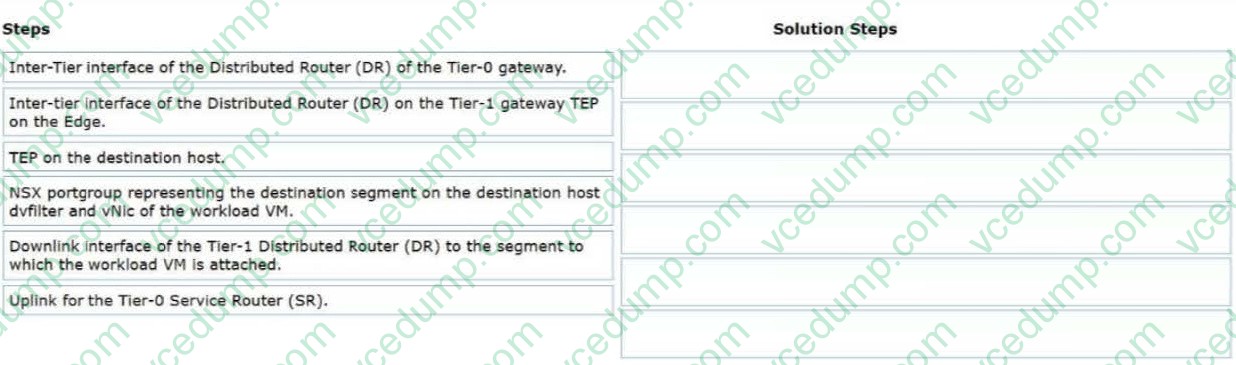
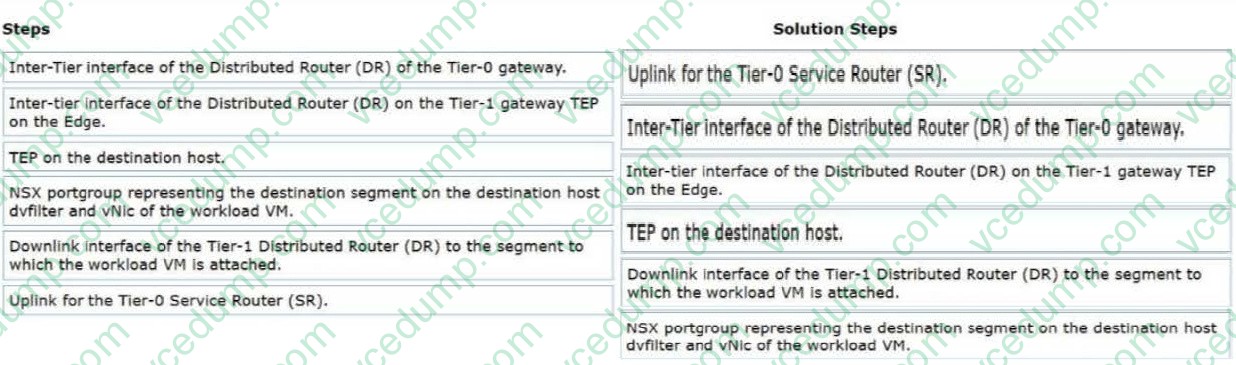
As part of the exercise, the administrator must map the traffic flow for data ingress into the workload domain to identify the steps that external network traffic will take to ingress into the workload domain and reach the virtual machine.
Drag and drop the six steps from the Steps list on the right and place them in order in the Solution Steps. (Choose six.)
Select and Place:
-
Question 53:
An administrator is troubleshooting a new Tier-0 gateway peering with an upstream router. Interface reachability is present, but the dynamic routing adjacency never establishes after both sides were configured independently.
Which configuration area is most likely to require comparison on both peers?
A. BGP neighbor settings such as autonomous system values and peer parameters
B. The display name of the NSX segment attached to the workloads
C. The display name of the Tier-1 gateway connected to the workload segment
D. The number of logical segments behind the Tier-1 gateway -
Question 54:
When using a DHCP Relay on a segment, which design restriction must be considered?
A. DHCP settings, DHCP options, and static bindings cannot be configured on the segment.
B. DHCP client requests cannot be relayed to the external DHCP servers.
C. DHCP settings, DHCP options, and static bindings can be configured on the segment.
D. DHCP Relay service is available to all the other segments in the network. -
Question 55:
During a design review, the administrator is asked to explain which underlying technology enables the NSX Edge to perform fast packet processing and achieve near line-rate performance for Virtual Network Functions (VNFs).
Which technology is leveraged in the NSX Edge for fast packet processing?
A. Data Plane Development Kit (DPDK)
B. AMD Power Now
C. Non-Uniform Memory Access (NUMA)
D. Intel Speed Step -
Question 56:
In an NSX environment, an administrator is observing low throughput and intermittent congestion between the Tier-0 Gateway and the upstream physical routers. The environment was designed for high availability and load balancing, using two Edge Nodes deployed in Active/Active mode. The administrator enables ECMP on the Tier-0 gateway, but the issues persist.
Which action would address low throughput and congestion?
A. Convert Tier-1 gateways to be edgeless.
B. Disable NAT on the Tier-0 gateway.
C. Add an additional vNIC to the NSX Edge node.
D. Deploy additional Edge nodes. -
Question 57:
A large multinational corporation is seeking proposals for the modernization of a Private Cloud environment.
The proposed solution must meet the following requirements:
- Support multiple data centers located in different geographic regions.
- Provide a secure and scalable solution that ensures seamless connectivity between data centers and different departments.
Which three NSX features or capabilities must be included in the proposed solution? (Choose three.)
A. NSX Edge
B. AVI Load Balancer
C. vDefend
D. Virtual Private Cloud (VPC)
E. Centralized Network Connectivity
F. NSX L2 Bridging -
Question 58:
An administrator has deployed a workload domain in VMware Cloud Foundation (VCF). The workload domain was deployed with NSX managers using the XL form factor. After deployment, the administrator realizes the NSX manager is oversized and needs to change to a smaller form factor.
What should the administrator do to accomplish this task?
A. Each NSX Manager must be redeployed.
B. Each NSX manager must be resized using the API.
C. Each NSX manager must be resized through vCenter.
D. Each NSX manager must be rightsized using VCF Operations. -
Question 59:
An architect has just deployed a new NSX Edge cluster in a VMware Cloud Foundation (VCF) fleet.
The BGP peer between the NSX Tier-0 gateway and the top-of-rack routers is successfully up and stable.
- BGP Connection is established, but the NSX Tier-0 is not receiving a default route from the top-of-rack routers.
- Workloads inside NSX have no Internet access.
What could be the solution?
A. Tier-0 gateway community settings are missing on the top-of-rack router configuration.
B. The top-of-rack router receives a default route from Tier-0 gateway.
C. Tier-0 gateway has a limit set too low for how many routes it can accept.
D. There is no default route configured on the top-of-rack router for the Tier-0 gateway. -
Question 60:
A cloud service provider runs VPCs with differing traffic patterns:
- Some VPCs are generating high, large North/South flows.
- Most of the VPCs generate very little traffic.
The architect needs to optimize Edge dataplane resource consumption while ensuring that noisyVPCs do not impact others.
Which optimization satisfies the requirement?
A. Assign one dedicated Edge node per high-traffic VPC.
B. Reduce the number of VPCs by consolidating VPCs into shared namespaces.
C. Convert high-traffic VPCs into VLAN-backed segments attached directly to Tier-0 gateways.
D. Use multiple Edge clusters and distribute VRF-backed VPCs based on traffic profiles.
Related Exams:
-
1V0-21.20
Associate VMware Data Center Virtualization -
1V0-31.21
Associate VMware Cloud Management and Automation -
1V0-41.20
Associate VMware Network Virtualization -
1V0-61.21
Associate VMware Digital Workspace -
1V0-71.21
Associate VMware Application Modernization -
1V0-81.20
Associate VMware Security -
2V0-11.24
VMware Cloud Foundation 5.2 Administrator -
2V0-11.25
VMware Cloud Foundation 5.2 Administrator -
2V0-13.24
VMware Cloud Foundation 5.2 Architect -
2V0-13.25
VMware Cloud Foundation 9.0 Architect
Tips on How to Prepare for the Exams
Nowadays, the certification exams become more and more important and required by more and more enterprises when applying for a job. But how to prepare for the exam effectively? How to prepare for the exam in a short time with less efforts? How to get a ideal result and how to find the most reliable resources? Here on Vcedump.com, you will find all the answers. Vcedump.com provide not only VMware exam questions, answers and explanations but also complete assistance on your exam preparation and certification application. If you are confused on your 3V0-25.25 exam preparations and VMware certification application, do not hesitate to visit our Vcedump.com to find your solutions here.