3V0-21.23 Exam Details
-
Exam Code
:3V0-21.23 -
Exam Name
:VMware vSphere 8.x Advanced Design -
Certification
:VMware Certifications -
Vendor
:VMware -
Total Questions
:92 Q&As -
Last Updated
:Jul 14, 2026
VMware 3V0-21.23 Online Questions & Answers
-
Question 71:
An architect is creating a design for a new vSphere solution to meet the following business requirement:
REQ001 - Reduce operational expenditure
Which design decision could the architect include in the logical design to satisfy this requirement?
A. Use vSphere Standard licenses on all clusters.
B. Use heterogeneous hardware for the hosts in all clusters.
C. Use vSphere Lifecycle Manager on all clusters.
D. Use an N + 1 design to define the required capacity on all clusters. -
Question 72:
A company has a requirement that all production applications must have a maximum tolerable downtime (MTD) of one hour per month. Which statement would be included in the conceptual design to support this requirement?
A. Production applications will run in a dedicated Tier 2 cluster.
B. Server hardware has been allocated for the production applications.
C. vSphere Fault Tolerance (FT) will not be enabled for the production applications.
D. vSphere HA Host Failure Response will be set to Restart VMs. -
Question 73:
An architect is designing a new vSphere solution. The following information has been gathered during the design workshops with the customer:
The solution will be deployed into two availability zones (AZs)
The solution will be configured as a single stretched cluster with shared storage across the two AZs
Production and Development workloads will run across both AZs
The cluster is configured as N + 1
The architect needs to ensure that, in the event of a host failure during maintenance of another host in the cluster, only the Production workloads are recovered.
What should the architect include in the design to meet this requirement?
A. Configure vSphere HA VM Monitoring to VM and Application Monitoring Set the VM monitoring sensitivity to Custom
B. Configure vSphere HA VM Monitoring to VM Monitoring only Set the VM monitoring sensitivity to Preset of High
C. Configure vSphere HA Host Failure Response to Restart VMs Set the Development VMs to Disabled as the Restart Priority
D. Configure vSphere HA Host Failure Response to Restart VMs Set the cluster default Restart VM Restart Priority to Highest -
Question 74:
An architect is designing an upgrade to an existing vSphere environment. The project has been created to provide options for enabling growth and scalability, without increasing the data center footprint. The CIO has also tasked the architect
with updating data protection operations, from the current agent-based backup approach.
During a workshop with key stakeholders, the following information has been noted:
The existing vSphere environment uses an external fibre attached storage array for the vSphere environment
The storage array is connected via 4 Gbps fibre cards host bus adaptors (HBAs)
The storage array does not support VMware Storage APIs--Data Protection (VADP)
The architecture must support scaling virtual machines CPU, memory, and storage
The environment will grow by an additional 20% virtual machines year over year
Only two additional racks of equipment can be provisioned
Which design choice will meet these requirements?
A. The architecture will extend the Fibre Channel external storage array, scaling out storage and compute by buying additional storage or server capacity as required.
B. The architecture will replace the Fibre Channel storage array with an updated model, scaling out storage capacity as required.
C. The architecture will be based on vSAN Ready Nodes, scaling out storage and compute by buying additional hyper-converged servers as required.
D. The architecture will be based on stretched vSAN Ready Nodes, scaling out storage and compute by buying additional hyper-converged servers as required. -
Question 75:
Refer to the exhibit.
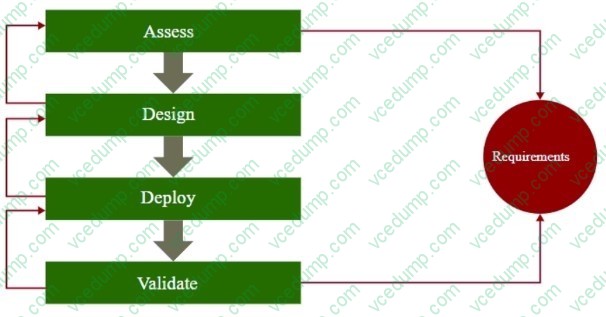
An architect is assigned a new project to design a VMware hybrid cloud solution.
The project is following a proven design methodology following the V-Model of systems engineering and verification. The selected methodology follows these phases: Assess, Design, Deploy and Validate.
Which activity would be conducted during the Design phase?
A. The architect conducts a series of group interviews with stakeholders
B. The architect helps stakeholders learn the mechanics of the solution
C. The architect resolves configuration issues and addresses concerns
D. The architect defines the scope of the project -
Question 76:
An architect will be updating an existing vSphere data center design.
The following information has been provided:
The new design must carry over existing VLANs for workloads.
The networking for storage must not share the data path with workload traffic.
The new design must be able to add additional VLANS.
The new design must reduce management overhead.
The new replacement servers have two 100 GB network cards.
Which design will meet the requirements for existing workload networks and allow scaling of additional networks?
A. One vSphere standard switch (VSS) configuration Workload and storage traffic on separate uplinks
B. One vSphere standard switch (VSS) configuration Workload and storage traffic on separate uplinks
C. Two vSphere distributed switches (VDS) Each VDS uses one uplink as active and the other uplink as passive Existing and new workload traffic on one VDS and storage traffic on the other VDS
D. One vSphere distributed switch (VDS) configuration The VDS uses aggregated uplinks Workload and storage traffic on the aggregated uplinks -
Question 77:
What are two valid use cases for VMware Cloud Foundation remote clusters? (Choose two.)
A. Provide disaster recovery for an existing workload domain.
B. Enable vSphere with Tanzu on a cluster deployed at a remote location.
C. Provide resources for virtual machines at an edge location.
D. Transform virtual machines to vSphere with Tanzu containers.
E. Deploy a cluster within the same rack as the central VMware Cloud Foundation instance. -
Question 78:
What is a use case for a VMware Cloud Foundation consolidated architecture model?
A. Run customer workloads in separate virtual infrastructure workload domains for scalability and autonomous licensing.
B. Deploy an SDDC for a small-scale environment that can be extended later.
C. Implement a dedicated management domain for high availability of management workloads.
D. Deploy a large-scale environment with multiple vCenter instances for workload isolation. -
Question 79:
An architect has made the following assumptions:
The customer will provide licensing for the vSphere platform.
The storage hardware has sufficient capacity for future workload scale.
The data center offers sufficient power, cooling and rack space for workload scale.
Which two risks must be documented in the design document in response to these assumptions? (Choose two.)
A. The assumptions must be approved by the customer, architect and the architect's company.
B. The storage may not have capacity to accommodate 20% year over year virtual machine growth.
C. The licenses provided by the customer only have support entitlement for one year.
D. The customer may not have an existing licensing subscription that covers features the architect intends to use.
E. The customer may not have sufficient data center cooling, power, and physical rack space available. -
Question 80:
An architect is tasked with designing a new workload domain in an existing VMware Cloud Foundation environment. The customer requirement is to physically separate the NSX host overlay network traffic from other management networks flows.
Which design decision should the architect make to meet this requirement?
A. Deploy the new workload domain with NSX Federation.
B. Deploy the new workload domain using multiple physical adapters.
C. Deploy the new workload domain using SDDC Manager.
D. Deploy the new workload domain using API.
Related Exams:
-
1V0-21.20
Associate VMware Data Center Virtualization -
1V0-31.21
Associate VMware Cloud Management and Automation -
1V0-41.20
Associate VMware Network Virtualization -
1V0-61.21
Associate VMware Digital Workspace -
1V0-71.21
Associate VMware Application Modernization -
1V0-81.20
Associate VMware Security -
2V0-11.24
VMware Cloud Foundation 5.2 Administrator -
2V0-11.25
VMware Cloud Foundation 5.2 Administrator -
2V0-13.24
VMware Cloud Foundation 5.2 Architect -
2V0-13.25
VMware Cloud Foundation 9.0 Architect
Tips on How to Prepare for the Exams
Nowadays, the certification exams become more and more important and required by more and more enterprises when applying for a job. But how to prepare for the exam effectively? How to prepare for the exam in a short time with less efforts? How to get a ideal result and how to find the most reliable resources? Here on Vcedump.com, you will find all the answers. Vcedump.com provide not only VMware exam questions, answers and explanations but also complete assistance on your exam preparation and certification application. If you are confused on your 3V0-21.23 exam preparations and VMware certification application, do not hesitate to visit our Vcedump.com to find your solutions here.