352-001 Exam Details
-
Exam Code
:352-001 -
Exam Name
:CCDE Written -
Certification
:Cisco Certifications -
Vendor
:Cisco -
Total Questions
:705 Q&As -
Last Updated
:Dec 07, 2025
Cisco 352-001 Online Questions & Answers
-
Question 411:
In a redesign of a multiple-area network, it is recommended that summarization is to be implemented. For redundancy requirements, summarization is done at multiple locations for each summary. Some customers now complain of higher latency and performance issues for a server hosted in the summarized area. What design issues should be considered when creating the summarization?
A. Summarization adds CPU overhead on the routers sourcing the summarized advertisement.
B. Summarization prevents the visibility of the metric to the component subnets.
C. Summarization creates routing loops.
D. Summarization causes packet loss when RPF is enabled. -
Question 412:
A service provider creates a network design that runs MPLS in its WAN backbone using OSPF as the IGP routing protocol. What would be two effects of additionally implementing MPLS-TE? (Choose two.)
A. MPLS-TE is required to reroute traffic within less than 1 second in case of a link failure inside the backbone.
B. MPLS-TE is required to route different MPLS QoS service classes through different paths.
C. MPLS-TE and OSPF cannot be used together inside one MPLS network.
D. MPLS-TE cannot use OSPF for the traffic path calculation.
E. MPLS-TE is required to create backup paths independently from the IGP. -
Question 413:
Refer to the exhibit.
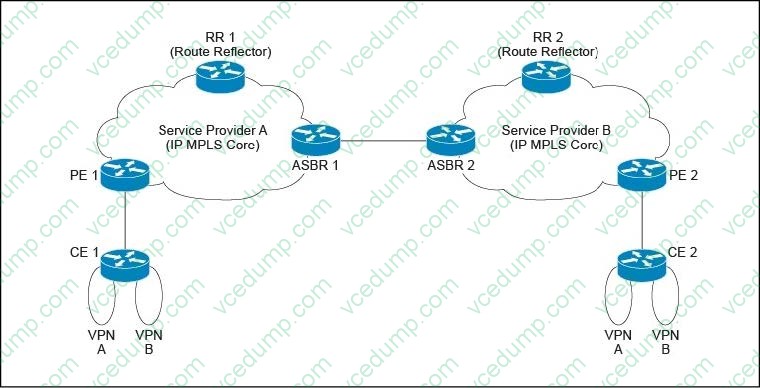
Service Provider A and Service Provider B have agreed to a strategic interconnect relationship that will allow them access into each other's geographies by using an inter-AS eBGP VPNv4 multihop between route reflectors. Which two options will accomplish this scenario? (Choose two.)
A. RR 1 and RR 2 peer using multihop eBGP VPNv4 to exchange prefixes.
B. ASBR 1 and ASBR 2 act as inline route reflectors that set themselves as the next-hop.
C. An LSP is formed between ASBR 1 and ASBR 2 using eBGP IPv4.
D. An LSP is formed between ASBR 1 and ASBR 2 using eBGP VPNv4.
E. RR 1 and RR 2 peer using multihop eBGP IPv4 to exchange prefixes. -
Question 414:
Which mechanism should be added to a network design to identify unidirectional Spanning Tree Protocol failures through BPDU loss?
A. UDLD
B. loop guard
C. BPDU guard?
D. root guard -
Question 415:
At which two networks points is route summarization supported? (Choose two)
A. At EIGRP AS boundaries
B. At EIGRP interface boundaries
C. At OSPF virtual-link boundaries
D. At EIGRP are boundaries
E. At OSPF area boundaries
F. At EIGRP stub interface boundaries -
Question 416:
Which action can identify and monitor denial of service attacks?
A. Deploy access control lists that match well-known attack vectors
B. Deploy deep packet inspection appliances
C. Select attack counter-measures
D. Establish normal network characteristics -
Question 417:
What is an advantage of placing the IS-IS flooding domain boundary at the core Layer in a three-layer hierarchical network?
A. The L1 and L2 domains can easily overlap
B. The L2 domain is contained and more stable
C. It can be applied to any kind of topology
D. It reduces the complexity of the L1 domains -
Question 418:
Which description of the RPF check in the multicast forwarding traffic is true?
A. The source address of the multicast packet is checked in the unicast routing table. If the multicast packet arrived from the interface that matches with the interface to reach the source address, this packet passes the RPF check.
B. The unicast address of the multicast packet is checked in the BGP database. If the multicast packet arrived from the interface that matches with the interface to reach BGP peer that advertised the multicast prefix, this packet passes the RPF check.
C. The destination address of the multicast packet is checked in the BGP database. If the multicast packet arrived from the interface that matches with the interface to reach BGP peer that advertised the multicast prefix, this packet fails the RPF check.
D. The source address of the multicast packet is checked in the unicast routing table. If the multicast packet arrived from the interface that matches with the interface to reach the source address, this packet fails the RPF check. -
Question 419:
A customer has a DMVPN network with EIGRP as the overlay protocol. EIGRP timers cannot be shortened, yet the customer requires the detection of lost connectivity between neighbors in less than three seconds. Which action achieves this requirement?
A. Adjust the GRE keepalive timers
B. Enable BFD
C. Deploy IPsec dead peer detection
D. Adjust the NHRP timers. -
Question 420:
Which tunneling mechanism provides confidentiality as well as tunneling capabilities?
A. MPLS L3VPN
B. IPsec ESP
C. L2TPv3
D. IPsec AH
Related Exams:
-
300-745
Designing Cisco Security Infrastructure (300-745 SDSI) v1.0 -
350-101
Implementing and Operating Cisco Wireless Core Technologies (350-101 WLCOR)v1.0 -
352-011
Cisco Certified Design Expert Practical -
500-052
Cisco Unified Contact Center Express -
500-173
Designing the FlexPod Solution (FPDESIGN) -
500-201
Deploying Cisco Service Provider Mobile Backhaul Solutions -
500-210
SP Optical Technology Field Engineer Representative -
500-220
Engineering Cisco Meraki Solutions (ECMS) v2.2 -
500-230
Cisco Service Provider Routing Field Engineer -
500-240
Cisco Mobile Backhaul for Field Engineers
Tips on How to Prepare for the Exams
Nowadays, the certification exams become more and more important and required by more and more enterprises when applying for a job. But how to prepare for the exam effectively? How to prepare for the exam in a short time with less efforts? How to get a ideal result and how to find the most reliable resources? Here on Vcedump.com, you will find all the answers. Vcedump.com provide not only Cisco exam questions, answers and explanations but also complete assistance on your exam preparation and certification application. If you are confused on your 352-001 exam preparations and Cisco certification application, do not hesitate to visit our Vcedump.com to find your solutions here.