351-001 Exam Details
-
Exam Code
:351-001 -
Exam Name
:CCIE Routing and Switching Written -
Certification
:Cisco Certifications -
Vendor
:Cisco -
Total Questions
:996 Q&As -
Last Updated
:Dec 06, 2021
Cisco 351-001 Online Questions & Answers
-
Question 771:
Which two statements about OSPF default route injection are true? (Choose two.)
A. The ABR requires manual configuration to send a default route into an NSSA area.
B. The ABR injects a default route into a Totally Stub Area.
C. In a stub area, the ASBR generates a summary LSA with link-state ID 0.0.0.0.
D. If the default route is missing from the routing table, the ASBR can use the default- information originate command to advertise the default into the OSPF domain.
E. By default, OSPF normal areas will generate default routes into the routing domain if a default route exists. -
Question 772:
Refer to the exhibit.
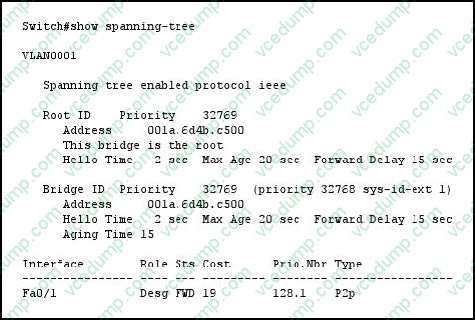
If you change the Spanning Tree Protocol from pvst to rapid-pvst, what is the effect on the interface Fa0/1 port state?
A. It transitions to the listening state, and then the forwarding state.
B. It transitions to the learning state and then the forwarding state.
C. It transitions to the blocking state, then the learning state, and then the forwarding state.
D. It transitions to the blocking state and then the forwarding state. -
Question 773:
Which IPv6 tunneling type establishes a permanent link between IPv6 domains over IPv4?
A. IPv4-compatible tunneling
B. ISATAP tunneling
C. 6to4 tunneling
D. manual tunneling -
Question 774:
What are two advantages to using Asynchronous mode instead of Demand mode for BFD? (Choose two.)
A. Asynchronous mode requires half as many packets as Demand mode for failure detection.
B. Asynchronous mode can be used in place of the echo function.
C. Asynchronous mode supports a larger number of BFD sessions.
D. Asynchronous mode requires one fourth as many packets as Demand mode for failure detection.
E. Asynchronous mode's round-trip jitter is less than that of Demand mode. -
Question 775:
Refer to the exhibit.
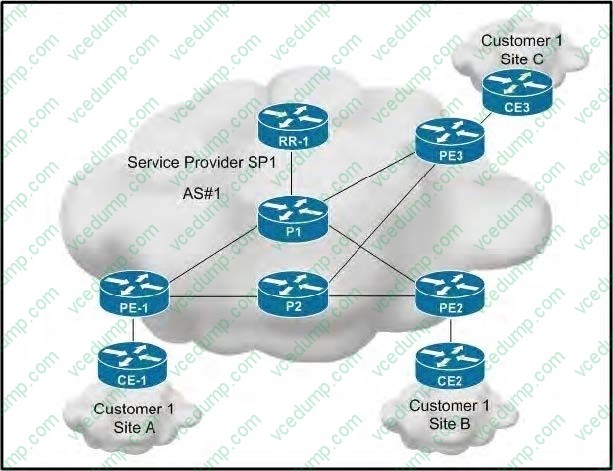
Service provider SP 1 is running the MPLS-VPN service. The MPLS core network has MP- BGP configured with RR-1 as route reflector. What will be the effect on traffic between PE1 and PE2 if router P1 goes down?
A. No effect, because all traffic between PE1 and PE2 will be rerouted through P2.
B. No effect, because P1 was not the only P router in the forwarding path of traffic.
C. No effect, because RR-1 will find an alternative path for MP-BGP sessions to PE-1 and PE-2.
D. All traffic will be lost because RR-1 will lose the MP-BGP sessions to PE-1 and PE-2. -
Question 776:
Which two statements about Layer 2 Frame Prioritization bits are true? (Choose two.)
A. 802.1Q frame headers carry the CoS value in the three most-significant bits of the 2- byte Tag Control Information field.
B. ISL frame headers carry an IEEE 802.1P CoS value in the three least-significant bits of the 2-byte User field.
C. ISL frame headers carry an IEEE 802.1P CoS value in the three most-significant bits of the 1-byte User field.
D. On 802.1Q trunks, traffic in the native VLAN is carried in 802.1Q frames.
E. Only 802.1Q and ISL frame types can carry CoS information.
F. On 802.1Q trunks, traffic in the native VLAN is carried in 802.1P frames. -
Question 777:
What is Nagle's algorithm used for?
A. To increase the latency
B. To calculate the best path in distance vector routing protocols
C. To calculate the best path in link state routing protocols
D. To resolve issues caused by poorly implemented TCP flow control. -
Question 778:
Which two statements about IPv4 and IPv6 networks are true? (Choose two.)
A. In IPv6, hosts perform fragmentation.
B. IPv6 uses a UDP checksum to verify packet integrity.
C. In IPv6, routers perform fragmentation.
D. In IPv4, fragmentation is performed by the source of the packet.
E. IPv4 uses an optional checksum at the transport layer.
F. IPv6 uses a required checksum at the network layer. -
Question 779:
Which BGP aggregate address configuration advertises only the aggregate address, with attributes inherited from the more specific routes?
A. summary-only as-set
B. as-set
C. summary
D. summary-only -
Question 780:
Which three statements about the route preference of IS-IS are true? (Choose three.)
A. An L1 path is preferred over an L2 path.
B. An L2 path is preferred over an L1 path.
C. Within each level, a path that supports optional metrics is preferred over a path that supports only the default metric.
D. Within each level of metric support, the path with the lowest metric is preferred.
E. The Cisco IS-IS implementation usually performs equal cost path load balancing on up to eight paths.
F. Both L1 and L2 routes will be installed in the routing table at the same time.
Related Exams:
-
300-745
Designing Cisco Security Infrastructure (300-745 SDSI) v1.0 -
350-101
Implementing and Operating Cisco Wireless Core Technologies (350-101 WLCOR)v1.0 -
352-011
Cisco Certified Design Expert Practical -
500-052
Cisco Unified Contact Center Express -
500-173
Designing the FlexPod Solution (FPDESIGN) -
500-201
Deploying Cisco Service Provider Mobile Backhaul Solutions -
500-210
SP Optical Technology Field Engineer Representative -
500-220
Engineering Cisco Meraki Solutions (ECMS) v2.2 -
500-230
Cisco Service Provider Routing Field Engineer -
500-240
Cisco Mobile Backhaul for Field Engineers
Tips on How to Prepare for the Exams
Nowadays, the certification exams become more and more important and required by more and more enterprises when applying for a job. But how to prepare for the exam effectively? How to prepare for the exam in a short time with less efforts? How to get a ideal result and how to find the most reliable resources? Here on Vcedump.com, you will find all the answers. Vcedump.com provide not only Cisco exam questions, answers and explanations but also complete assistance on your exam preparation and certification application. If you are confused on your 351-001 exam preparations and Cisco certification application, do not hesitate to visit our Vcedump.com to find your solutions here.