350-501 Exam Details
-
Exam Code
:350-501 -
Exam Name
:Implementing and Operating Cisco Service Provider Network Core Technologies (SPCOR) -
Certification
:CCIE Service Provider -
Vendor
:Cisco -
Total Questions
:568 Q&As -
Last Updated
:Jul 11, 2026
Cisco 350-501 Online Questions & Answers
-
Question 471:
Refer to the exhibit.
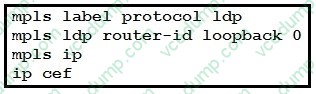
A network operator working for service provider with an employee id: 1234:56:789 applied this configuration to a router.
Which additional step should the engineer use to enable LDP?
A. Enable MPLS LDP on the interface.
B. Disable Cisco Express Forwarding globally.
C. Delete the static router ID.
D. Configure the both keyword to enable LDP globally. -
Question 472:
Which condition must be met for TI-LFA to protect LDP traffic?
A. For single-segment protection, the PQ node must be LDP and SR-capable.
B. The protected destination must have an associated LDP label and prefix-SID.
C. The point of local repair must be LDP-capable.
D. For double-segment protection, the P and Q nodes must be SR-capable. -
Question 473:
An engineer needs to implement QOS mechanism on customer's network as some applications going over the internet are slower than others.
Which two actions must the engineer perform when implementing traffic shaping on the network in order to accomplish this task? (Choose two)
A. Configure a queue with sufficient memory to buffer excess packets.
B. Configure the token values in bytes.
C. Implement packet remarking for excess traffic.
D. Implement a scheduling function to handle delayed packets.
E. Configure a threshold over which excess packets are discarded. -
Question 474:
An engineer must implement QoS to prioritize traffic that requires better service throughout the network. The engineer started by configuring a class map to identify the high-priority traffic. Which additional tasks must the engineer perform to implement the new QoS policy?
A. Attach the class map to a policy map that sets the minimum bandwidth allocated to the classified traffic and designates the action to be taken on the traffic.
B. Attach the class map to a policy map that designates the action to be taken on the classified traffic and then attach the policy map to an interface using a service policy.
C. Attach the class map to a policy map within a VRF to segregate the high-priority traffic and then attach the policy map to an interface in another VRF.
D. Create a route map to manipulate the routes that are entered into the routing table and then attach the route map to an interface using a service policy. -
Question 475:
A service provider is using multicast flows to provide streaming video content to its customers. Video streams are sometimes interrupted, and network instability is determined to be the cause. Which action should the service provider take to decrease the burden on the router resources in an unstable unicast routing environment?
A. increase the PIM hello hold timers
B. reduce the volume of query messages
C. filter unnecessary SA messages
D. tune the RPF backoff -
Question 476:
What is the function of the FEC field within the OTN signal structure?
A. It allows the sending devices to apply QoS within the OTN forwarding structure.
B. It allows deep inspection of data payload fields.
C. It allows receivers to correct errors upon data arrival
D. It allows source nodes to discard payload errors before transmitting data on the network. -
Question 477:
Refer to the exhibit.
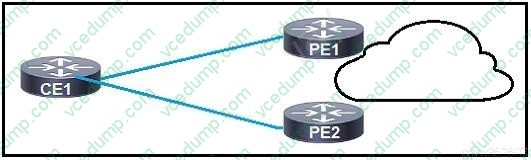
Which BGP attribute should be manipulated to have CE1 use PE1 as the primary path to the internet?
A. The local preference attribute should be manipulated on PE2 on inbound and outbound routes advertised to CE1.
B. The origin of all routes should be modified on each router on inbound and outbound routes advertised to CE1.
C. The MED attribute should be manipulated on CE1 on inbound routes from PE1.
D. The weight attribute should be manipulated on PE1 on outbound routes advertised to CE1. -
Question 478:
Refer to the exhibit
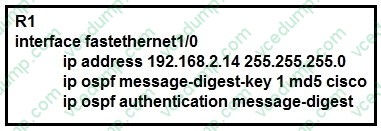
Which condition must be met by the OSPF peer of router R1 before the two devices can establish communication?
A. The OSPF peer must use clear-text authentication.
B. The OSPF peer must be configured as an OSPF stub router.
C. The interface on the OSPF peer may have a different key ID, but it must use the same key value as the configured interface.
D. The interface on the OSPF peer must use the same key ID and key value as the configured interface. -
Question 479:
Refer to the exhibit.
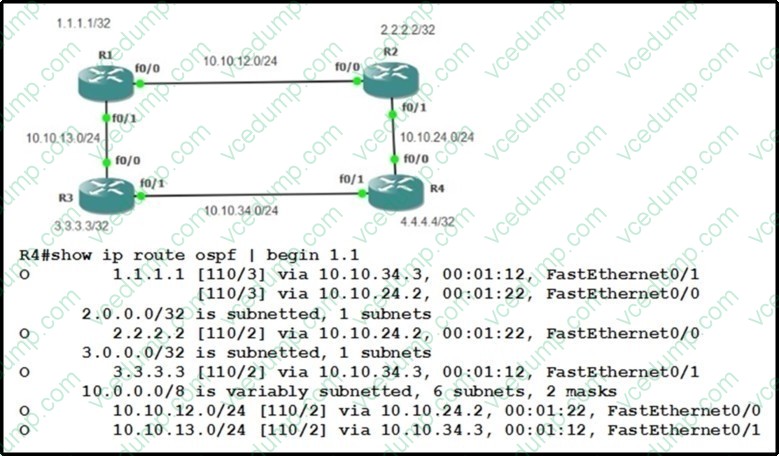
Which command group does a network administrator use to filter out R3 (3.3.3.3 subnet) from the R4 routing table?
A. R4(config)# router ospf 1distribute-list prefix-list filter in
B. R2(config)# router ospf 1distribute-list prefix-list filter out Fa0/1
C. R4(config)# router ospf1distribute-list prefix-list filter in Fa 0/0
D. R3(config)# router ospf 1distribute-list prefix-list filter out Fa 0/0 -
Question 480:
SIMULATION
Guidelines
This is a lab item in which tasks will be performed on virtual devices.
1. Refer to the Tasks tab to view the tasks for this lab item.
2. Refer to the Topology tab to access the device console(s) and perform the tasks.
3. Console access is available for all required devices by clicking the device icon or using the tab(s) above the console window.
4. All necessary preconfigurations have been applied.
5. Do not change the enable password or hostname for any device.
6. Save your configurations to NVRAM before moving to the next item.
7. Click Next at the bottom of the screen to submit this lab and move to the next question.
8. When Next is clicked, the lab closes and cannot be reopened.
Topology
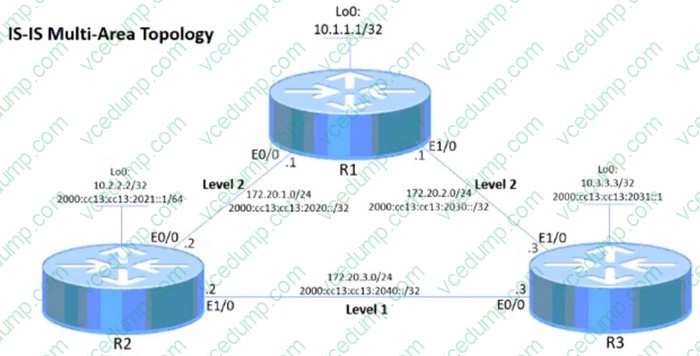
Tasks
Configure the IS-IS routing protocol for R1, R2, and R3 according to the topology to achieve these goals:
1. Enable IS-IS routing protocol parameters:
R1: Routing area tag: 1, Net: 49.0001.0010.0001.0101.00 R2: Routing area tag: 2, Net: 49.0001.0010.0002.0202.00 R3: Routing area tag: 3, Net: 49.0001.0010.0003.0303.00
2. Configure IS-IS IPv4 and IPv6:
Only Level 1 adjacency for: R2 and R3 links Only Level 2 adjacency for: R1 and R2 links Only Level 2 adjacency for: R1 and R3 links
3. Configure CLNS Domain and Area password C1sc0! for the authentication of all IS-IS adjacency links on R1, R2, and R3. Use the clear text ISIS authentication mechanism for this task.
A. See explanation below.
B. PlaceHolder
C. PlaceHolder
D. PlaceHolder
Tips on How to Prepare for the Exams
Nowadays, the certification exams become more and more important and required by more and more enterprises when applying for a job. But how to prepare for the exam effectively? How to prepare for the exam in a short time with less efforts? How to get a ideal result and how to find the most reliable resources? Here on Vcedump.com, you will find all the answers. Vcedump.com provide not only Cisco exam questions, answers and explanations but also complete assistance on your exam preparation and certification application. If you are confused on your 350-501 exam preparations and Cisco certification application, do not hesitate to visit our Vcedump.com to find your solutions here.