350-501 Exam Details
-
Exam Code
:350-501 -
Exam Name
:Implementing and Operating Cisco Service Provider Network Core Technologies (SPCOR) -
Certification
:CCIE Service Provider -
Vendor
:Cisco -
Total Questions
:568 Q&As -
Last Updated
:Jul 19, 2026
Cisco 350-501 Online Questions & Answers
-
Question 351:
A network engineer must configure a router for Flexible NetFlow IPFIX export. The IP address of the destination server is 172.17.12.1 The source address must be set to the Loopback0 IPv4 address and exported packets must be set to DSCP CS3. The TTL must be 64 and the transport protocol must be set to UDP with destination port 4739. Which configuration must the engineer apply to the router?
A. configure terminalflow exporter EXPORTER-1destination 172.17.12.1source Loopback0dscp 3ttl 64export-protocol netflow-v9transport udp 4739end
B. configure terminalflow exporter EXPORTER-1destination 172.17.12.1source Loopback0dscp 24ttl 64export-protocol ipfixend
C. configure terminalflow exporter EXPORTER-1destination 172.17.12.1source Loopback0dscp 24ttl 64export-protocol netflow-v9transport udp 4739end
D. configure terminalflow exporter EXPORTER-1destination 172.17.12.1source Loopback0dscp 3ttl 64export-protocol ipfixend -
Question 352:
A network engineer is configuring RIP as the routing protocol between multiple PEs and CEs. The engineer must avoid advertising the same routes back to their sources. Which action should be performed on the routers to accomplish this task?
A. Define the site of origin on each interface.
B. Configure a different route distinguisher for each prefix.
C. Define VRFs on each device to separate the traffic.
D. Enable bidirectional forwarding detection on each device. -
Question 353:
An support engineer has been tasked to protect an ISP infrastructure from the growing number of encrypted DDoS attacks. The solution should also validate the eBGP peering.
Which solution accomplishes these goals?
A. BGP FlowSpec
B. BTSH
C. BGP Route Dampening
D. BGP LS
E. RTBH -
Question 354:
Refer to the exhibit.
R1# show ip ospf interface gig 2 GigabitEthernet2 is up, line protocol is up Internet Address 172.20.1.12/31, Area 0.0.1.255, Attached via Interface enable Process ID 1, Router ID 10.255.255.1, Network Type Point_to_point, cost:1 Topology-MTID : 0 Cost : 1 Dsiabled : No Shutdown : No Topology Name : Base Enabled by interface config, including secondary ip addresses Transmit delay is 1 sec, state point_to_point Timer intervals configured, Hello 10, Dead 40, wait 40, Retransmit 5
R1# show ip interface gig 2 GigabitEthernet2 is up, line protocol is up Internet Address 172.20.1.12/31 MTU is 9216 bytes
R2# show ip ospf interface gig 2 GigabitEthernet2 is up, line protocol is up Internet Address 172.20.1.13/31, Area 511, Attached via Interface enable Process ID 1, Router ID 10.255.255.2, Network Type Point_to_multipoint, cost:1 Topology-MTID : 0 Cost : 1 Dsiabled : No Shutdown : No Topology Name : Base Enabled by interface config, including secondary ip addresses Transmit delay is 1 sec, state point_to_multipoint Timer intervals configured, Hello 10, Dead 40, wait 40, Retransmit 5
R2# show ip interface gig 2 GigabitEthernet2 is up, line protocol is up Internet Address 172.20.1.13/31 MTU is 1500 bytes
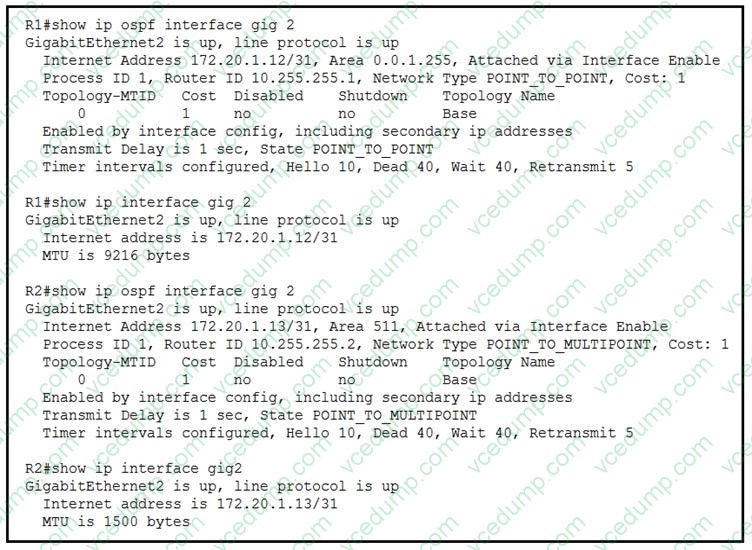
While troubleshooting the OSPF adjacency between routers R1 and R2 an engineer noticed that both routers are stuck in the EXCHANGE/EXSTART state.
What should the engineer fix to solve the ongoing issue?
A. match IPv4 addresses
B. match OSPF areas
C. match OSPF network types
D. match MTU values -
Question 355:
A network engineer is configuring a newly installed PE router at the regional gateway location. The new PE router must use MPLS core routing protocols with the existing P router, and LDP sessions between the two routers must be protected to provide faster MPLS convergence. Which configuration must the engineer perform on the network so that LDP sessions are established?
A. Enable RSVP-TE FRR on the LDP interface to protect the LDP session between routers.
B. Enable communication over TCP port 646 T-LDP hello messages.
C. Set the LDP session protection timer on each router to the same value.
D. Enable LDP session protection on either one of the routers, which allows them to autonegotiate. -
Question 356:
Refer to the exhibit.
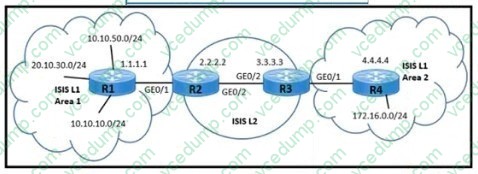
A network engineer must meet these requirements to provide a connects, solution:
1. The customer connected to Area 2 needs to access the application in Area 1 on the 10.10.10.0/24 subnet 2. The Customer must not have access to the 20.10 30.0/24 subnet.
3. The service provider must make sure that the Area 2 routing database limits the number of IP addresses in the routing table
Which two configurations must be implemented to meet the requirements? (Choose two)
A. Set a tag value of 200 to match the summary address 10.0.0/16 on R2.
B. Set a tag value of 200 to match the summary address 10.0.0.0/16 on R3.
C. Apply the route map for tag 200 and leak Level 2 routes into Level 1 Area 2 on R3
D. Apply the route map for tag 200 and teak Level 2 routes into Level 1 Area 2 on R4.
E. Set a tag value of 200 to match the summary address 10.0.0./16 on R1. -
Question 357:
Refer to the exhibit.
router[config]# router ospf 11
router[config-if]# passive-interface default
An engineer started lo configure a router for OSPF. Which configuration must me engineer perform on me router without changing any interface configuration so that the router establishes an OSPF neighbor relationship with its peer?
A. router(config)# router ospf 11router(config-if)# no passive-interface ethernet 1/1
B. router(config)# interface ethernet 1/1router(config-if)# no shutdown
C. router(config)# interface ethernet 1/1router(config-if)# ip ospaf hello-interval
D. router(config)# interface ethernet 1/1router(config-if)# ip ospf priority 0 -
Question 358:
In an MPLS network, which protocol can be used to distribute a Segment Prefix?
A. LDP
B. EIGRP
C. OSPF
D. RSVP-TE -
Question 359:
Which two steps must a service provider consider when adding multicast support to the existing MPLS L3VPN? (Choose two.)
A. Using SSM for data MDT helps to minimize the number of group addresses needed in the core
B. Using default MDT results in a reduction of multicast routing states in the core
C. All PEs must be configured as RPs inside of each customer VRF to minimize impact of the RPF lookups
D. Bandwidth may be wasted on PEs as a result of only using the default MDT
E. Forwarding customer multicast traffic only via the default MDT optimizes PE utilization -
Question 360:
An engineer is setting up overlapping VPNs to allow VRF ABC and XYZ to communicate with VRF CENTRAL but wants to make sure that VRF ABC and XYZ cannot communicate.
Which configuration accomplishes these objectives?
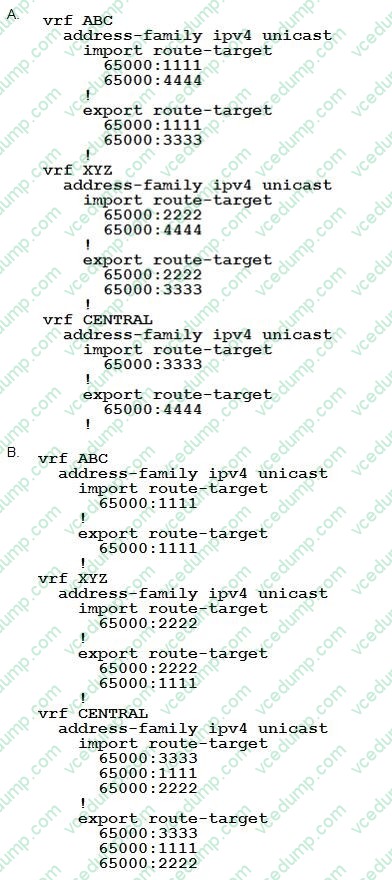
A. Option A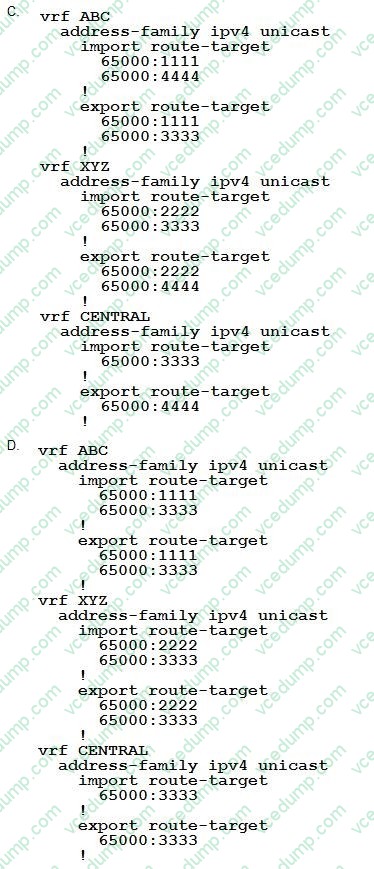
B. Option B
C. Option C
D. Option D
Tips on How to Prepare for the Exams
Nowadays, the certification exams become more and more important and required by more and more enterprises when applying for a job. But how to prepare for the exam effectively? How to prepare for the exam in a short time with less efforts? How to get a ideal result and how to find the most reliable resources? Here on Vcedump.com, you will find all the answers. Vcedump.com provide not only Cisco exam questions, answers and explanations but also complete assistance on your exam preparation and certification application. If you are confused on your 350-501 exam preparations and Cisco certification application, do not hesitate to visit our Vcedump.com to find your solutions here.