350-501 Exam Details
-
Exam Code
:350-501 -
Exam Name
:Implementing and Operating Cisco Service Provider Network Core Technologies (SPCOR) -
Certification
:CCIE Service Provider -
Vendor
:Cisco -
Total Questions
:568 Q&As -
Last Updated
:Jul 11, 2026
Cisco 350-501 Online Questions & Answers
-
Question 211:
Refer to the exhibit:
mpls label protocol ldp mpls ldp router-id loopback 0 mpls ip ip cef
A network operator working for service provider with an employee id 3715 15:021 applied this configuration to a router.
Which additional step should the engineer use to enable LDP?
A. Disable Cisco Express Forwarding globally
B. Delete the static router ID
C. Enable MPLS LDP on the interface
D. Configure the both keyword to enable LDP globally -
Question 212:
Which Cisco software OS uses monolithic architecture?
A. NX-OS
B. IOS XE
C. IOS XR
D. IOS -
Question 213:
Which CLI mode must be used to configure the BGP keychain in Cisco IOS XR Software?
A. routing configuration mode
B. BGP neighbor configuration mode
C. global configuration mode
D. BGP address-family configuration mode -
Question 214:
Why do packet loops occur during the configuration of BIDIR-PIM?
A. The network does not support BIDIR-PIM.
B. The network is partially upgraded to support BIDIR-PIM.
C. The router has not been configured to advertise itself.
D. No interface for carrying traffic for multicast groups has been configured. -
Question 215:
Refer to the exhibit.
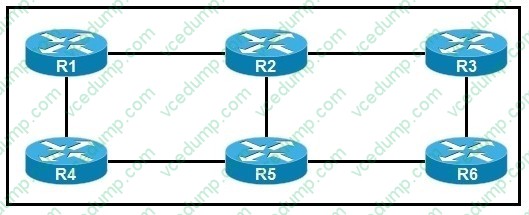
You are configuring an administrative domain in the given multi-vendor environment with PIM-SM.
Which feature can you implement so that devices can dynamically learn the RP?
A. BSR
B. BIDIP-PIM
C. Auto-RP
D. SSM -
Question 216:
SIMULATION
Guidelines
This is a lab item in which tasks will be performed on virtual devices.
1. Refer to the Tasks tab to view the tasks for this lab item.
2. Refer to the Topology tab to access the device console(s) and perform the tasks.
3. Console access is available for all required devices by clicking the device icon or using the tab(s) above the console window.
4. All necessary preconfigurations have been applied.
5. Do not change the enable password or hostname for any device.
6. Save your configurations to NVRAM before moving to the next item.
7. Click Next at the bottom of the screen to submit this lab and move to the next question.
8. When Next is clicked, the lab closes and cannot be reopened.
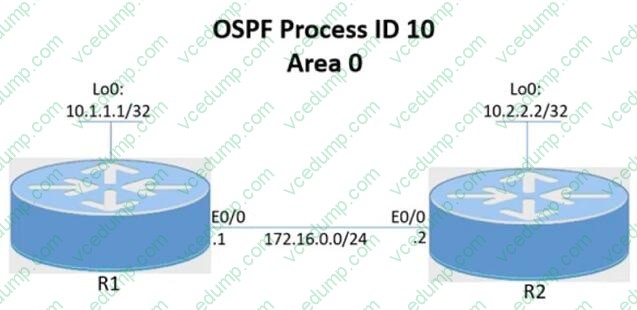
Topology
Tasks
Configure and verify the OSPF neighbor adjacency between R1 and R2 in OSPF area 0 according to the topology to achieve these goals:
1. Configure OSPF cost to 15 on R1 and R2.
2. Redistribute all the static routes defined in R1 and R2 to the OSPF routing protocol.
3. Set the OSPF hello interval to 5 and the OSPF dead interval to 10 between R1 and R2.
A. See explanation below.
B. PlaceHolder
C. PlaceHolder
D. PlaceHolder -
Question 217:
Which feature describes the weight parameter for BGP path selection?
A. Its value is local to the router
B. Its value is set either locally or globally.
C. Its default value is 0.
D. Its value is global to the router. -
Question 218:
A customer of an ISP requests support to setup a BGP routing policy. Which BGP attribute should be configured to choose specific BGP speakers as preferred points for the customer AS?
A. lowest multi-exit discriminator
B. highest local preference outbound
C. lowest local preference inbound
D. highest local preference inbound -
Question 219:
Which router or router combination is used to calculate the MPLS traffic engineering tunnel path?
A. head-end router and tail-end router
B. middle-point router
C. head-end router
D. tail-end router -
Question 220:
Refer to the exhibit.
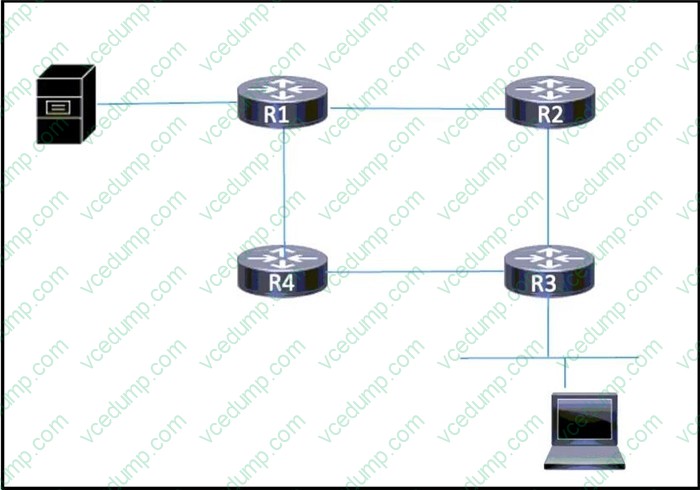
A host connected to R3 must connect with a server on R1 that provides critical, time-sensitive data. Traffic between the host and server must always be given bandwidth to traverse the links when they are congested, with other traffic being dropped. How must the network engineer implement a QoS strategy with classification to ensure that the traffic is given the appropriate bandwidth?
A. Implement policing to rate-limit noncritical traffic that exceeds designated thresholds.
B. Implement traffic shaping to delay noncritical traffic when the link is congested.
C. Implement strict priority to guarantee bandwidth for the server traffic.
D. Implement FIFO to guarantee that the server traffic is sent first while other traffic is queued.
Tips on How to Prepare for the Exams
Nowadays, the certification exams become more and more important and required by more and more enterprises when applying for a job. But how to prepare for the exam effectively? How to prepare for the exam in a short time with less efforts? How to get a ideal result and how to find the most reliable resources? Here on Vcedump.com, you will find all the answers. Vcedump.com provide not only Cisco exam questions, answers and explanations but also complete assistance on your exam preparation and certification application. If you are confused on your 350-501 exam preparations and Cisco certification application, do not hesitate to visit our Vcedump.com to find your solutions here.