350-501 Exam Details
-
Exam Code
:350-501 -
Exam Name
:Implementing and Operating Cisco Service Provider Network Core Technologies (SPCOR) -
Certification
:CCIE Service Provider -
Vendor
:Cisco -
Total Questions
:568 Q&As -
Last Updated
:Jul 11, 2026
Cisco 350-501 Online Questions & Answers
-
Question 181:
How does SR policy operate in Segment Routing Traffic Engineering?
A. An SR policy for color and endpoint is deactivated at the headend as soon as the headend learns a valid candidate path for the policy.
B. When "invalidation drop" behavior occurs, the SR policy forwarding entry is removed and the router drops all traffic that is steered into the SR policy.
C. When a set of SID lists is associated with the SR policy designated path, traffic steering is ECMP-based according to the qualified cost of each SID-list.
D. An active SR policy installs a BSID-keyed entry in the forwarding table to steer the packets that match the entry to the SR policy SID-list. -
Question 182:
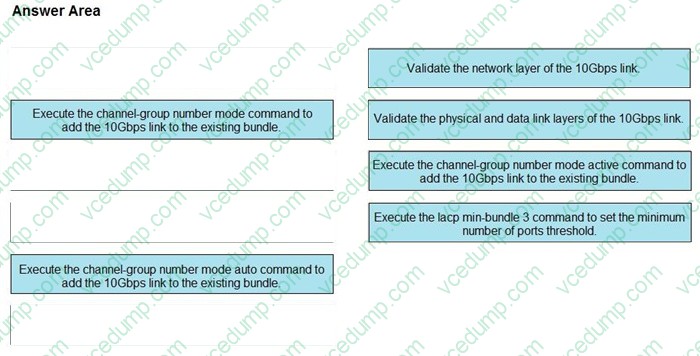
DRAG DROP
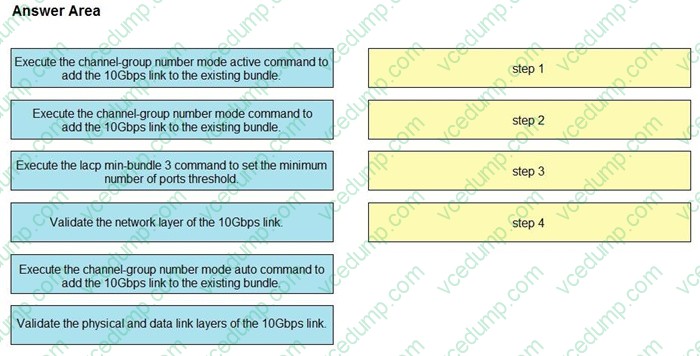
A network engineer is adding an additional 10Gbps link to an existing 2x10Gdps LACP-based LAG to augment its capacity. Network standards require a bundle interface to be taken out of service if one of its member links goes down, and the new link must be added with minimal impact to the production network. Drag and drop the tasks that the engineer must perform from the left into the sequence on the right. Not all options are used.
Select and Place:
-
Question 183:
What is the primary purpose of Terraform in the network?
A. to manage the Cisco network infrastructure as code to ensure consistent configuration and scalability
B. to facilitate the integration of Cisco networking solutions with cloud platforms to improve scalability
C. to schedule and manage maintenance tasks on Cisco network devices to minimize errors and downtime
D. to enable the seamless migration of Cisco network configurations between diverse network environments -
Question 184:
Refer to the exhibit.
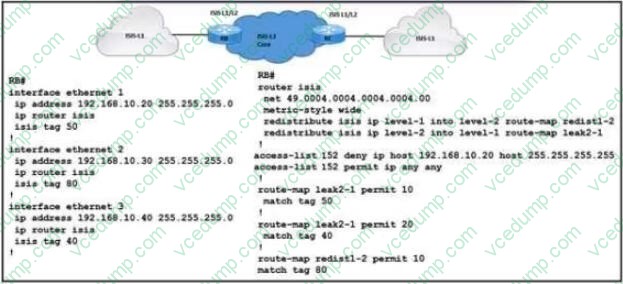
RB#
interface ethernet 1 ip address 192.168.10.20 255.255.255.0 ip router isis isis tag 50 !
interface ethernet 2 ip address 192.168.10.30 255.255.255.0 ip router isis isis tag 80 !
interface ethernet 3 ip address 192.168.10.40 255.255.255.0 ip router isis isis tag 40 !
RB#
router isis net 49.0004.0004.0004.0004.00 metric-style wide redistribute isis ip level-1 into level-2 route-map redist1-2 redistribute isis ip level-2 into level-1 route-map leak2-1 !
access-list 152 deny ip host 192.168.10.20 host 255.255.255.255 access-list 152 permit ip any any !
route-map leak2-1 permit 10 match tag 50 !
route-map leak2-1 permit 20 match tag 40 !
A network engineer with an employee ID 4402:98:032 is setting up an IS-IS network with these requirements:
1. Routes with a tag of 80 and IP prefixes other than 192.168.10.20/24 must be redistributed from Level 1 into Level 2 2. Route leaking must be configured from Level 2 into the Level 1 domain for routes that are tagged with only 50 or 40
Which configuration must be implemented on RB to meet the requirements?
A. Remove match tag 40 from route-map leak2-1
B. Add match tag 80 in route-map leak2-1
C. Change match tag 80 to match tag 50 in route-map redist1-2
D. Add match ip address 152 in route-map redist1-2 -
Question 185:
An engineer working for telecommunication company needs to secure the LAN network using a prefix list.
Which best practice should the engineer follow when he implements a prefix list?
A. An engineer must identify the prefix list with a number only.
B. The final entry in a prefix list must be /32.
C. An engineer must include only the prefixes for which he needs to log activity.
D. An engineer must use nonsequential sequence numbers in the prefix list so that he can insert additional entries later. -
Question 186:
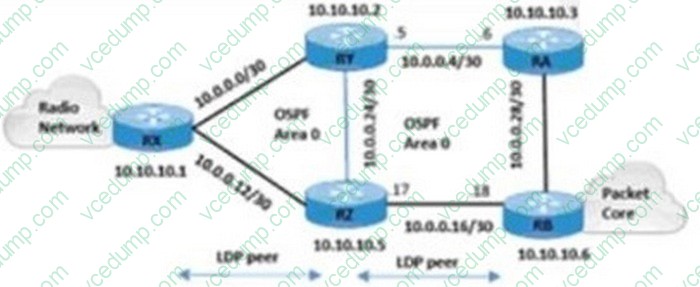
Refer to the exhibit.
RZ# ipv4 access-list peer_acl_1 10 permit ipv4 host 10.10.10.2 any 20 permit ipv4 host 10.10.10.1 any
ipv4 access-list peer_acl_2 10 permit ipv4 host 10.10.10.6 any mpls ldp session protection duration 30 for peer_acl_2
RX# ipv4 access-list peer_acl_1 10 permit ipv4 host 10.10.10.2 any 20 permit ipv4 host 10.10.10.5 any
mpls ldp session protection duration 60 for peer_acl_1
The radio network and packet core are using the route RX-RZ-RB to establish communication. The LDP session between 10.10.10.5 and 10.10.10.1 is experiencing link flapping at random intervals for 30-45 seconds each time. A network engineer must protect the LDP session and improve MPLS traffic convergence.
Which action meets these requirements?
A. Configure peer_acl_2 on RX and allow IP address 10.10.10.6 in LDP.
B. Attach peer_acl_1 in for session protection duration 1 on RX.
C. Add session protection duration 60 for peer_acl_1 under the MPLS LDP instance on RZ.
D. Enable IGP-LDP sync on RZ and RX. -
Question 187:
A layer 2 aggregation deployed via IEEE 802.1D has many nodes on a single link A DHCP version 6 server cannot recognize how the clients are attached to a network, Which solution provides a client identification to the DHCPv6 in this scenario?
A. LDRA
B. DHCPv6 relay agent
C. DHCP snooping
D. Broadband Forum Trunk N:1 -
Question 188:
What is a feature of model-driven telemetry?
A. It occasionally streams to multiple servers in the network.
B. It is less secure because it uses community strings.
C. It uses the pull model to send requested data to a client when polled.
D. It uses the push model to stream data to desired destinations. -
Question 189:
SIMULATION
Guidelines
This is a lab item in which tasks will be performed on virtual devices.
1. Refer to the Tasks tab to view the tasks for this lab item.
2. Refer to the Topology tab to access the device console(s) and perform the tasks.
3. Console access is available for all required devices by clicking the device icon or using the tab(s) above the console window.
4. All necessary preconfigurations have been applied.
5. Do not change the enable password or hostname for any device.
6. Save your configurations to NVRAM before moving to the next item.
7. Click Next at the bottom of the screen to submit this lab and move to the next question.
8. When Next is clicked, the lab closes and cannot be reopened.
Topology
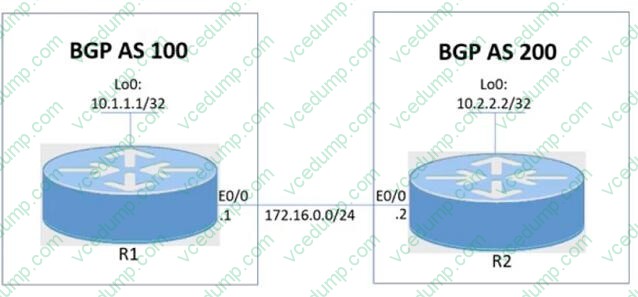
Tasks
R1 and R2 are having issues forming an eBGP neighbor relationship. Troubleshoot and resolve the issue to achieve these goals:
1. Configure R1 and R2 to form a BGP neighborship using their Loopback interfaces.
2. Form the neighbor relationship using a BGP multihop mechanism. Use minimal values to solve the issue.
A. See explanation below.
B. PlaceHolder
C. PlaceHolder
D. PlaceHolder -
Question 190:
What are two features of 6RD IPv6 transition mechanism? (Choose two.)
A. It inserts IPv4 bits into an IPv6 delegated prefix.
B. It uses a native IPv6-routed network between CE routers and the BR router.
C. It allows dynamic 1:N translation of IPv6 address.
D. It uses stateful automatic 6to4 tunnels between CE routers and the BR router.
E. It uses stateless automatic 6to4 tunnels between CE routers and the BR router.
Tips on How to Prepare for the Exams
Nowadays, the certification exams become more and more important and required by more and more enterprises when applying for a job. But how to prepare for the exam effectively? How to prepare for the exam in a short time with less efforts? How to get a ideal result and how to find the most reliable resources? Here on Vcedump.com, you will find all the answers. Vcedump.com provide not only Cisco exam questions, answers and explanations but also complete assistance on your exam preparation and certification application. If you are confused on your 350-501 exam preparations and Cisco certification application, do not hesitate to visit our Vcedump.com to find your solutions here.