350-501 Exam Details
-
Exam Code
:350-501 -
Exam Name
:Implementing and Operating Cisco Service Provider Network Core Technologies (SPCOR) -
Certification
:CCIE Service Provider -
Vendor
:Cisco -
Total Questions
:568 Q&As -
Last Updated
:Jul 11, 2026
Cisco 350-501 Online Questions & Answers
-
Question 101:
The network-engineering team of a service provider is integrating several recently acquired networks into a more scalable common Unified MPLS architecture. The new network architecture will support end-to-end VPNv4 and VPNv6 services with these requirements:
1. The IGP of the core layer is IS-IS in Area 0.
2. The IGP of the aggregation layers is OSPF in Area 0.
3. The LDP protocol is used to distribute label bindings within each IGP domain.
Which task must the network engineer perform when implementing this new architecture?
A. Configure a BGP session between the ABR routers of each IGP domain to exchange VPNv4 or VPNv6 prefixes.
B. Configure mutual redistribution of each IGP domain's loopback prefix to provide end-to-end LDP LSP.
C. Configure the ABR in each IGP domain to preserve next-hop information on all VPNv4 and VPNv6 prefixes advertised by the PE.
D. Configure BGP-LU between ABR routers of each IGP domain to carry MPLS label information in NLRI. -
Question 102:
Which protocol in the IPv6 stack does the MLD protocol use to carry its messages?
A. NDP
B. IGMPv6
C. DHCPv6
D. IGMP
E. ICMPv6 -
Question 103:
Which three OSPF parameters must match before two devices can establish an OSPF adjacency? (Choose three.)
A. IP address
B. subnet mask
C. interface cost
D. process ID
E. area number
F. hello timer setting -
Question 104:
Which set of facts must the network architect consider when deciding whether to implement SaltStack or Chef?
A. Chef is an agent-based tool based on Ruby and SaltStack is a module tool based on Python
B. Chef refers to its automation instructions as manifests and SaltStack refers to its instructions as a playbook
C. Chef uses a message-based system and SaltStack uses an agent to deliver messages.
D. Chef is written in Python and SaltStack is written in Ruby. -
Question 105:
Which two PHY modes are available to implement an IOS XR 10 Gigabit Ethernet interface? (Choose two.)
A. LAN
B. SONET
C. MAN
D. WAN
E. WDWM -
Question 106:
According to RFC5305 on IS-IS extensions for traffic engineering, what is the 4-octet sub- TLV type 10 of extended IS-IS reachability TLV type 22?
A. TE default metric
B. maximum reservable link bandwidth
C. administrative group (color)
D. IPv4 neighbor address -
Question 107:
Refer to the exhibit.
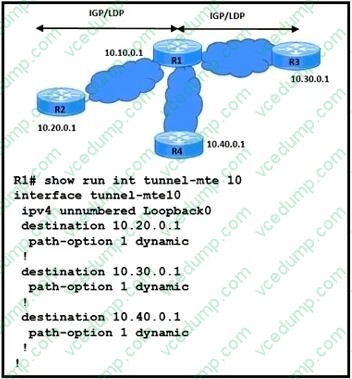
An engineer must implement a traceroute operation to verify the R1 point-to-multipoint LSP connections. The traceroute operation must return all labels and hop-by-hop IP addresses for destinations 10.20.0.1, 10.30.0.1, and 10 40.0.1, and the maximum number of hops is 4.
Which command must be executed to meet the requirements?
A. traceroute mpls ipv4 10.30.0.1/32 fec-type generic
B. traceroute mpls ipv4 10.20.0.1/32 ttl 4
C. traceroute mpls traffic-eng tunnel-mte 10 ttl 4
D. traceroute mpls traffic-eng tunnel-mte 10 responder-id 10.40.0.1 -
Question 108:
Refer to the exhibit.
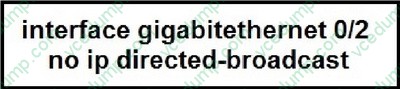
interface gigabitethernet 0/2 no ip directed-broadcast
Which type of DDoS attack will be mitigated by this configuration?
A. SYN flood
B. smurf attack
C. SIP INVITE flood attacks
D. teardrop attack -
Question 109:
Refer to the exhibit.
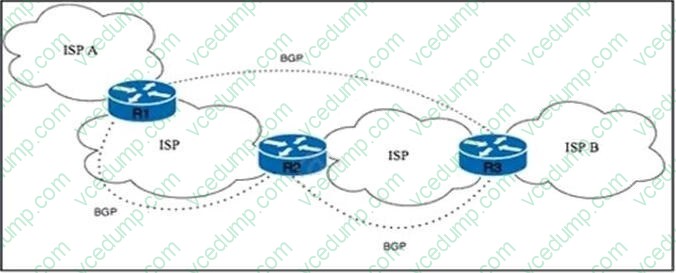
Tier 1 ISP A is connected to small Tier 3 ISP B. The EBGP routing protocol is used for route exchange. The networking team at ISP A noticed the flapping of BGP sessions with ISP B. The team decides to improve stability on the network by suppressing the subnet for 30 minutes when a session begins to flap.
Which action must the team perform to meet this goal?
A. Implement BGP route dampening on ISP A router R1 with the bgp dampening 15 700 1500 30 command.
B. Implement a BGP route withdraw-delay timer on ISP B router R3 with the bgp withdraw-delay 30 15 90 30 command.
C. Implement a BGP route-penalty timer on ISP A router R1 with the bgp penalty-timer 30 250 750 15 command.
D. Implement BGP route suppression on ISP A router R2 with the bgp suppression 30 600 1200 30 command. -
Question 110:
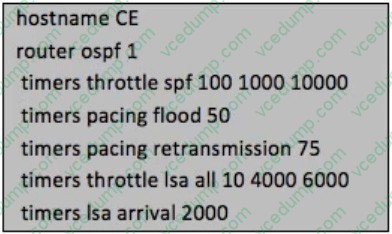
Refer to the exhibit. OSPF is the routing protocol between the PE-CE link in a multihomed topology. OSPF is needed to achieve rapid convergence in case of a link failure. Which option is the waiting time between reception of the same LSA from an OSPF neighbor?
A. 50 msecs
B. 2 seconds
C. 6 seconds
D. 4000 seconds
E. 75 msecs
Tips on How to Prepare for the Exams
Nowadays, the certification exams become more and more important and required by more and more enterprises when applying for a job. But how to prepare for the exam effectively? How to prepare for the exam in a short time with less efforts? How to get a ideal result and how to find the most reliable resources? Here on Vcedump.com, you will find all the answers. Vcedump.com provide not only Cisco exam questions, answers and explanations but also complete assistance on your exam preparation and certification application. If you are confused on your 350-501 exam preparations and Cisco certification application, do not hesitate to visit our Vcedump.com to find your solutions here.