300-620 Exam Details
-
Exam Code
:300-620 -
Exam Name
:Implementing Cisco Application Centric Infrastructure (DCACI) -
Certification
:CCNP Data Center -
Vendor
:Cisco -
Total Questions
:388 Q&As -
Last Updated
:Jul 09, 2026
Cisco 300-620 Online Questions & Answers
-
Question 131:
A network engineer is integrating a new Hyperflex storage duster into an existing Cisco ACI fabric. The Hyperflex cluster must be managed by vCenter, so a new vSphere Distributed switch must be created. In addition, the hardware discovery must be performed by a vendor-neutral discovery protocol. Which set of steps meets these requirements?
A. Configure an Interface Policy group, select CDP, and apply it to the desired interfaces. Enter the vCenter IP and credentials in the Create vCenter Controller dialog box. In the Create VMware VMM domain dialog box, select Read-Only Mode.
B. Configure an Interface Policy group, select LLDP, and apply it to the selected interfaces. Create a VLAN pool, add it to the VMware VMM domain, and include the appropriate interfaces. Enter the vCenter IP and credentials in the Create vCenter Controller dialog box.
C. Configure a Switch Policy group, select LLDP, and apply it to the indicated interfaces. Set up a VMware VMM domain and apply it to the appropriate interfaces. Enter the APIC management IP and credentials in the Create vCenter Controller dialog box.
D. Configure an Interface Policy group, select CDP, and apply it to the designated interfaces. Create a VMware VMM domain, add it to the VLAN pool, and associate it to the designated interfaces. Select Read Only Mode in the Create VMware VMM domain dialog box. -
Question 132:
Refer to the exhibit.
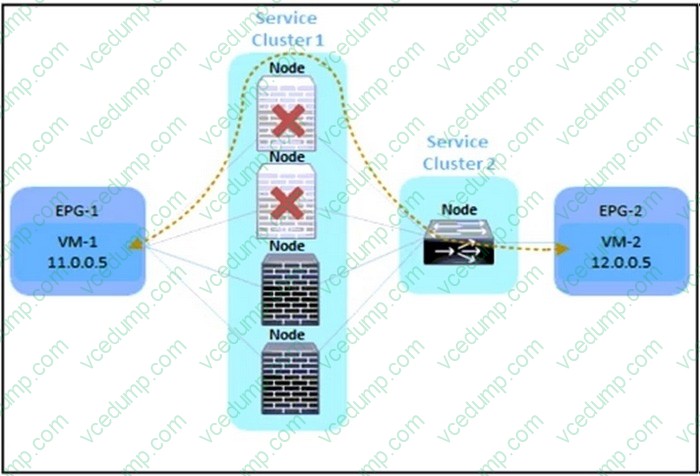
An engineer must divert the traffic between VM-1 and VM-2 by using a Multi-Node service graph. The solution should prevent an insufficient number of available Layer 4 to Layer 7 devices in the first cluster. Which configuration set accomplishes this goal?
A. PBR node tracking tracking threshold with action bypass symmetric PBR resilient hashing
B. PBR node tracking tracking threshold with action permit unidirectional PBR resilient hashing
C. PBR node tracking tracking threshold with action permit symmetric PBR resilient hashing
D. PBR node tracking tracking threshold with action deny symmetric PBR unidirectional PBR -
Question 133:
An administrator must collect hardware and environmental messages from leaf and spine switches and send them to an external logging server. Which monitoring method should be configured?
A. endpoint retention policy
B. syslog destination and source policy
C. COOP policy
D. bridge domain subnet scope -
Question 134:
How does a Cisco ACI fabric update endpoint information when an endpoint transitions between two Cisco ACI leaf switches?
A. The original leaf reports the move to the COOP database on spine switches.
B. COOP creates a bounce entry in the new leaf instead of data plane learning.
C. The new leaf updates the COOP database on spine switches with the new endpoint.
D. The spine switch pushes all endpoint database entries to each leaf switch. -
Question 135:
Refer to the exhibit.
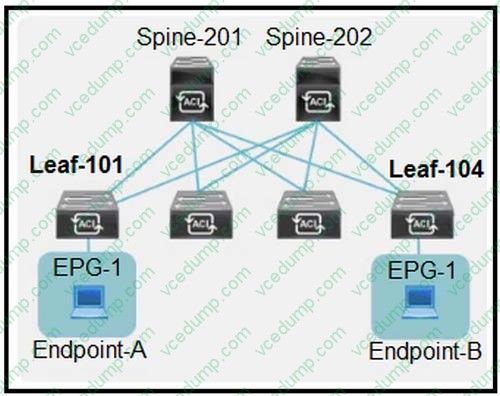
Endpoint-A must communicate with Endpoint-B, but Leaf-101 has not learned the location of Endpoint-B. Which step must Leaf-101 take before sending the data?
A. Leaf-101 forwards the packet to the anycast proxy VTEP IP.
B. Leaf-101 creates an eVXLAN tunnel to Leaf-104.
C. Leaf-101 sends the packet to the Spine-201.
D. Leaf-101 broadcasts an ARP request on a link to one of the spines. -
Question 136:
Which two types of interfaces are supported on border leaf switches to connect to an external router? (Choose two.)
A. subinterface with VXLAN tagging
B. subinterface with 802.1Q tagging
C. FEX host interface
D. out of band interface
E. Switch Virtual Interface -
Question 137:
When Layer 3 routed traffic is destined to a Cisco ACI fabric, which mechanism does ACI use to detect silent hosts?
A. gratuitous ARP
B. ARP gleaning
C. proxy ARP
D. inverse ARP -
Question 138:
Refer to the exhibit.
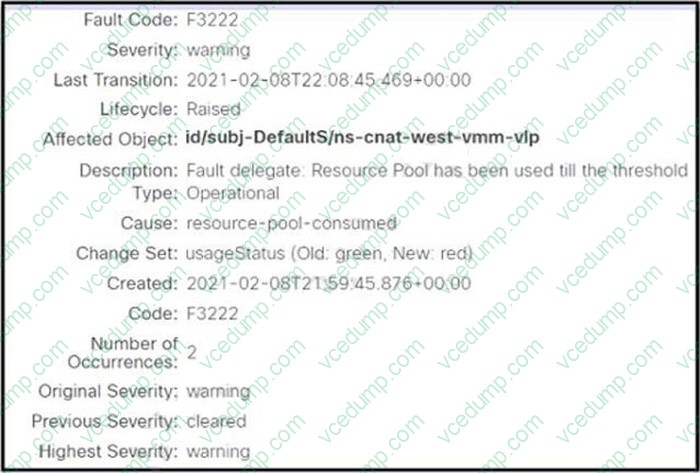
A Cisco APIC raises an error when the EPG must accept endpoints from a VMM domain created. Which action clears the fault?
A. Expand the VLAN pool for the VMM domain.
B. Create a bridge domain for the VMM domain.
C. Associate the EPG with the VMM domain.
D. Associate the VLAN pool with the VMM domain. -
Question 139:
A company deploys separate ACI sites, each with its own APIC cluster, and wants policy-based intersite connectivity between them. Which ACI Anywhere architecture is being described?
A. Multi-Pod
B. Remote Leaf
C. Multi-Site
D. bridge domain stretching only -
Question 140:
A RADIUS user resolves its role via the Cisco AV Pair. What object does the Cisco AV Pair resolve to?
A. tenant
B. security domain
C. primary Cisco APIC
D. managed object class
Related Exams:
-
300-610
Designing Cisco Data Center Infrastructure (DCID) -
300-615
Troubleshooting Cisco Data Center Infrastructure (DCIT) -
300-620
Implementing Cisco Application Centric Infrastructure (DCACI) -
300-630
Implementing Cisco Application Centric Infrastructure - Advanced (DCACIA) -
300-635
Automating and Programming Cisco Data Center Solutions (DCAUTO) -
350-601
Implementing and Operating Cisco Data Center Core Technologies (DCCOR)
Tips on How to Prepare for the Exams
Nowadays, the certification exams become more and more important and required by more and more enterprises when applying for a job. But how to prepare for the exam effectively? How to prepare for the exam in a short time with less efforts? How to get a ideal result and how to find the most reliable resources? Here on Vcedump.com, you will find all the answers. Vcedump.com provide not only Cisco exam questions, answers and explanations but also complete assistance on your exam preparation and certification application. If you are confused on your 300-620 exam preparations and Cisco certification application, do not hesitate to visit our Vcedump.com to find your solutions here.