300-510 Exam Details
-
Exam Code
:300-510 -
Exam Name
:Implementing Cisco Service Provider Advanced Routing Solutions (SPRI) -
Certification
:CCNP Service Provider -
Vendor
:Cisco -
Total Questions
:279 Q&As -
Last Updated
:Jul 09, 2026
Cisco 300-510 Online Questions & Answers
-
Question 191:
Refer to the exhibit.

The Cisco router has a single uplink to the upstream network, which is critical to the business. The router is configured for traffic steering with the Autoroute mechanism configured to steer all OSPF and IS-IS prefixes over non-shortest paths and divert traffic for those prefixes to the SR-TE policy. However, the Autoroute Announce functionality for all prefixes is not working.
Which additional command set must the engineer configure on the router to correct this issue?
A. Option A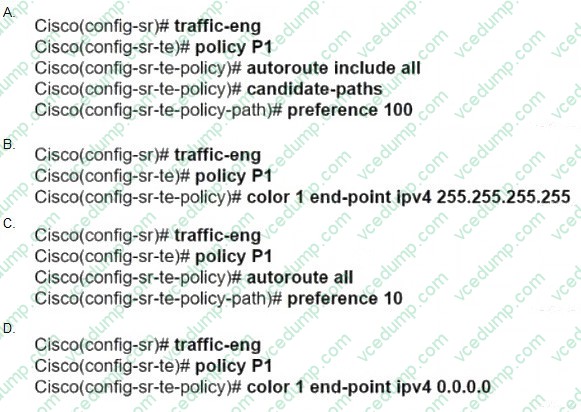
B. Option B
C. Option C
D. Option D -
Question 192:
Refer to the exhibit.
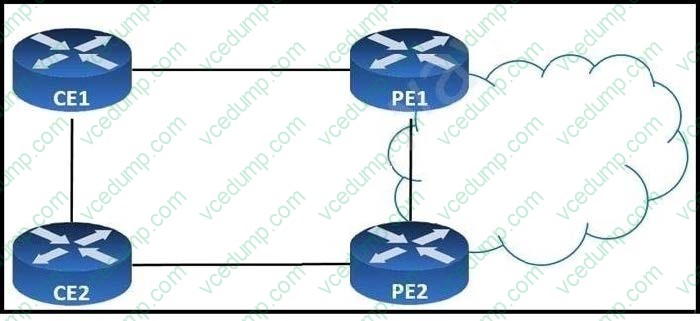
CE1 and CE2 are iBGP neighbors in AS 65516. All traffic that exits AS 65516 must use the link from CE1 to PE1. CE1 is advertising a higher local preference to CE2, but traffic from CE2 still prefers the PE2 link. Which action corrects the problem?
A. Add the lower local-preference value on PE2 towards CE2.
B. Configure CE1 to send routes to CE2 with a higher MED.
C. Configure CE1 to send routes to CE2 with a higher weight.
D. Add the next-hop self command to the CE1 neighbor statement for CE2. -
Question 193:
Refer to the exhibit.
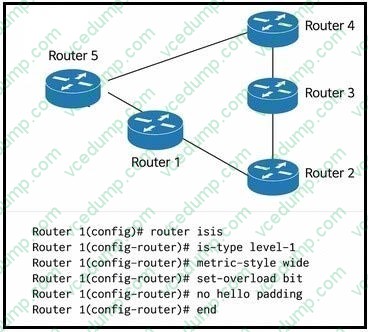
A network engineer commissioned Router 1, which connects to Router 2 and Router 5. Router 1 participates in IS-IS routing with other routers, but it is not used for transit traffic. Traffic from Router 2 to Router 5 is expected to travel via Router 1, but the traffic is traveling via Router 3 and Router 4. Which action resolves this problem?
A. Add hello padding on Router 1.
B. Remove the hello padding on Router 5.
C. Add the overload bit on Router 5.
D. Remove the overload bit on Router 1. -
Question 194:
Refer to the exhibit.
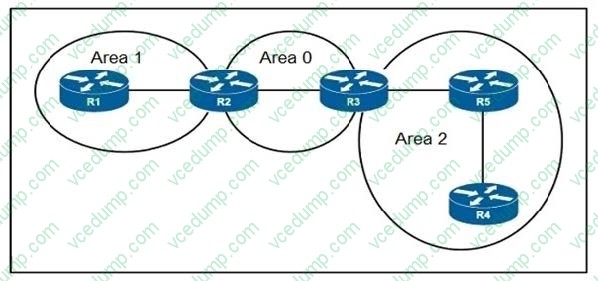
A network engineer applied configuration on R5 to summarize all OSPF routes, but R4 is still receiving specific routes from R5. The engineer has confirmed that both R5 and R4 routers are configured with correct summarization configuration, but R5 is not sending the summary routes. What action must the engineer take to fix the problem?
A. Remove summarization configuration on R5 and configure it on R4
B. Clear link-state database on both R4 and R5 routers for summarization to work
C. Configure a sham link between R4 and R5 to support summarization within Area 2
D. Move R4 and R5 in separate areas as now they maintain the same link-state database -
Question 195:
Refer to the exhibit.
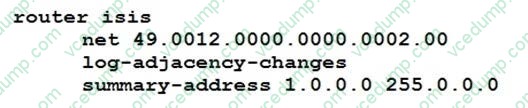
A network engineer applied configuration on R1 to summarize all ISIS routes, but R2 is still receiving specific routes from R1. The engineer has confirmed that both routers are configured with the correct summarization configuration, but R1 is not sending the correct summary routes. Which configuration must be applied to router R1 to summarize routes within Level 1?
A. R1(config-router)#no summary-address 1.0.0.0 255.0.0.0 level-1
B. R1(config-router)#summary-address 1.0.0.0 255.0.0.0 level-2
C. R1(config-router)#summary-address 1.0.0.0 255.0.0.0 level-1-2 D. R1(config-router)#summary-address 1.0.0.0 255.0.0.0 level-1 -
Question 196:
What are two features of dual-stack? (Choose two.)
A. It is implemented without excessive processing power.
B. It supports IPv4 and IPv6 traffic on the same infrastructure.
C. It allows an engineer to stack multiple Layer 2 switches to serve as a single switching unit.
D. It requires tunneling IPv6 traffic over an IPv4 infrastructure.
E. It securely routes and tunnels traffic between separate sites over the Internet. -
Question 197:
An engineer is implementing LFA FRR on PE routers to allow unicast traffic to rapidly converge around link or node failures. The engineer configured IS-IS on the newly deployed routers in the data center in the same exchange as other routers. Which additional action must the engineer take before configuring LFA on the PE routers?
A. Configure IP Cisco Express Forwarding on each router.
B. Configure the isis network point-to-multipoint command on each router.
C. Configure MPLS on each router.
D. Configure the isis network point-to-point command on each router. -
Question 198:
Refer to the exhibit.
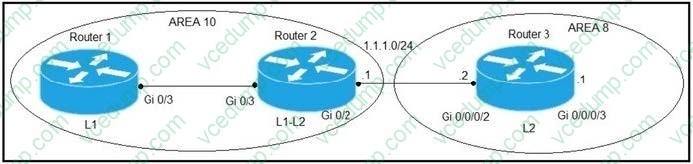
An engineer at a large ISP is troubleshooting suboptimal routing on a customer's IS-IS network with multiple Level 1-2 routers. The network consists of numerous routers that are configured for MPLS. When IS-IS picks the closest Level 1-2
router to exit the area, suboptimal routing occurs in Area 8 and Area 10. The other IGP protocols are running correctly, and the IS-IS adjacency between routers is established.
Which action resolves the issue?
A. Configure each interface as either Level 1 or Level 2 circuit type on router 1.
B. Configure the router as DIS for each of the interfaces on router 1.
C. Redistribute Level 2 prefixes into Level 1 on router 2.
D. Disable advertisement of the default route on router 2. -
Question 199:
Which tag command is used within route-map to redistribute routes that match with routes tagged with the specified tag numbers?
A. match route tag
B. match all tag
C. match tag
D. match routing tag -
Question 200:
Refer to the exhibit.
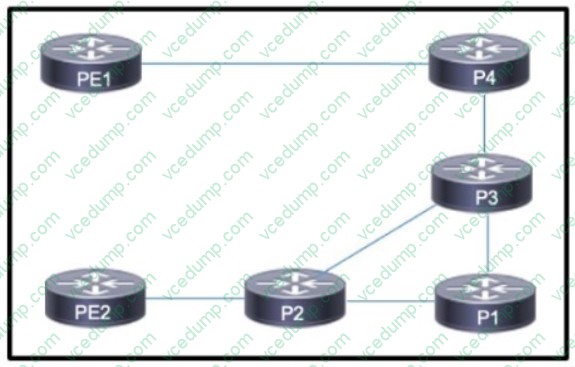
A regional service provider provides connectivity for several midsize businesses that run mission-critical applications between multiple offices connected via PE1 and PE2. Links throughout the service provider network are connected using
shared resources, and an SR-TE tunnel is used to route traffic over different paths depending on congestion policies. The networking team must implement SR updates to reduce downtime in the event of a link failure.
Which action must the team take to meet the requirements?
A. Implement SRLG protection to identify a post-convergence backup path.
B. Implement BGP timers to support immediate reconvergence when the BGP neighbor relationship status changes.
C. Implement targeted LDP neighbors to prevent unwanted LDP relationships from forming.
D. Implement VRFs to segment the network and avoid large-scale network outages when a link fails.
Related Exams:
-
300-510
Implementing Cisco Service Provider Advanced Routing Solutions (SPRI) -
300-515
Implementing Cisco Service Provider VPN Services (SVPI) -
300-535
Automating and Programming Cisco Service Provider Solutions (SPAUTO) -
350-501
Implementing and Operating Cisco Service Provider Network Core Technologies (SPCOR)
Tips on How to Prepare for the Exams
Nowadays, the certification exams become more and more important and required by more and more enterprises when applying for a job. But how to prepare for the exam effectively? How to prepare for the exam in a short time with less efforts? How to get a ideal result and how to find the most reliable resources? Here on Vcedump.com, you will find all the answers. Vcedump.com provide not only Cisco exam questions, answers and explanations but also complete assistance on your exam preparation and certification application. If you are confused on your 300-510 exam preparations and Cisco certification application, do not hesitate to visit our Vcedump.com to find your solutions here.