300-510 Exam Details
-
Exam Code
:300-510 -
Exam Name
:Implementing Cisco Service Provider Advanced Routing Solutions (SPRI) -
Certification
:CCNP Service Provider -
Vendor
:Cisco -
Total Questions
:279 Q&As -
Last Updated
:Jul 17, 2026
Cisco 300-510 Online Questions & Answers
-
Question 161:
Refer to the exhibit.
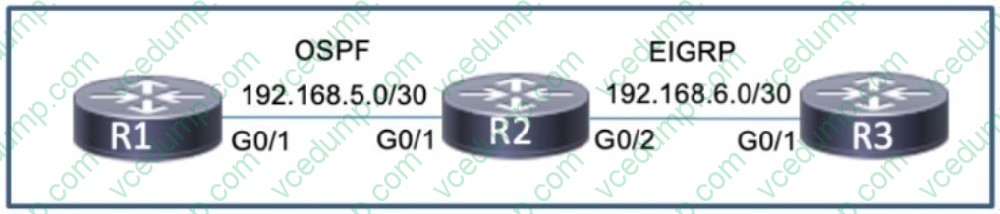
A company has been running OSPF and EIGRP on two separate portions of the network. To allow communication to flow between these previously isolated parts of the business, the networking team just configured R2 to mutually redistribute routes between EIGRP and OSPF. R3 has the OSPF routes in its routing table, but R1 is failing to receive EIGRP routes for the link between R2 and R3. Which action must the team take to resolve the issue?
A. Configure EIGRP on R1.
B. Configure the redistribution statement with the subnets keyword under the R2 OSPF configuration.
C. Configure a virtual link between R1 and R2 to handle traffic without an assigned area.
D. Configure R1 with a static route with the next hop set to R3, using the vrf keyword to avoid the global routing table. -
Question 162:
Refer to the exhibit.
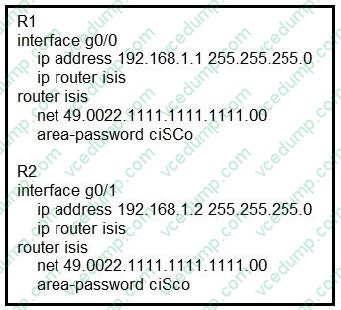
After you applied these configurations to routers R1 and R2, the two devices could not form a neighbor relationship. Which reason for the problem is the most likely?
A. The two routers cannot authenticate with one another.
B. The two routers have the same area ID.
C. The two routers have the same network ID.
D. The two routers have different IS-types. -
Question 163:
Refer to the exhibit.
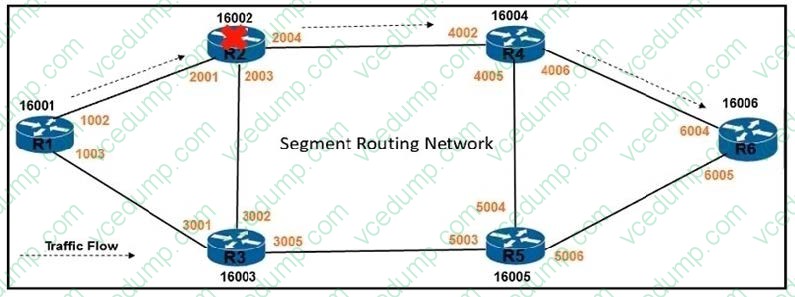
Traffic flow from router R1 to router R6 is delay-sensitive. It must consider potential link-failure and node-failure conditions. Which configuration must an engineer apply to router R1 to route traffic to router R6 if router R2 fails?
A. Option A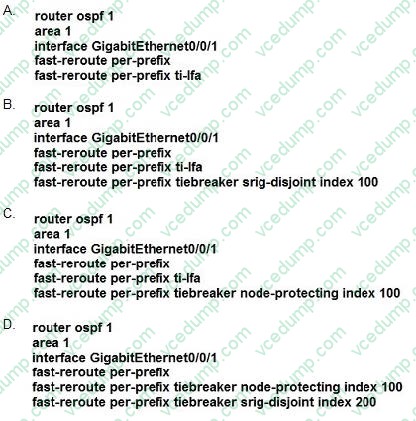
B. Option B
C. Option C
D. Option D -
Question 164:
Refer to the exhibit.
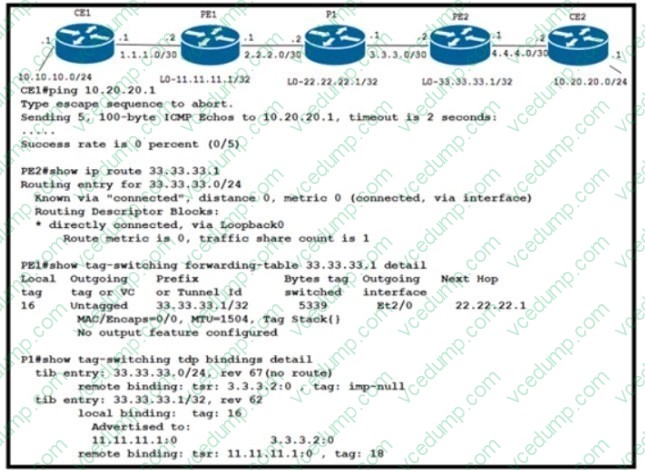
The network is situated at different locations on the customer site. The customer runs a mission-critical application behind CE2, which is connected over a 10G link to the customer's local network. After recent configuration changes to the P and PE routers, an LSP failure has occurred, causing connectivity issues. CE1 is unable to reach the CE2 internal IP address. Which action resolves this issue?
A. Implement BGP in the core and configure an MPLS TE tunnel between PE1 and PE2.
B. Configure the ip ospf network point-to-multipoint command on PE2.
C. Change the subnet mask on the PE2 loopback interface from /24 to /32.
D. Configure the ip ospf network point-to-point command on PE2. -
Question 165:
An engineer is working to implement segment routing protocol on the customer's core network. Which step should the engineer take before the segment routing is enabled and is running with BGP?
A. Segment routing must be configured with ISIS.
B. Segment routing must be configured with EIGRP.
C. Explicit-null must be configured for all neighbors.
D. MPLS must be configured. -
Question 166:
Refer to the exhibit.
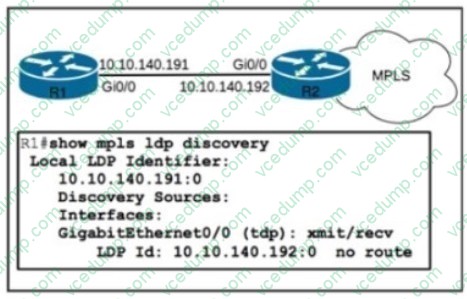
Routers R1 and R2 are RFC 5036-based, MPLS-enabled core routers. MPLS IP is enabled globally on both routers. OSPF with area 0 configuration is used as the interior routing protocol between the routers. After new services were enabled on the MPLS network, LDP connectivity failed on R1. TCP/UDP port 711 is confirmed to be open. Which two actions must the engineer take to correct the problem? (Choose two.)
A. Configure network 10.10.140.192 0.0.0.0 area 0 under the OSPF configuration on R2.
B. Configure mpls label protocol ldp under the Gi0/0 interface on R1.
C. Configure mpls ip under the Gi0/0 interface on R1.
D. Configure network 10.10.140.192 0.0.0.255 area 0 under the OSPF configuration on R2.
E. Configure mpls label protocol tdp under the Gi0/0 interface on R1. -
Question 167:
Refer to the exhibit.
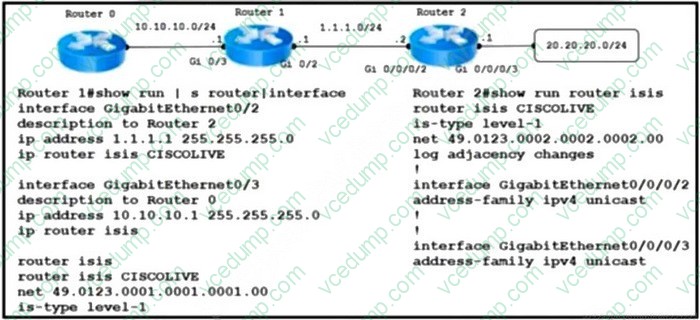
An engineer is troubleshooting a network routing issue on this IS-IS network situated at the customer's regional hub. Router 2 that runs Cisco IOS XR Software cannot see the network 10.10.10.0/24 on router 1. The Layer 2 encapsulations are correct. The ARP connectivity for the Ethernet interface that runs IS-IS is working. Which action resolves the issue?
A. On router 1, remove the CISCOLIVE keyword after the ip router isis command under interface GigabitEthernet0/2.
B. Under the router isis command on router 2, change is-type level-1 to is-type level-2.
C. Under the router isis command on router 1, change is-type level-1 to is-type level-2.
D. On router 1, add the CISCOLIVE keyword after the ip router isis command under interface GigabitEthernet0/3. -
Question 168:
Refer to the exhibit.
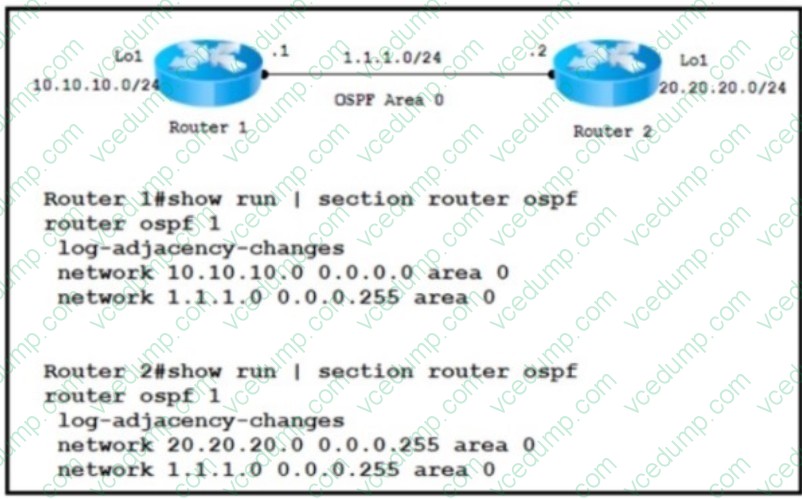
A network engineer at a large ISP with an employee ID 4876 94 052 started to configure OSPF on two routers. The engineer notices that Router 1 learned about network 20.20.20.0/24 from Router 2, but Router 2 did not learn about
10.10.10.0/24 from Router 1. Layer 2 and Layer 3 connectivity are working between the two routers, and the physical connection between the devices is functioning.
Which action must the engineer take to resolve the issue?
A. Replace the Router 1 OSPF network configuration with network 10.10.10.0 0.0.0.255 area 0.
B. On Router 1, configure a route map with a distribute-list for the 10.10.10.0/24 network.
C. Replace the Router 2 OSPF network configuration with network 10.10.10.0 0.0.0.255 area 0.
D. On Router 2, configure a route map with a distribute-list for the 10.10.10.0/24 network. -
Question 169:
Refer to the exhibit
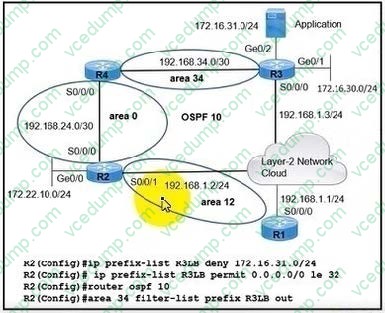
Networks 172.16.31.0/24 and 172.16.30.0/24 are advertised in area 34, and network 172.22.10.0/24 is advertised in area 0.
A recent security review discovered that users connected to routers R1 and R2 have been making unauthorized access to an application running on network 172.16.31.0/24.
An engineer determined that routers R1 and R2 are receiving updates for network 172.16.31.0/24.
Which action resolves the issue?
A. Apply route filtering on routers R3 and R4.
B. Apply route filtering on router R3 only.
C. Apply route filtering on routers R1 and R2
D. Apply route filtering on router R4 only. -
Question 170:
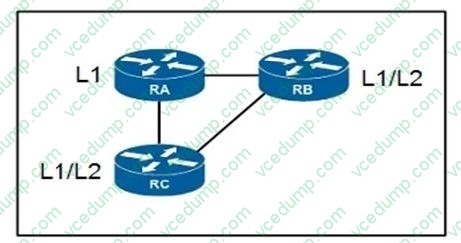
Refer to the exhibit. Routers RA and RB are IS-IS peers configured for NSF, but router RC is an IS-IS peer without NSF capability. If RA undergoes processor switchover, what is the effect on the network environment?
A. If RC is operating without the Cisco configuration option, only 2 routers tear down their peering relationships and re-establish peering
B. All peer relationships remain up, but the link-state database is rebuild on each device
C. If RC is operating without the Cisco configuration option, all three routers tear down their peering relationships and re-establish peering
D. All peer relationships remain up and the link-state database is unchanged
Related Exams:
-
300-510
Implementing Cisco Service Provider Advanced Routing Solutions (SPRI) -
300-515
Implementing Cisco Service Provider VPN Services (SVPI) -
300-535
Automating and Programming Cisco Service Provider Solutions (SPAUTO) -
350-501
Implementing and Operating Cisco Service Provider Network Core Technologies (SPCOR)
Tips on How to Prepare for the Exams
Nowadays, the certification exams become more and more important and required by more and more enterprises when applying for a job. But how to prepare for the exam effectively? How to prepare for the exam in a short time with less efforts? How to get a ideal result and how to find the most reliable resources? Here on Vcedump.com, you will find all the answers. Vcedump.com provide not only Cisco exam questions, answers and explanations but also complete assistance on your exam preparation and certification application. If you are confused on your 300-510 exam preparations and Cisco certification application, do not hesitate to visit our Vcedump.com to find your solutions here.