300-510 Exam Details
-
Exam Code
:300-510 -
Exam Name
:Implementing Cisco Service Provider Advanced Routing Solutions (SPRI) -
Certification
:CCNP Service Provider -
Vendor
:Cisco -
Total Questions
:279 Q&As -
Last Updated
:Jul 17, 2026
Cisco 300-510 Online Questions & Answers
-
Question 131:
What is the difference between a source tree and a shared tree in a multicast environment?
A. To route traffic from source to receiver a source tree uses a link-state routing protocol and a shared tree uses a distance-vector routing protocol.
B. A source tree has its root at the source, and a shared tree has its root at a designated rendezvous point.
C. To stream multicast from source to receiver, a source tree uses PIM-SM and a shared tree uses PIM-DM.
D. Source trees are the default type for bidirectional PIM, and PIM-DM uses shared trees by default. -
Question 132:
Refer to the exhibit.
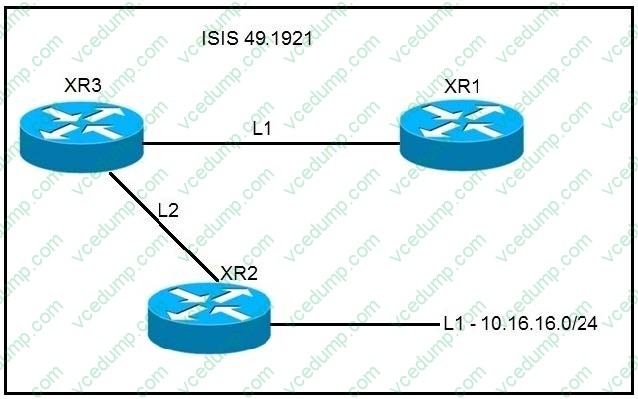
A network operator must inject a Level 1 route from XR2 (10.16.16.0/24) into the ISIS topology.
Which configuration allows the injection in a way that XR3 and XR1 have a valid and working route for 10.16.16.0/24?
A. Option A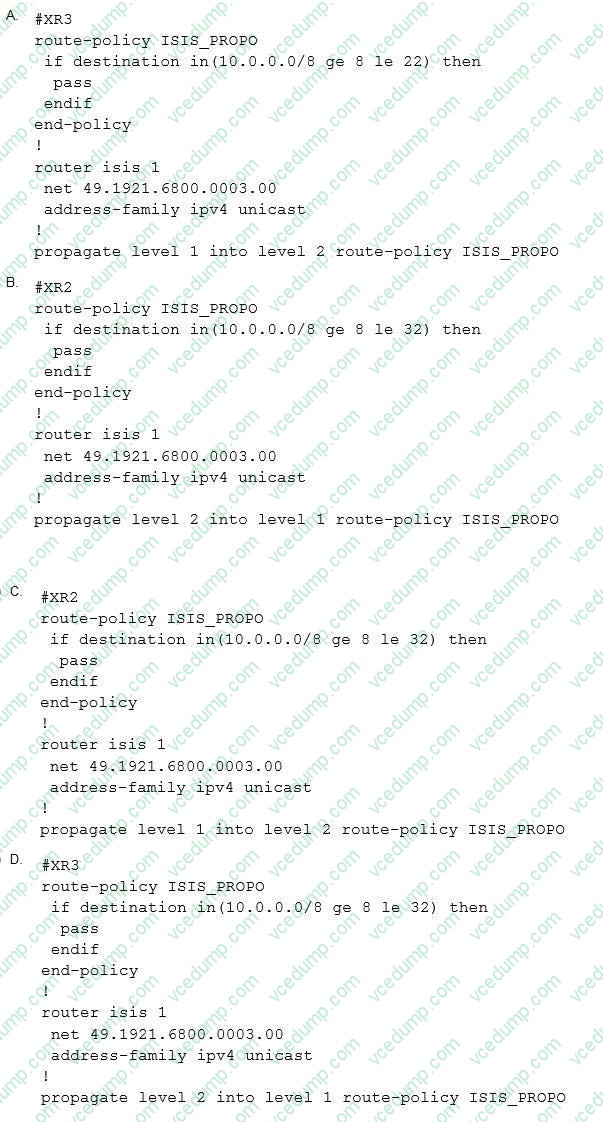
B. Option B
C. Option C
D. Option D -
Question 133:
Refer to the exhibit.
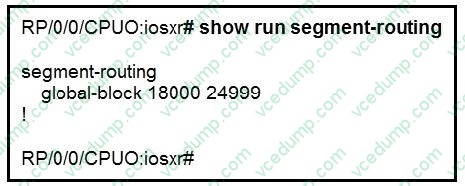
A network engineer implemented this segment routing configuration. Which statement about the output is true?
A. This range conflicts with the segment routing local block range.
B. The device must be reloaded for these ranges to be allocated and used.
C. The default segment routing global block range is being used on this device.
D. A nondefault segment routing global block range is being used on this device. -
Question 134:
Which difference must an engineer consider when Implementing Inter-domain and Intra- domain multicast routing on the network?
A. Intra-domain routing allows the service provider to control incoming and outgoing multicast data streams on its network, but inter-domain routing limits the service provider's control.
B. Intra-domain routing uses the PIM and MBGP protocols for multicast routing, but inter- domain routing must use PIM.SSM or MSDP.
C. Intra-domain routing is dependent on the RP router within the same SP network, but inter-domain routing reduces the dependency on the other SP network.
D. Inter-domain routing supports policy routing to connect different multicast domains using PIM.SM, but intra-domain routing supports policy routing using PIM-SM only within a single domain. -
Question 135:
In which four ways does DHCPv6 differ from DHCPv4? (Choose four.)
A. DHCPv6 uses the same message types as DHCPv4.
B. DHCPv4 functions without external protocols.
C. A host discovers a DHCPv6 server by using a DHCP Discover packet.
D. A hosts discovers a DHCPv6 server by using a DHCP Solicit packet.
E. A DHCPv6 server replies with a DHCP Offer packet.
F. A DHCP server replies with a DHCP Advertise message.
G. An IPv6 host can request multiple addresses at the same time from a DHCPv6 server.
H. An IPv6 host can request only one IP address at a time from a DHCPv6 server. -
Question 136:
Refer to the exhibit.
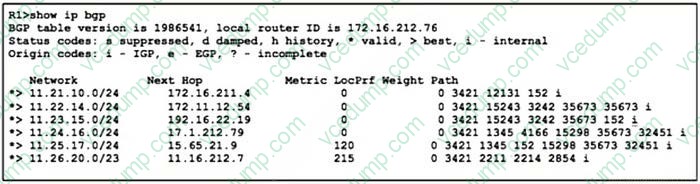
Company A established BGP sessions with several ISPs. A network engineer at the company must filter out all traffic except for routes that transit AS 152.
The engineer configured the filtering policy "permit _152S_(_[0.9])" on R1, but after applying the configuration, the engineer notices that other routes are still visible.
Which action resolves the issue?
A. Add a second filtering policy in the format ip access-list 1 permit ^152_([0-9]+).
B. Add a second filtering policy in the format ip prefix-list 1 permit ^152^.
C. Change the filtering policy to ip explicit-path 1 permit $152^.
D. Change the filtering policy to ip as-path access-list 1 permit _152_. -
Question 137:
Refer to the exhibit.
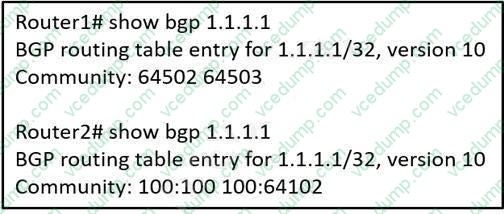
An engineer working on a client's network is trying to solve the BGP community issue on R1 and R2 routers. After displaying the BGP entries, the engineer notices that both routers still have different outputs. Which action must the engineer perform to any of the routers to correct the problem and get the same output?
A. Execute the lp bgp-community new-format command in Router1.
B. Remove the lp bgp-community new-format command in Router1.
C. Advertise the route to Router2 as standard community.
D. Advertise the route to Router2 as extended community. -
Question 138:
An ISP has an MPLS VPN-based network with 12 PE routers.
How many peerings are required between the 12 routers if the engineer has not configured route reflectors?
A. 60
B. 66
C. 78
D. 84 -
Question 139:
Level 3 switch SW1 is part of an EIGRP enabled network located at the edge of an area. Cisco Express Forwarding and SSO are enabled on the router. A network engineer must minimize the downtime of data-transmit services in the network. HSRP group 2 has already been configured with standby preempt delay minimum 2 and standby timers 140. Which additional action must the engineer take on SW1 to suppress routing flaps for 2 minutes?
A. Configure timers standby 2 wait 2 under the HSRP group 2 configuration.
B. Configure timers nsf route-hold 120 under the global EIGRP configuration.
C. Configure timers nsf signal 2 under the global EIGRP IPv4 address family.
D. Configure timers standby 2 coverage 120 under the HSRP group 2 configuration. -
Question 140:
Refer to the exhibit.
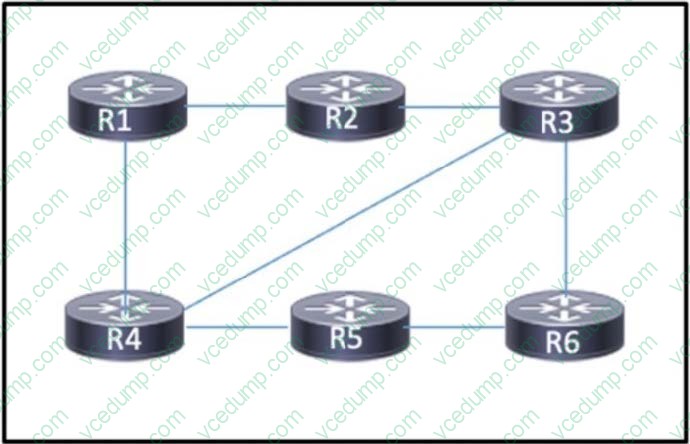
IS-IS is the IGP for the network, where routers R1, R2, R3, and R4 are Level 1 routers in Area 12 and routers R5 and R6 are Level 2 routers in area 16. According to the network design, router R1 must send traffic to R6 using R4 as its next hop. To meet the requirement, a network engineer configured route filtering on R2 to prevent the route to R6 from being advertised from R2. However, R1 is still using R2 as the next hop. Which action must the engineer take to resolve the issue?
A. Disable wide area metrics and use only cost to perform the route manipulation.
B. Manipulate link costs to provide the desired routing through R4
C. Move all routers into the same IS-IS area.
D. Configure routers R5 and R6 as Level 1/2 routers
Related Exams:
-
300-510
Implementing Cisco Service Provider Advanced Routing Solutions (SPRI) -
300-515
Implementing Cisco Service Provider VPN Services (SVPI) -
300-535
Automating and Programming Cisco Service Provider Solutions (SPAUTO) -
350-501
Implementing and Operating Cisco Service Provider Network Core Technologies (SPCOR)
Tips on How to Prepare for the Exams
Nowadays, the certification exams become more and more important and required by more and more enterprises when applying for a job. But how to prepare for the exam effectively? How to prepare for the exam in a short time with less efforts? How to get a ideal result and how to find the most reliable resources? Here on Vcedump.com, you will find all the answers. Vcedump.com provide not only Cisco exam questions, answers and explanations but also complete assistance on your exam preparation and certification application. If you are confused on your 300-510 exam preparations and Cisco certification application, do not hesitate to visit our Vcedump.com to find your solutions here.