300-410 Exam Details
-
Exam Code
:300-410 -
Exam Name
:Implementing Cisco Enterprise Advanced Routing and Services (ENARSI) -
Certification
:CCNP Enterprise -
Vendor
:Cisco -
Total Questions
:955 Q&As -
Last Updated
:Jul 13, 2026
Cisco 300-410 Online Questions & Answers
-
Question 691:
How does an MPLS Layer 3 VPN function?
A. set of sites use multiprotocol BGP at the customer site for aggregation
B. multiple customer sites interconnect through service provider network to create secure tunnels between customer edge devices
C. set of sites interconnect privately over the Internet for security
D. multiple customer sites interconnect through a service provider network using customer edge to provider edge connectivity -
Question 692:
Refer to the exhibit.
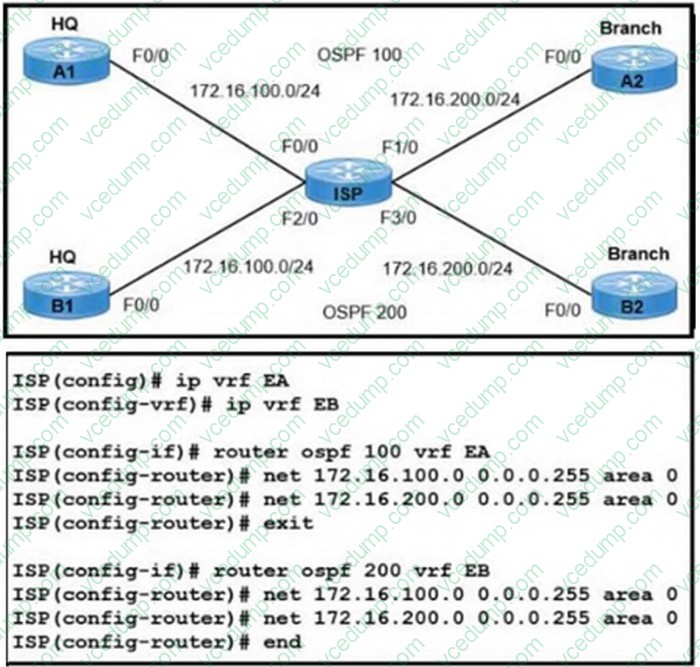
A network engineer is provisioning end-to-end traffic service for two different enterprise networks with these requirements:
1. The OSPF process must differ between customers on HQ and Branch office routers, and adjacencies should come up instantly.
2. The enterprise networks are connected with overtapping networks between HQ and a Branch office.
Which configuration meets the requirements for a customer site?
A. ISP(config-if)#int f1/0 ISP(config-if)#ip vrf forwarding EA ISP(config-if)#description TO->EA2_Branch ISP(config-if)#ip add 172.16.200.2 255.255.255.0 ISP(config-if)#no shut
B. ISP(config-vrf)#int f0/0 ISP(config-if)#ip vrf forwarding EB ISP(config-if)#description TO->EB1_Branch ISP(config-if)#ip add 172.16.100.2 255.255.255.0 ISP(config-if)#no shut
C. ISP(config)#int f2/0 ISP(config-if)#ip vrf forwarding EA ISP(config-if)#description TO->EA1_HQ ISP(config-if)#ip address 172.16.100.2 255.255.255.0 ISP(config-if)#no shut
D. ISP(config-if)#int f3/0 ISP(config-if)#ip vrf forwarding EA ISP(config-if)#description TO->EA2_Branch ISP(config-if)#ip address 172.16.200.2 255.255.255.0 ISP(config-if)#no shut -
Question 693:
Select three benefits of setting up a MPLS Network from the below options. (Choose three.)
A. Connection less Service
B. Security as good as connection-oriented VPNs
C. Provides IPS level intelligence to filter packets.
D. Integrated QoS support
E. All variations of Static routes are supported -
Question 694:
SIMULATION

Guidelines
This is a lab item in which tasks will be performed on virtual devices.
1. Refer to the Tasks tab to view the tasks for this lab item.
2. Refer to the Topology tab to access the device console(s) and perform the tasks.
3. Console access is available for all required devices by clicking the device icon or using the tab(s) above the console window.
4. All necessary preconfigurations have been applied.
5. Do not change the enable password or hostname for any device.
6. Save your configurations to NVRAM before moving to the next item.
7. Click Next at the bottom of the screen to submit this lab and move to the next question.
8. When Next is clicked, the lab closes and cannot be reopened.
Topology
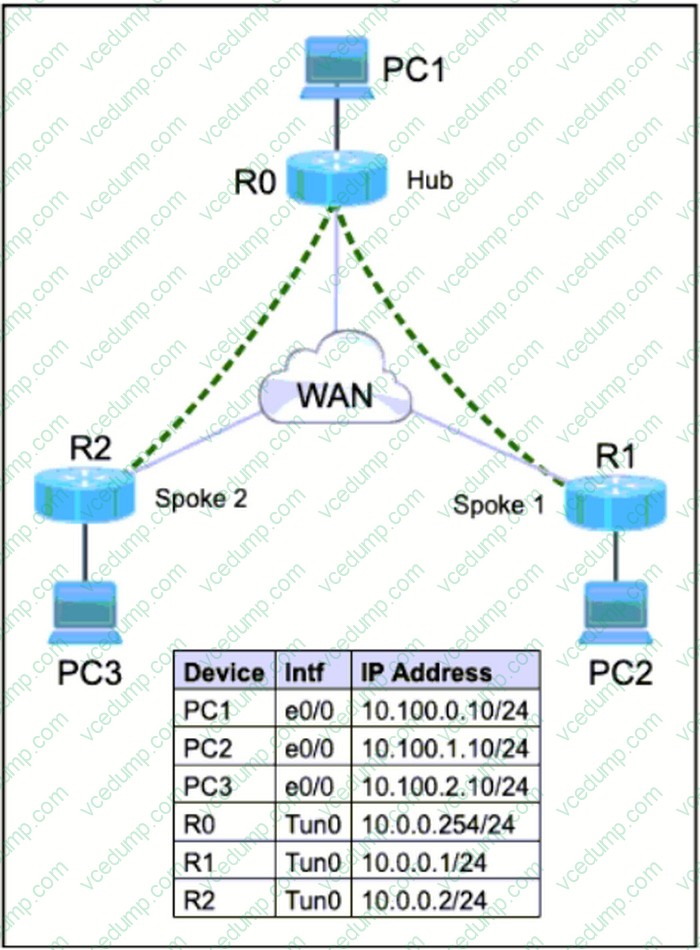
Tasks
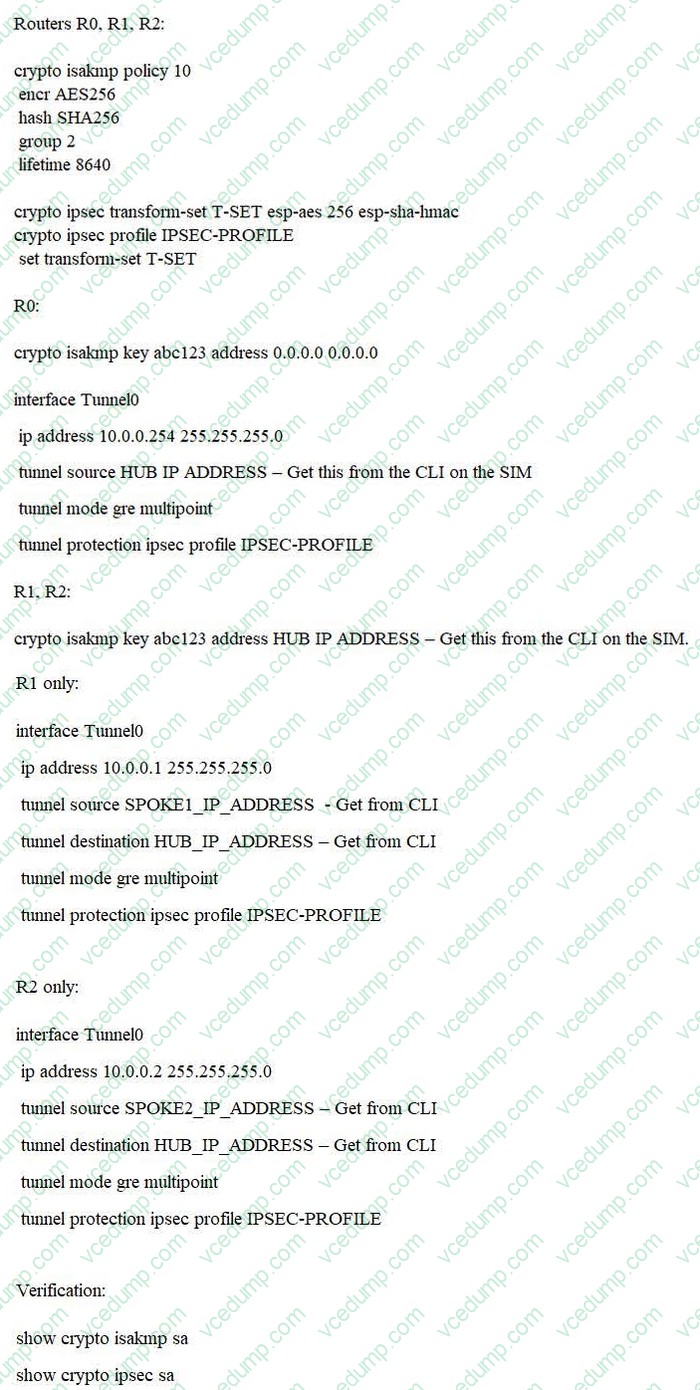
Configure IPSec security policy on tunnel interfaces to ensure data confidentiality and integrity where mGRE tunnels are up and running between HUB and SPOKE routers.
1. Configure the ISAKMP policy parameters with the following attributes: AES256 SHA256 Group2 lifetime 86400
2. Ensure that GRE IP Header should be encrypted inside the IPSec packet. Verify IPSec security association and ISAKMP encrypted key. Use ISAKMP key "abc123".
3. Configure a flexible ISAKMP Policy on the HUB to add peers that have the dynamic IP addresses where SPOKES must add HUB IP static entry using an encrypted key. Use a single command to configure it. Use IPSec phase-2 transform-set name as T-SET and IPSec Profile name as ’IPSEC-PROFILE’.
A. See the solution below in Explanation.
B. PlaceHolder
C. PlaceHolder
D. PlaceHolder -
Question 695:
SIMULATION
Guidelines
This is a lab item in which tasks will be performed on virtual devices.
1. Refer to the Tasks tab to view the tasks for this lab item.
2. Refer to the Topology tab to access the device console(s) and perform the tasks.
3. Console access is available for all required devices by clicking the device icon or using the tab(s) above the console window.
4. All necessary preconfigurations have been applied.
5. Do not change the enable password or hostname for any device.
6. Save your configurations to NVRAM before moving to the next item.
7. Click Next at the bottom of the screen to submit this lab and move to the next question.
8. When Next is clicked, the lab closes and cannot be reopened.
Topology
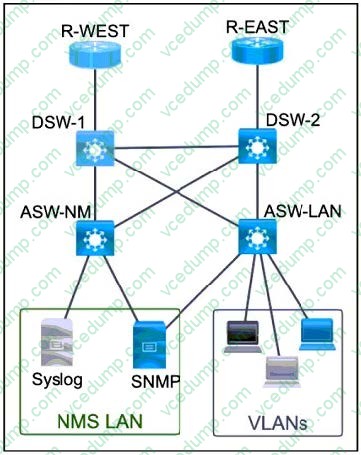
Tasks
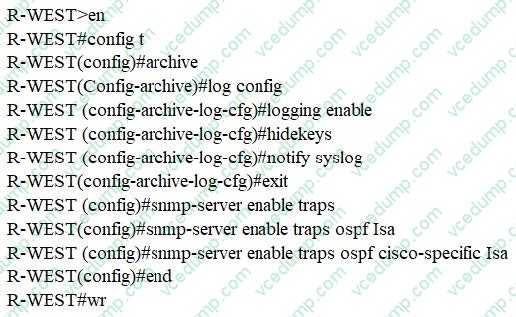
Troubleshoot R-WEST to achieve the desired results:
1. All the commands should be locally saved to the router as well as sent to the Syslog server except passwords.
2. All the Cisco OSPF LSA traps should be sent to the SNMP server.
A. See the solution below in Explanation.
B. PlaceHolder
C. PlaceHolder
D. PlaceHolder -
Question 696:
Refer to the exhibit. An engineer must establish a point-to-point GRE VPN between R1 and the remote site. Which configuration accomplishes the task for the remote site?
A. Interface Tunnel1 tunnel source 199.1.1.1 tunnel destination 200.1.1.3 ip address 192.168.1.3 255.255.255.0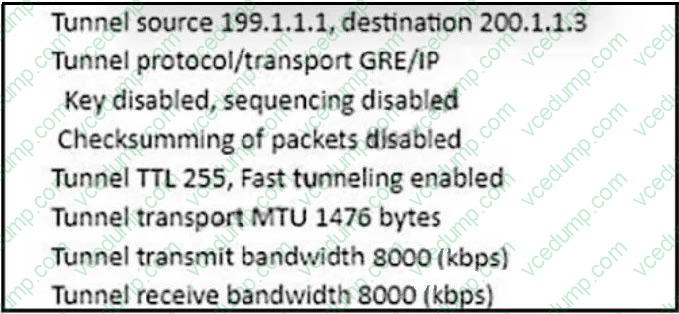
B. Interface Tunnel1 tunnel source 200.1.1.3 tunnel destination 199.1.1.1 ip address 192.168.1.1.255.255.255.0
C. Interface Tunnel1 tunnel source 200.1.1.3 tunnel destination 199.1.1.1 ip address 192.168.1.3.255.255.255.0
D. Interface Tunnel lunnel source 199.1.1.1 tunnel destination 200.1.1.3 ip address 192.168.1.1.255.255.255.0 -
Question 697:
Some of the technicians in your organization use the secure web interface to make some of the configurations changes on the router R68. Today it was reported that a technician could not make a connection to the secure web server. You execute a show run command on R68 and receive the following output:
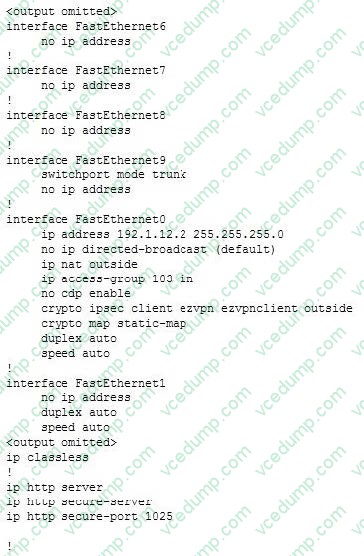
What must the technician do to make the connection to the secure web interface?
A. specify port 443 in the command
B. specify port 1025 in the command
C. disable the HTTP server first
D. enable the secure server -
Question 698:
A network administrator is troubleshooting a high utilization issue on the route processor of a router that was reported by NMS. The administrator logged into the router to check the control plane policing and observed that the BGP process is dropping a high number of routing packets and causing thousands of routes to recalculate frequently. Which solution resolves this issue?
A. Police the pir for BGP, conform action set-prec-transmit, and exceed action set-clp-transmit.
B. Police the cir for BGP, conform action transmit, and exceed action transmit
C. Shape the cir for BGP, conform-action transmit and exceed action transmit
D. Shape the pir for BGP, conform-action set-prec-transmit, and exceed action set-frde-transmit. -
Question 699:
You have implemented the following IP SLA configuration, as shown in the following partial output of the show run command:
ip sla 1 dns cow.cisco.com name-server 10.52.128.30 ip sla schedule 1 start-time now
Which of the following statements is true of this configuration?
A. it will find the response time to resolve the DNS name cow.cisco.com
B. it will find the response time to connect to the DNS server at 10.52.128.30
C. it will start in one minute
D. it will gather data from one minute -
Question 700:
How do devices operate in MPLS L3VPN topology?
A. P and associated PE routers with IGP populate the VRF table in different VPNs.
B. CE routers connect to the provider network and perform LSP functionality
C. P routers provide connectivity between PE devices with MPLS switching.
D. P routers support PE to PE VPN tunnel without LSP functionality
Related Exams:
-
300-410
Implementing Cisco Enterprise Advanced Routing and Services (ENARSI) -
300-415
Implementing Cisco SD-WAN Solutions (ENSDWI) -
300-420
Designing Cisco Enterprise Networks (ENSLD) -
300-425
Designing Cisco Enterprise Wireless Networks (ENWLSD) -
300-430
Implementing Cisco Enterprise Wireless Networks (ENWLSI) -
300-435
Automating and Programming Cisco Enterprise Solutions (ENAUTO) -
300-440
Designing and Implementing Cloud Connectivity (ENCC) -
350-401
Implementing and Operating Cisco Enterprise Network Core Technologies (ENCOR)
Tips on How to Prepare for the Exams
Nowadays, the certification exams become more and more important and required by more and more enterprises when applying for a job. But how to prepare for the exam effectively? How to prepare for the exam in a short time with less efforts? How to get a ideal result and how to find the most reliable resources? Here on Vcedump.com, you will find all the answers. Vcedump.com provide not only Cisco exam questions, answers and explanations but also complete assistance on your exam preparation and certification application. If you are confused on your 300-410 exam preparations and Cisco certification application, do not hesitate to visit our Vcedump.com to find your solutions here.