300-410 Exam Details
-
Exam Code
:300-410 -
Exam Name
:Implementing Cisco Enterprise Advanced Routing and Services (ENARSI) -
Certification
:CCNP Enterprise -
Vendor
:Cisco -
Total Questions
:955 Q&As -
Last Updated
:Jul 13, 2026
Cisco 300-410 Online Questions & Answers
-
Question 441:
Refer to the exhibit.
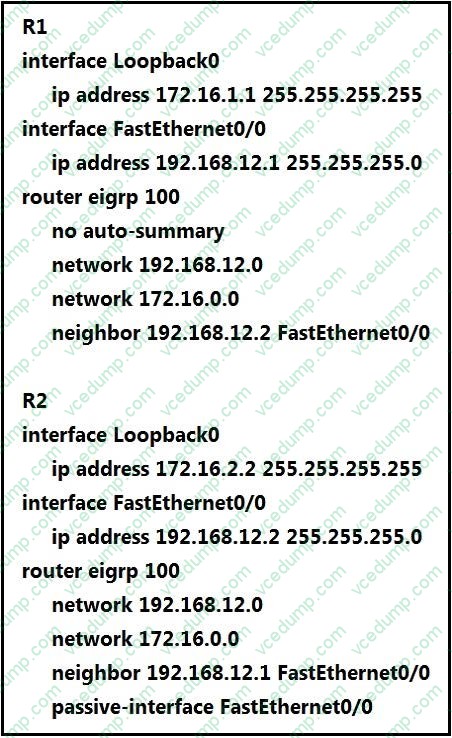
R1 and R2 cannot establish an EIGRP adjacency. Which action establishes EIGRP adjacency?
A. Remove the current autonomous system number on one of the routers and change to a different value.
B. Remove the passive-interface command from the R2 configuration so that it matches the R1 configuration.
C. Add the no auto-summary command to the R2 configuration so that it matches the R1 configuration.
D. Add the passive-interface command to the R1 configuration so that it matches the R2 configuration. -
Question 442:
A network administrator is tasked to permit http and https traffic only toward the internet from the User1 laptop to adhere to company's security policy. The administrator can still ping to www.cisco.com Which interface should the access list 101 be applied to resolve this issue?
A. Interface G0/48 in the incoming direction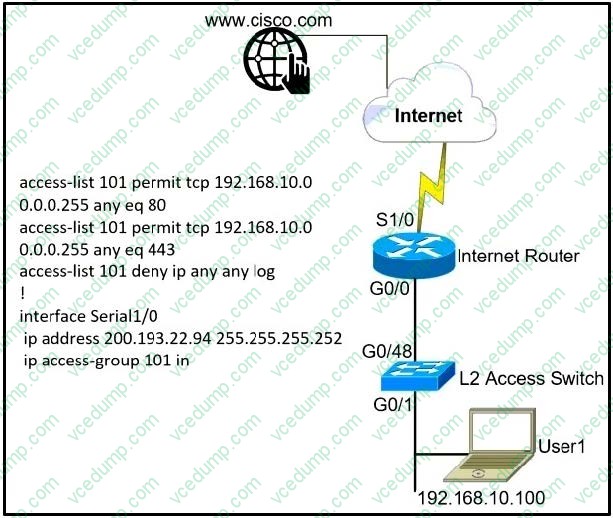
B. Interface G0/0 in the outgoing direction.
C. Interface S1/0 in the outgoing direction.
D. Interface G0/0 in the incoming direction. -
Question 443:
Refer to the exhibit.
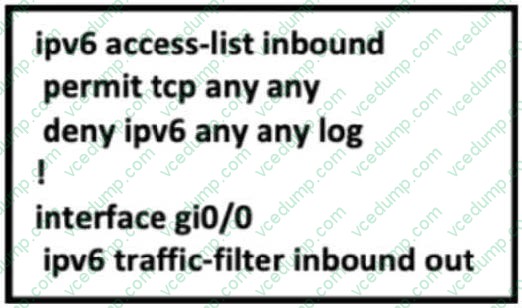
A network administrator configured an IPv6 access list to allow TCP return traffic only, but it is not working as expected. Which changes resolve this issue?
A. ipv6 access-list inbound permit tcp any any syn deny ipv6 any any log ! interface gi0/0 ipv6 traffic-filter inbound out
B. ipv6 access-list inbound permit tcp any any syn deny ipv6 any any log ! interface gi0/0 ipv6 traffic-filter inbound in
C. ipv6 access-list inbound permit tcp any any established deny ipv6 any any log ! interface gi0/0 ipv6 traffic-filter inbound in
D. ipv6 access-list inbound permit tcp any any established deny ipv6 any any log ! interface gi0/0 ipv6 traffic-filter inbound out -
Question 444:
Refer to the exhibit.
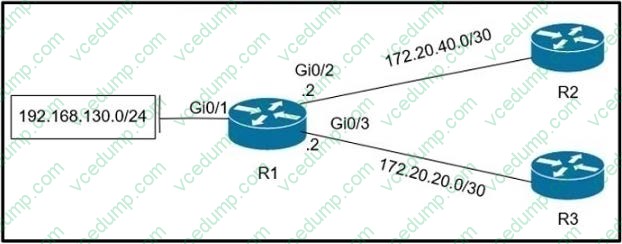
Which policy configuration on R1 forwards any traffic that is sourced from the 192 168 130 0'24 network to R2?
A. Option A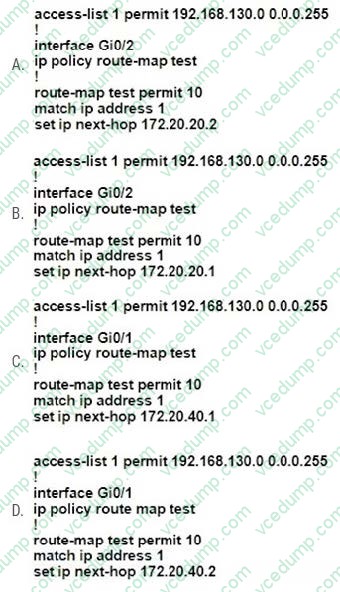
B. Option B
C. Option C
D. Option D -
Question 445:
Refer to the exhibit.
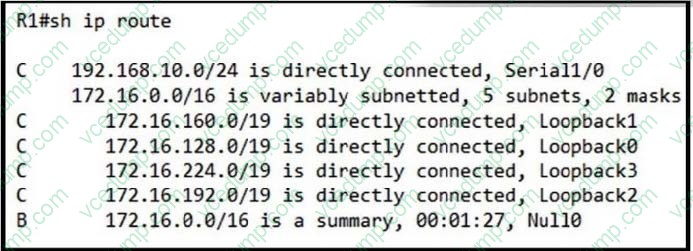
Which configuration advertises more specific routes to R1 without sending a BGP summary route?
A. R1#configure terminal R1 (config)#rouler BGP 100 R1 (conflg-router)#no auto-summary
B. R1#configure terminal R1 (config)#router BGP 100 R1 (config-router)#auto-summary
C. R2#configure terminal R2 (conflg)#router BGP 100 R2 (config-rouler)#no auto-summary
D. R2#configure terminal R2 (config)#router BGP 100 R2 (config-router)#auto-summary -
Question 446:
Refer to the exhibit.
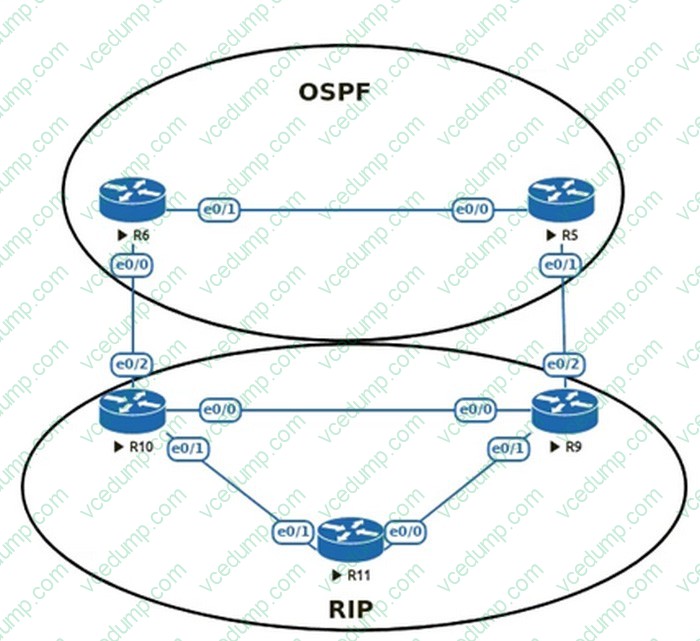
An engineer must configure OSPF with R9 and R10 and configure redistribution between OSPF and RIP, causing a routing loop. Which configuration on R9 and R10 meets this objective?
A. router ospf 1 redistribute rip subnets tag 20 ! route-map deny_tag20 deny 10 match tag 20 route-map deny_tag20 permit 20 ! router ospf 1 distribute-list route-map deny_tag20 in
B. router ospf 1 redistribute rip subnets tag 20 ! route-map deny_tag20 deny 10 match tag 20 route-map deny_tag20 deny 20 ! router ospf 1 distribute-list route-map deny_tag20 in
C. router ospf 1 redistribute rip subnets tag 20 ! route-map deny_tag20 deny 10 match tag 20 route-map deny_tag20 permit 20 ! router rip 1 distribute-list route-map deny _tag20 in
D. router ospf 1 redistribute rip subnets tag 20 ! route-map deny_tag20 permit 10 match tag 20 route-map deny_tag20 permit 20 ! router ospf 1 distribute-list route-map deny_tag20 in -
Question 447:
In an MPLS VPN network, how are customer routes controlled and distributed?
A. Through the use of GRE tunnels
B. Customer routes are redistributed into the IGP that the service provider is using
C. Customer routes are redistributed into BGP within the service provider
D. It is distributed through the use of route targets -
Question 448:
Refer to the exhibit. An engineer configures a static route on a router, but when the engineer checks the route to the destination, a different next hop is chosen. What is the reason for this?
A. Dynamic routing protocols always have priority over static routes.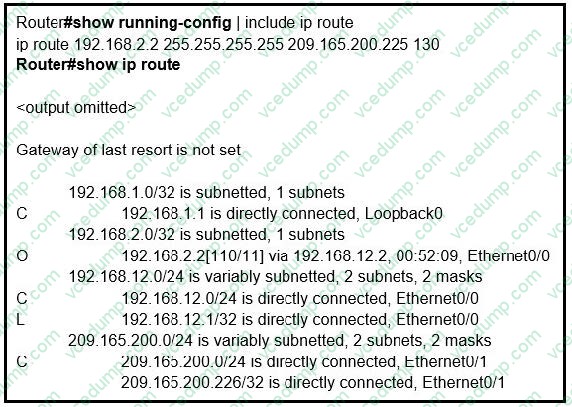
B. The metric of the OSPF route is lower than the metric of the static route.
C. The configured AD for the static route is higher than the AD of OSPF.
D. The syntax of the static route is not valid, so the route is not considered. -
Question 449:
A network administrator is troubleshooting a redistribution of OSPF routes into EIGRP.
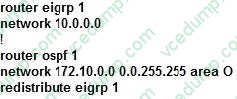
Given the exhibited commands, which statement is true?
A. Redistributed routes will have an external type of 1 and a metric of 1.
B. Redistributed routes will have an external type of 2 and a metric of 20.
C. Redistributed routes will maintain their original OSPF routing metric.
D. Redistributed routes will have a default metric of 0 and will be treated as reachable and advertised.
E. Redistributed routes will have a default metric of 0 but will be treated as unreachable and not advertised. -
Question 450:
An engineer is configuring a network and needs packets to be forwarded to an interface for any destination address that is not in the routing table. What should be configured to accomplish this task?
A. set ip next-hop
B. set ip default next-hop
C. set ip next-hop recursive
D. set ip next-hop verify-availability
Related Exams:
-
300-410
Implementing Cisco Enterprise Advanced Routing and Services (ENARSI) -
300-415
Implementing Cisco SD-WAN Solutions (ENSDWI) -
300-420
Designing Cisco Enterprise Networks (ENSLD) -
300-425
Designing Cisco Enterprise Wireless Networks (ENWLSD) -
300-430
Implementing Cisco Enterprise Wireless Networks (ENWLSI) -
300-435
Automating and Programming Cisco Enterprise Solutions (ENAUTO) -
300-440
Designing and Implementing Cloud Connectivity (ENCC) -
350-401
Implementing and Operating Cisco Enterprise Network Core Technologies (ENCOR)
Tips on How to Prepare for the Exams
Nowadays, the certification exams become more and more important and required by more and more enterprises when applying for a job. But how to prepare for the exam effectively? How to prepare for the exam in a short time with less efforts? How to get a ideal result and how to find the most reliable resources? Here on Vcedump.com, you will find all the answers. Vcedump.com provide not only Cisco exam questions, answers and explanations but also complete assistance on your exam preparation and certification application. If you are confused on your 300-410 exam preparations and Cisco certification application, do not hesitate to visit our Vcedump.com to find your solutions here.