300-410 Exam Details
-
Exam Code
:300-410 -
Exam Name
:Implementing Cisco Enterprise Advanced Routing and Services (ENARSI) -
Certification
:CCNP Enterprise -
Vendor
:Cisco -
Total Questions
:955 Q&As -
Last Updated
:Jul 13, 2026
Cisco 300-410 Online Questions & Answers
-
Question 131:
Refer to the exhibit.
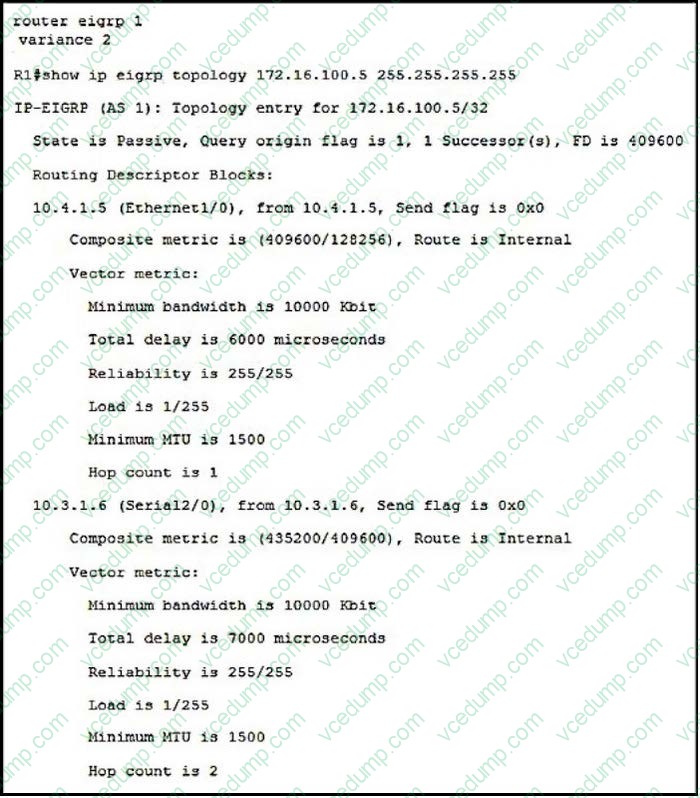
A network engineer troubleshooting a packet drop problem for the host 172.16.100.5 notices that only one link is used and installed on the routing table, which saturates the bandwidth. Which action must the engineer take to resolve the high bandwidth utilization problem and share the traffic toward this host between the two available links?
A. Disable the eigrp split horizon loop protection mechanism.
B. Set the eigrp variance equal to 3 to install a second route with a metric not larger than 3 times of the best metric.
C. Change the EIGRP delay metric to meet the feasibility condition.
D. Set the eigrp variance equal to 4 to install a second route with a metric not larger than 4 times of the best metric. -
Question 132:
You have configured BGP on both rtrA in AS 1 and rtrB in AS 2. There are two routes created using the network command between the two routers. One route traverses through AS 5 and AS 6 from rtrA to rtrB, while the other route traverses AS 7, AS 8, and AS 9 from rtrA to rtrB. Both routes use default values for the Weight and LOCAL_PREF attributes. Which of the following attributes determines the BEST route between rtrA and rtrB routers?
A. Weight
B. LOCAL_PREF
C. Origin type
D. AS_PATH -
Question 133:
Which of the following are valid fields in an MPLS header? (Choose four.)
A. Label
B. Sequence Number
C. Experimental (Exp)
D. Bottom of Stack (BoS)
E. Time to Live (TTL)
F. Checksum -
Question 134:
Refer to the exhibit.
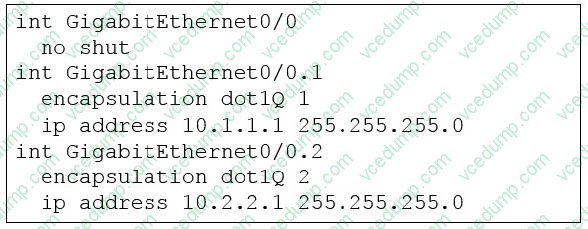
Two routers are connected back to back via Gigabit Ethernet 0/0 interfaces. Which configuration provides VRF-Lite connectivity for two separate VRFs using the prefixes 10.1.1.0/24 for one VRF and 10.2.2.0/24 for the other VRF?
A. ip vrf 1 rd 65001:1 ip vrf 2 rd 65001:2 ! int GigabitEthernet0/0 no shut ! int GigabitEthernet0/0.1 encapsulation dot1Q 1 ip vrf forwarding ip address 10.1.1.1 255.255.255.0 ! int GigabitEthernet0/0.2 encapsulation dot1Q 2 ip vrf forwarding ip address 10.2.2.1 255.255.255.0
B. ip vrf 1 rd 65001:1 ip vrf 2 rd 65001:1 ! int GigabitEthernet0/0 no shut ! int GigabitEthernet0/0.1 encapsulation dot1Q 1 ip vrf forwarding 1 ip address 10.1.1.1 255.255.255.0 ! int GigabitEthernet0/0.2 encapsulation dot1Q 2 ip vrf forwarding 2 ip address 10.2.2.1 255.255.255.0
C. ip vrf 1 ip vrf 2 int GigabitEthernet0/0 no shut ! int GigabitEthernet0/0.1 encapsulation dot1Q 1 ip vrf forwarding 1 ip address 10.1.1.1 255.255.255.0 ! int GigabitEthernet0/0.2 encapsulation dot1Q 2 ip vrf forwarding 2 ip address 10.2.2.1 255.255.255.0
D. ip vrf 1 ip vrf 2 ! int GigabitEthernet0/0 no shut ! int GigabitEthernet0/0.1 encapsulation dot1Q 1 ip address 10.1.1.1 255.255.255.0 ip vrf forwarding 1 ! int GigabitEthernet0/0.2 encapsulation dot1Q 2 ip address 10.2.2.1 255.255.255.0 ip vrf forwarding 2 -
Question 135:
Users report issues with reachability between areas as soon as an engineer configured summary routes between areas in a multiple area OSPF autonomous system. Which action resolves the issue?
A. Configure the summary-address command on the ABR.
B. Configure the area range command on the ASBR.
C. Configure the summary-address command on the ASBR.
D. Configure the area range command on the ABR. -
Question 136:
Refer to the exhibit.
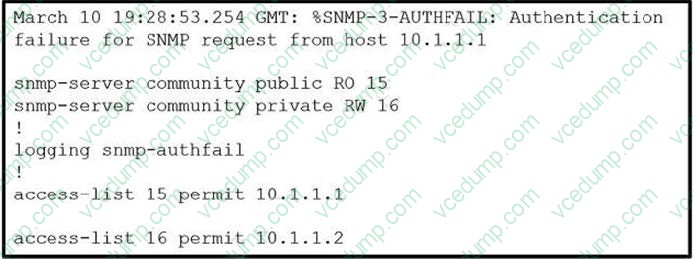
Which action resolves the issue?
A. Configure host IP address in access-list 16.
B. Configure SNMPv3 on the router.
C. Configure SNMP authentication on the router.
D. Configure a valid SNMP community string. -
Question 137:
Refer to the exhibit. The administrator noticed that the connection was flapping between the two ISPs instead of switching to ISP2 when the ISP1 failed. Which action resolves the issue?
A. Include a valid source-interface keyword in the icmp-echo statement.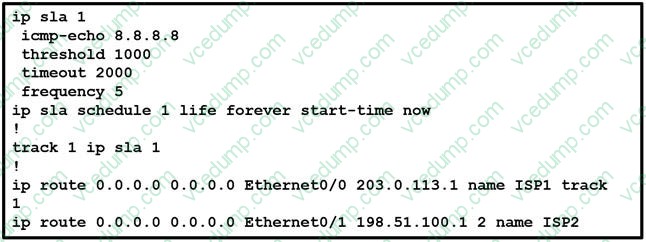
B. Reference the track object 1 on the default route through ISP2 instead of ISP1.
C. Modify the static routes to refer both to the next hop and the outgoing intertace.
D. Modify the threshold to match the administrative distance of the ISP2 route. -
Question 138:
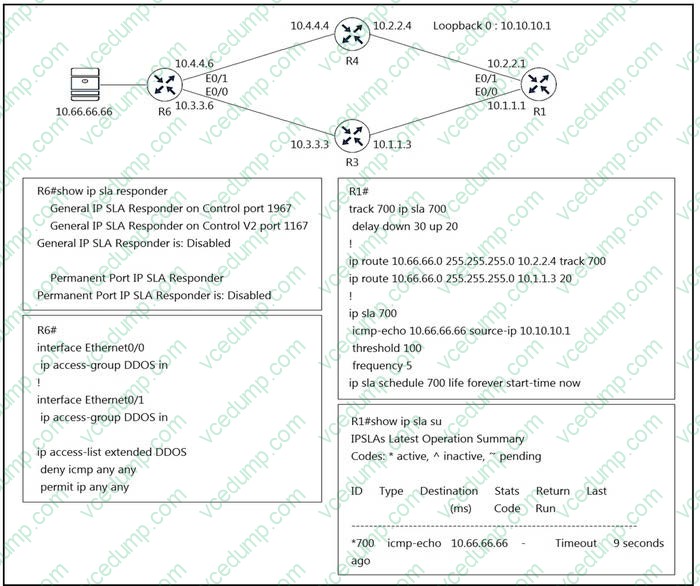
Refer to the exhibit. R1 is configured with IP SLA to check the availability of the server behind R6 but it kept failing.
Which configuration resolves the issue?
A. R6(config)#ip sla responder udp-echo ip address 10.10.10.1 port 5000
B. R6(config)#ip access-list extended DDOS R6(config-ext-nacl)#5 permit icmp host 10.10.10.1 host 10.66.66.66
C. R6(config)#ip sla responder
D. R6(config)#ip access-list extended DDOS R6(config-ext-nacl)#5 permit icmp host 10.66.66.66 host 10.10.10.1 -
Question 139:
Refer to the exhibit.
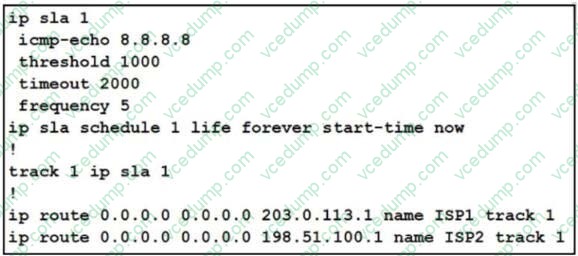
An administrator configures a router to stop using a particular default route if the DNS server 8.8.8.8 is not reachable through that route. However, this configuration did not work as desired and the default route still works even if the DNS server 8.8.8 8 is unreachable.
Which two configuration changes resolve the issue? (Choose two.)
A. Configure two static routes for the 8.8.8.8/32 destination to match the IP SLA probe for each ISP.
B. Associate every IP SLA probe with the proper WAN address of the router.
C. Reference the proper exit interfaces along with the next hops in both static default routes.
D. Use a separate track object to reference the existing IP SLA 1 probe for every static route.
E. Use a separate IP SLA probe and track object for every static route -
Question 140:
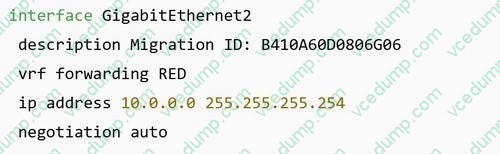
An engineer is implementing a coordinated change with a server team. As part of the change, the engineer must configure interface GigabitEthernet2 in an existing VRF "RED", then move the interface to an existing VRF "BLUE" when the server team is ready. The engineer configured interface GigabitEthernet2 in VRF "RED".
Which configuration completes the change?
A. interface GigabitEthernet2 no ip address vrf forwarding BLUE
B. interface GigabitEthernet2 no vrf forwarding RED vrf forwarding BLUE ip address 10.0.0.0 255.255.255.254
C. interface GigabitEthernet2 no vrf forwarding RED vrf forwarding BLUE
D. interface GigabitEthernet2 no ip address ip address 10.0.0.0 255.255.255.254 vrf forwarding BLUE
Related Exams:
-
300-410
Implementing Cisco Enterprise Advanced Routing and Services (ENARSI) -
300-415
Implementing Cisco SD-WAN Solutions (ENSDWI) -
300-420
Designing Cisco Enterprise Networks (ENSLD) -
300-425
Designing Cisco Enterprise Wireless Networks (ENWLSD) -
300-430
Implementing Cisco Enterprise Wireless Networks (ENWLSI) -
300-435
Automating and Programming Cisco Enterprise Solutions (ENAUTO) -
300-440
Designing and Implementing Cloud Connectivity (ENCC) -
350-401
Implementing and Operating Cisco Enterprise Network Core Technologies (ENCOR)
Tips on How to Prepare for the Exams
Nowadays, the certification exams become more and more important and required by more and more enterprises when applying for a job. But how to prepare for the exam effectively? How to prepare for the exam in a short time with less efforts? How to get a ideal result and how to find the most reliable resources? Here on Vcedump.com, you will find all the answers. Vcedump.com provide not only Cisco exam questions, answers and explanations but also complete assistance on your exam preparation and certification application. If you are confused on your 300-410 exam preparations and Cisco certification application, do not hesitate to visit our Vcedump.com to find your solutions here.