2V0-642 Exam Details
-
Exam Code
:2V0-642 -
Exam Name
:VMware Certified Professional 6 - Network Virtualization 6.2 -
Certification
:VMware Certifications -
Vendor
:VMware -
Total Questions
:121 Q&As -
Last Updated
:Dec 22, 2024
VMware 2V0-642 Online Questions & Answers
-
Question 1:
Which NSX component can validate that security policies at your organization are being enforced correctly?
A. Activity Monitoring
B. Flow Monitoring
C. ERSPAN
D. Distributed firewalls -
Question 2:
Which three changes to a distributed switch configuration could trigger a rollback? (Choose three.)
A. Blocking all ports in the distributed port group containing the management VMkernel network adapter.
B. Configure the virtual machine system traffic to enable bandwidth allocation using Network I/O Control.
C. Adding a new host with a previous vDS configuration.
D. Changing the MTU.
E. Changing the VLAN settings in the distributed port group of the management VMkernel adapter. -
Question 3:
Which two networking and security components are contained in the backup configuration data of an NSX Manager backup file? (Choose two.)
A. vSphere Distributed Switch
B. Resource Pools
C. Edge Services Gateway
D. Grouping Objects -
Question 4:
In a Cross-vCenter environment, where is information about local logical switches and local logical routers maintained?
A. Local Controller Cluster
B. Platform Services Controller
C. Universal Controller Cluster
D. Local Transport Zone -
Question 5:
An administrator is deploying NSX in a Cross-vCenter configuration across three data centers located 100 miles apart Datacenter-1 and Datacenter-3 already have NSX deployed locally and Datacenter-2 does not have NSX deployed yet. What is the correct order of steps to configure all three data centers for this solution?
A. 1. Remove the NSX manager from Datacenter-1 and Datacenter-3. 2. Reinstall all three NSX managers at the same time. 3. Deploy a universal transport zone. 4. Deploy a universal distributed logical router.
B. 1. Deploy an NSX manager at Dataenter-2. 2. Change the roles of the NSX managers in Datacentar-1 and Datacenter-3 to Transit Mode. 3. Deploy a universal transport zone. 4. Configure the Primary and Secondary roles on all three NSX managers.
C. 1. Deploy an NSX manager in Datacenter 2. 2. Update the NSX manager role in Datacenter-1 to Primary. 3. Update the roles in Datacenter-2 and Datacentar-3 to Secondary. 4. Deploy a universal transport zone.
D. 1. Deploy the NSX manager at Datacenter-2. 2. Update the NSX manager role in Datacenter-1 to Primary. 3. Deploy a universal transport zone. 4. Deploy a universal distributed logical router. -
Question 6:
An administrator enables the NSX Ticket Logger to track infrastructure changes. The administrator logs out for lunch, returns and logs back in to complete the task. What is the status of ticket logger when the administrator logs back in?
A. The ticket logger still tracks changes until it is turned off by the administrator.
B. The ticket logger is turned off.
C. The ticket logger will prompt the user if they still want to continue tracking changes.
D. The ticket logger will display an error. -
Question 7:
What resource must a partner security service be registered with before the service is available to a security policy?
A. NSX Manager
B. ESXi host
C. Service Composer
D. vCenter Server -
Question 8:
Which tool is used to detect rogue services?
A. NSX Logical Firewall
B. NSX Logical Router
C. Activity Monitoring
D. Flow Monitoring -
Question 9:
A workload was attached to a logical switch port group in Compute Cluster 1. Users are complaining that they can communicate with other workloads on that port group in the cluster, but not with other workloads on different networks.
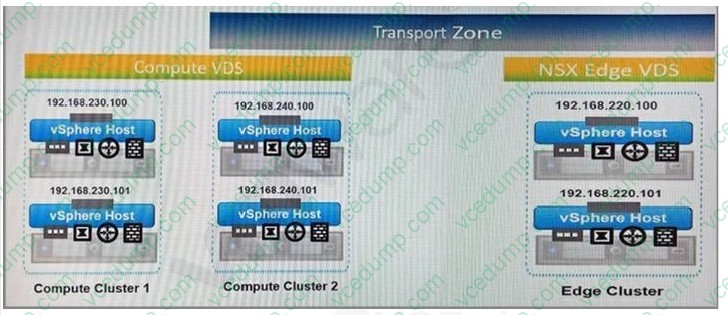
What is the most probable cause?
A. The distributed firewall has a default rule set to deny all.
B. The Distributed Logical Router was not configured on Compute Cluster 1.
C. Compute Cluster 1 is NOT a member of the Transport Zone.
D. An NSX Edge has NOT been deployed into Compute Cluster 1. -
Question 10:
What are two requirements of the network infrastructure to virtualize the access layer? (Choose two.)
A. IPv4 connectivity among ESXi hosts provided by a spine-leaf network design.
B. IPv4 connectivity among ESXi hosts.
C. Increased MTU if the virtual machines are using the default MTU size of 1500.
D. A Redundant, Layer 3, Top-of-Rack network design to provide high availability to ESX hosts.
Related Exams:
-
1V0-21.20
Associate VMware Data Center Virtualization -
1V0-31.21
Associate VMware Cloud Management and Automation -
1V0-41.20
Associate VMware Network Virtualization -
1V0-61.21
Associate VMware Digital Workspace -
1V0-71.21
Associate VMware Application Modernization -
1V0-81.20
Associate VMware Security -
2V0-11.24
VMware Cloud Foundation 5.2 Administrator -
2V0-11.25
VMware Cloud Foundation 5.2 Administrator -
2V0-13.24
VMware Cloud Foundation 5.2 Architect -
2V0-13.25
VMware Cloud Foundation 9.0 Architect
Tips on How to Prepare for the Exams
Nowadays, the certification exams become more and more important and required by more and more enterprises when applying for a job. But how to prepare for the exam effectively? How to prepare for the exam in a short time with less efforts? How to get a ideal result and how to find the most reliable resources? Here on Vcedump.com, you will find all the answers. Vcedump.com provide not only VMware exam questions, answers and explanations but also complete assistance on your exam preparation and certification application. If you are confused on your 2V0-642 exam preparations and VMware certification application, do not hesitate to visit our Vcedump.com to find your solutions here.