200-901 Exam Details
-
Exam Code
:200-901 -
Exam Name
:Developing Applications and Automating Workflows using Cisco Platforms (DEVASC) -
Certification
:Cisco Certified DevNet Associate -
Vendor
:Cisco -
Total Questions
:624 Q&As -
Last Updated
:Jul 15, 2026
Cisco 200-901 Online Questions & Answers
-
Question 171:
Refer to the exhibit.

A development team is creating a Python application. After several days of work, a developer notices several pycache folders and creates a Bash script to clean up the folders. What being automated by the Bash script?
A. Recursively delete all the __pycache__ folders.
B. Find all the empty __pycache__ folders and delete them.
C. Delete all the files in the __pycache__ folders.
D. Find all the files named PWD and delete them. -
Question 172:
An engineer clones a repository that contains a Python script from GitLab to a laptop. After modifying the code, the engineer wants to validate the changes. Which command starts the CI/CD pipeline and runs the automated tests?
A. git commit
B. git test
C. git fetch
D. git push -
Question 173:
Developer is working on a new feature and made changes on a branch named `branch-413667549a-new'. When merging the branch to production, conflicts occurred. Which Git command must the developer use to recreate the pre-merge state?
A. git merge -no-edit
B. git merge -commit
C. git merge -revert
D. git merge -abort -
Question 174:
A developer is working on a new feature in a branch named 'newfeat123456789' and the current working primary branch is named 'prim987654321'. The developer requires a merge commit during a fast forward merge for record-keeping purposes. Which Git command must be used?
A. git merge --no-ff newfeat123456789
B. git commit --no-ff newfeat123456789
C. git add --commit-ff newfeat123456789
D. git reset --commit-ff newfeat123456789 -
Question 175:
A developer must test the performance and reliability of an application. After functional and load tests are run, the application crashes due to traffic spikes from users. Which type of API constraint must be implemented to maintain reliability?
A. rate limiting
B. pagination
C. payload limits
D. filtering -
Question 176:
How are load balancers used in modern application deployments?
A. Turn off traffic and take down compute units, then update and bring the compute units back up.
B. Allow traffic to continue as new compute units are brought up and old compute units are taken down.
C. Allow http and https traffic to continue as old compute units are discontinued before new units are brought up.
D. Bring up new compute units, test the compute units, and switch the traffic from old units to new units. -
Question 177:
What is a benefit of using edge computing in an IoT implementation?
A. high speed in data processing
B. low network design complexity
C. low cost in network design
D. high availability for network components -
Question 178:
Which statement about authenticating a RESTCONF API session with a router that runs Cisco IOS XE Software is true?
A. No authentication is required.
B. OAuth must be used.
C. A token must be retrieved and the associated string must be embedded in the X-Auth-Token header.
D. Basic authentication must be used. -
Question 179:
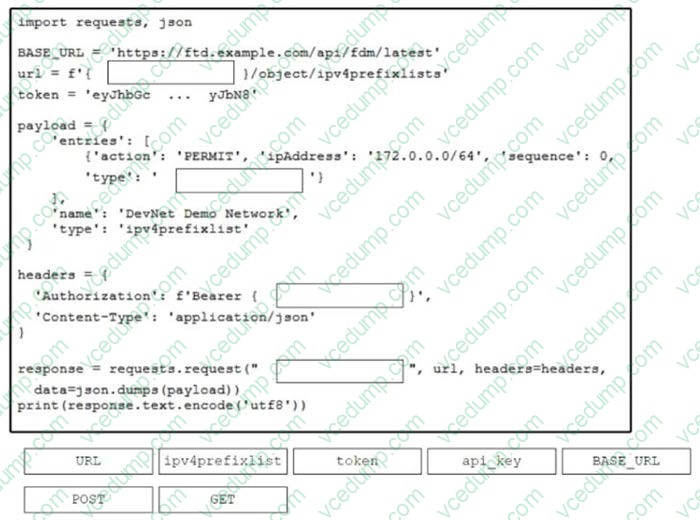
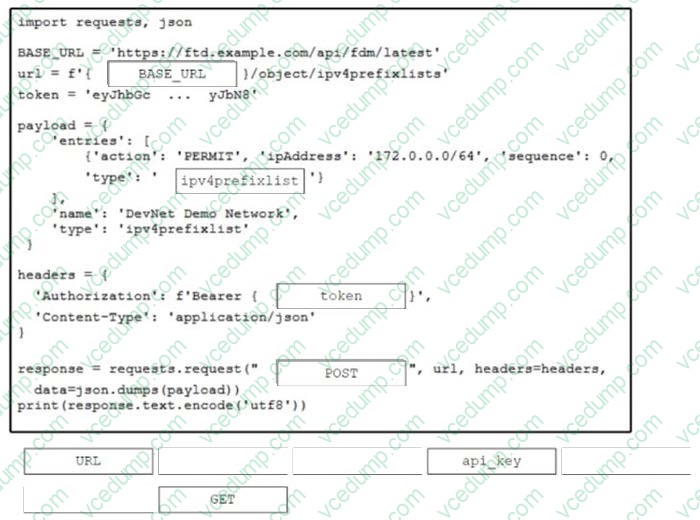
DRAG DROP Refer to the exhibit. Drag and drop the code from the bottom onto the box where the code is missing to construct an API request that creates a new IPv4 prefix. Not all options are used
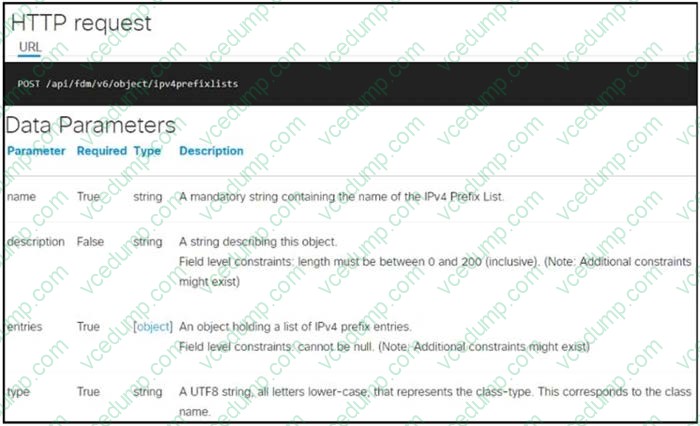
Select and Place:
-
Question 180:
Which platform is run directly on top of a hypervisor?
A. bare metal systems
B. virtual machines
C. containers
D. applications
Tips on How to Prepare for the Exams
Nowadays, the certification exams become more and more important and required by more and more enterprises when applying for a job. But how to prepare for the exam effectively? How to prepare for the exam in a short time with less efforts? How to get a ideal result and how to find the most reliable resources? Here on Vcedump.com, you will find all the answers. Vcedump.com provide not only Cisco exam questions, answers and explanations but also complete assistance on your exam preparation and certification application. If you are confused on your 200-901 exam preparations and Cisco certification application, do not hesitate to visit our Vcedump.com to find your solutions here.