200-101 Exam Details
-
Exam Code
:200-101 -
Exam Name
:Interconnecting Cisco Networking Devices Part 2 (ICND2) -
Certification
:Cisco Certifications -
Vendor
:Cisco -
Total Questions
:149 Q&As -
Last Updated
:Dec 14, 2021
Cisco 200-101 Online Questions & Answers
-
Question 111:
Which protocol provides a method of sharing VLAN configuration information between two Cisco switches?
A. STP
B. VTP
C. 802.1Q
D. RSTP -
Question 112:
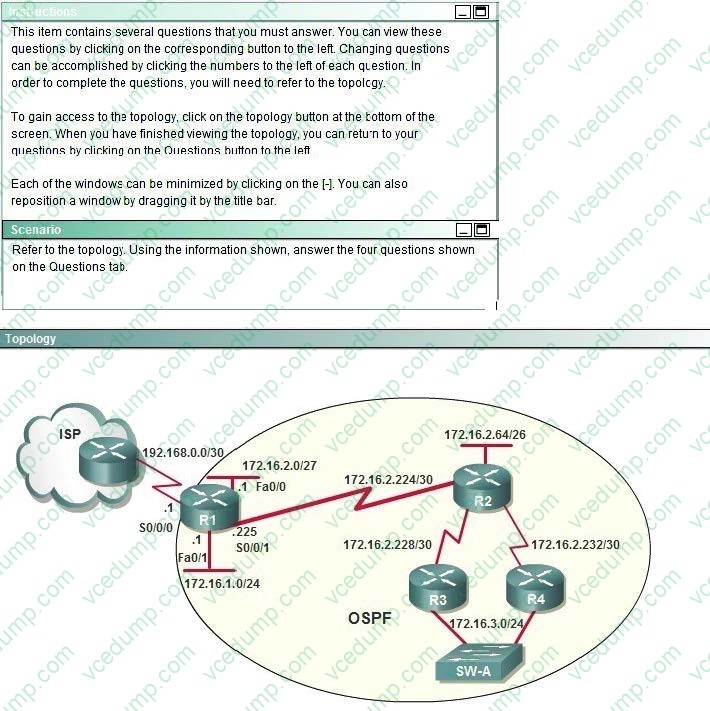
OSPF is configured using default classful addressing. With all routers and interfaces operational, how many networks will be in the routing table of R1 that are indicated to be learned by OSPF?
A. 2
B. 3
C. 4
D. 5
E. 6
F. 7 -
Question 113:
Refer to the exhibit.
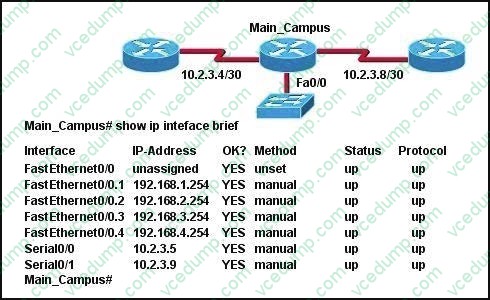
What information about the interfaces on the Main_Campus router is true?
A. The LAN interfaces are configured on different subnets.
B. Interface FastEthernet 0/0 is configured as a trunk.
C. The Layer 2 protocol of interface Serial 0/1 is NOT operational.
D. The router is a modular router with five FastEthernet interfaces.
E. Interface FastEthernet 0/0 is administratively deactivated. -
Question 114:
Scenario
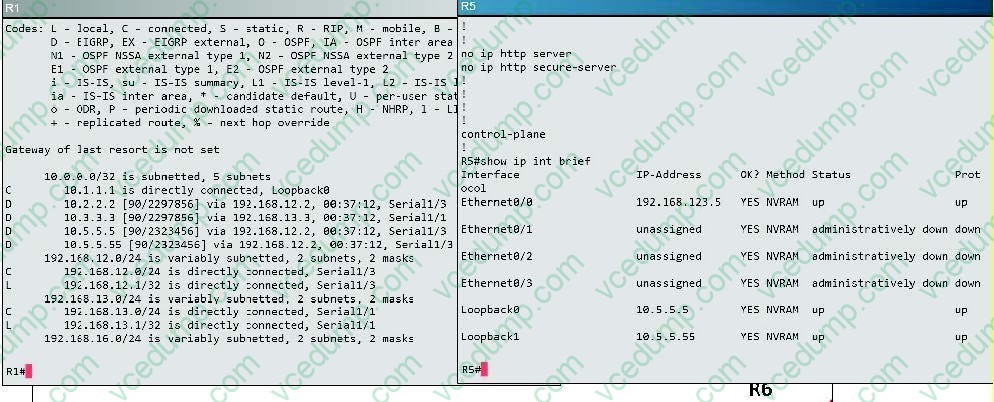
Refer to the topology. Your company has connected the routers R1. R2. and R3 with serial links. R2 and R3 are connected to the switches SW1 and SW2, respectively. SW1 and SW2 are also connected to the routers R4 and R5.
The EIGRP routing protocol is configured.
You are required to troubleshoot and resolve the EIGRP issues between the various routers.
Use the appropriate show commands to troubleshoot the issues.
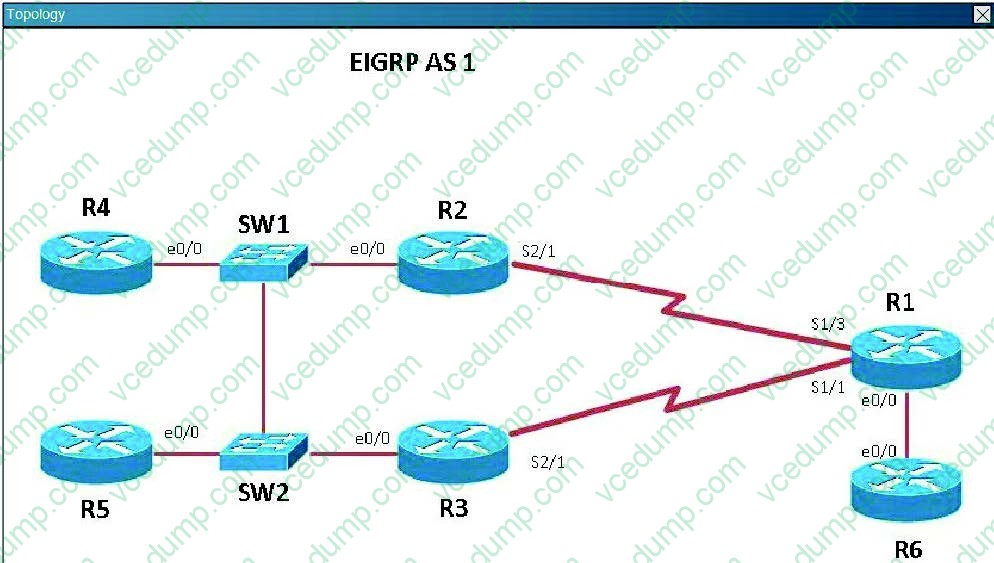
Which path does traffic take from R1 to R5?
A. The traffic goes through R2.
B. The traffic goes through R3.
C. The traffic is equally load-balanced over R2 and R3.
D. The traffic is unequally load-balanced over R2 and R3. -
Question 115:
Refer to the exhibit.
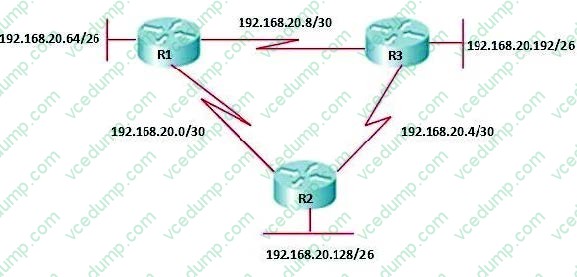
The company uses EIGRP as the routing protocol. What path will packets take from a host on 192.168.10.192/26 network to a host on the LAN attached to router R1?
R3# show ip route Gateway of last resort is not set 192 168.20.0/24 is variably subnetted, 6 subnets, 2 masks D 192.168.20.64/26 [90/2195456] via 192.168.20.9, 00:03:31, Serial0/0 D 192.168.20.0/30 [90/2681856] via 192.168.20.9, 00:03:31, Serial0/0 C 192.168.20.4/30 is directly connected, Serial0/1 C 192.168.20.8/30 is directly connected, Serial0/0 C 192.168.20.192/26 is directly connected, FastEthernet0/0 D 192.168.20.128/26 [90/2195456] via 192.168.20.5,00:03:31, Serial0/1
A. The path of the packets will be R3 to R2 to R1
B. The path of the packets will be R3 to R1 to R2
C. The path of the packets will be both R3 to R2 to R1 and R3 to R1
D. The path of the packets will be R3 to R1 -
Question 116:
Scenario
Refer to the topology. Your company has connected the routers R1. R2. and R3 with serial links. R2 and R3 are connected to the switches SW1 and SW2, respectively. SW1 and SW2 are also connected to the routers R4 and R5.
The EIGRP routing protocol is configured.
You are required to troubleshoot and resolve the EIGRP issues between the various routers.
Use the appropriate show commands to troubleshoot the issues.
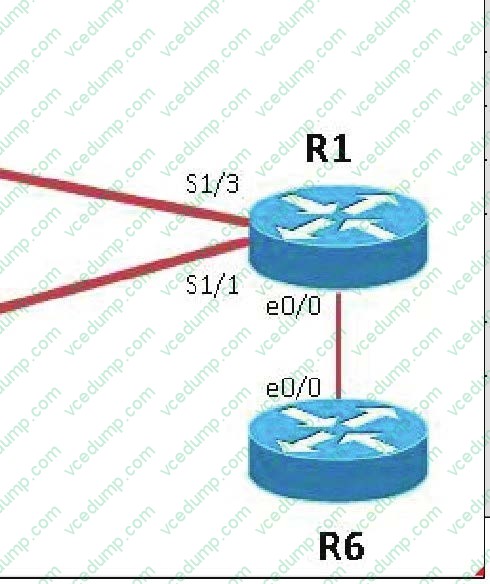
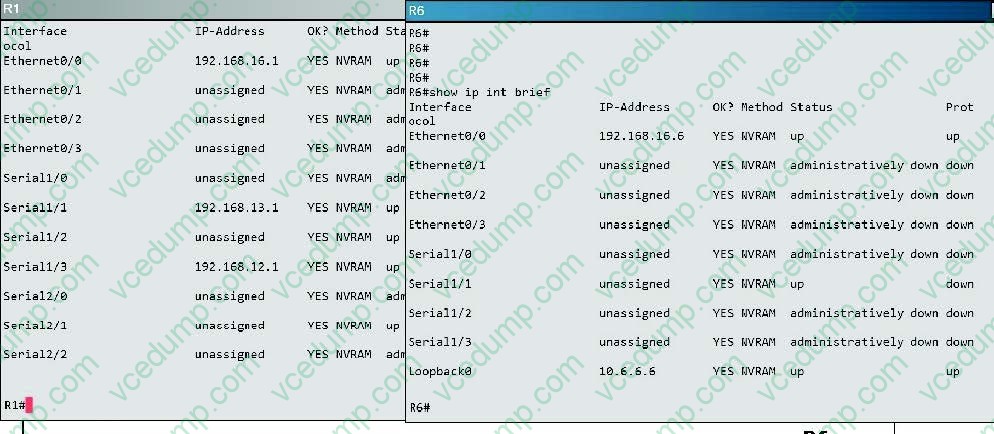
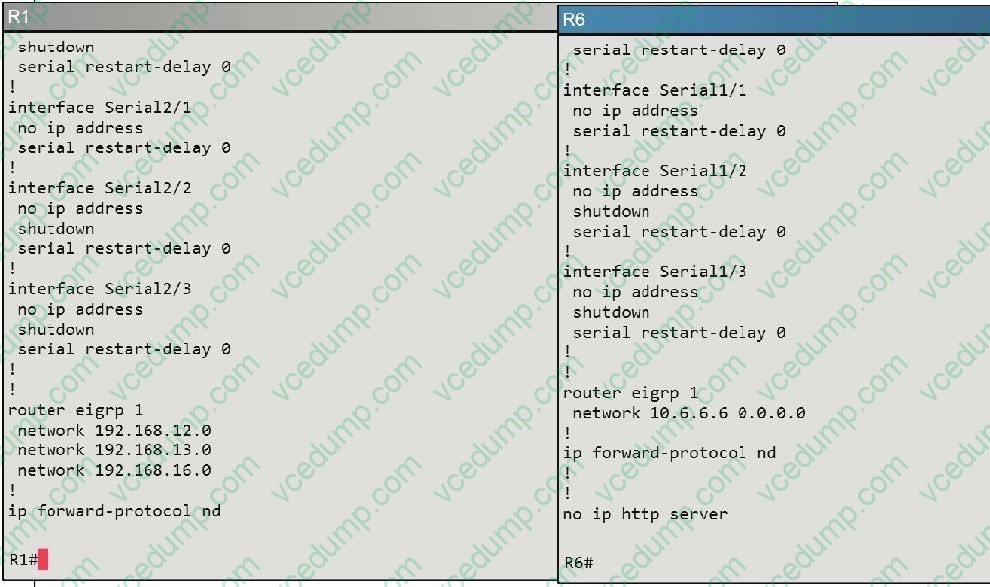
Router R6 does not form an EIGRP neighbor relationship correctly with router R1. What is the cause for this misconfiguration?
A. The K values mismatch.
B. The AS does not match.
C. The network command is missing.
D. The passive-interface command is enabled. -
Question 117:
Which commands are required to properly configure a router to run OSPF and to add network 192.168.16.0/24 to OSPF area 0? (Choose two.)
A. Router(config)# router ospf 0
B. Router(config)# router ospf 1
C. Router(config)# router ospf area 0
D. Router(config-router)# network 192.168.16.0 0.0.0.255 0
E. Router(config-router)# network 192.168.16.0 0.0.0.255 area 0
F. Router(config-router)# network 192.168.16.0 255.255.255.0 area 0 -
Question 118:
Refer to the exhibit.
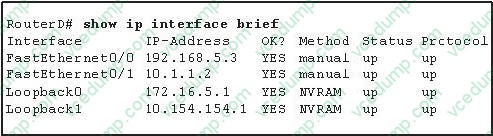
Given the output for this command, if the router ID has not been manually set, what router ID will OSPF use for this router?
A. 10.1.1.2
B. 10.154.154.1
C. 172.16.5.1
D. 192.168.5.3 -
Question 119:
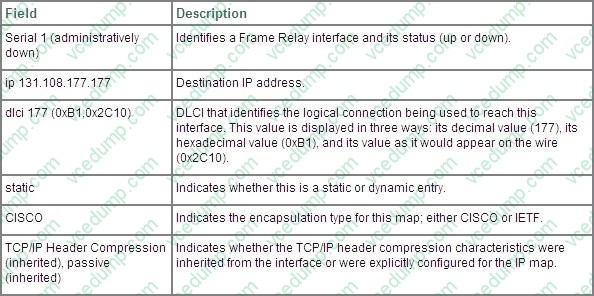
The command show frame-relay map gives the following output:
Serial 0 (up): ip 192.168.151.4 dlci 122, dynamic, broadcast, status defined, active
Which statements represent what is shown?(Choose three.)
A. 192.168.151.4 represents the IP address of the remote router
B. 192.168.151.4 represents the IP address of the local serial interface
C. DLCI 122 represents the interface of the remote serial interface
D. DLCI 122 represents the local number used to connect to the remote address
E. broadcast indicates that a dynamic routing protocol such as RIP v1 can send packets across this PVC
F. active indicates that the ARP process is working -
Question 120:
Refer to the exhibit.
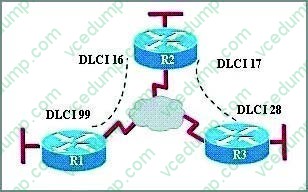
Which statement describes DLCI 17?
A. DLCI 17 describes the ISDN circuit between R2 and R3.
B. DLCI 17 describes a PVC on R2. It cannot be used on R3 or R1.
C. DLCI 17 is the Layer 2 address used by R2 to describe a PVC to R3.
D. DLCI 17 describes the dial-up circuit from R2 and R3 to the service provider.

Related Exams:
-
300-745
Designing Cisco Security Infrastructure (300-745 SDSI) v1.0 -
350-101
Implementing and Operating Cisco Wireless Core Technologies (350-101 WLCOR)v1.0 -
352-011
Cisco Certified Design Expert Practical -
500-052
Cisco Unified Contact Center Express -
500-173
Designing the FlexPod Solution (FPDESIGN) -
500-201
Deploying Cisco Service Provider Mobile Backhaul Solutions -
500-210
SP Optical Technology Field Engineer Representative -
500-220
Engineering Cisco Meraki Solutions (ECMS) v2.2 -
500-230
Cisco Service Provider Routing Field Engineer -
500-240
Cisco Mobile Backhaul for Field Engineers
Tips on How to Prepare for the Exams
Nowadays, the certification exams become more and more important and required by more and more enterprises when applying for a job. But how to prepare for the exam effectively? How to prepare for the exam in a short time with less efforts? How to get a ideal result and how to find the most reliable resources? Here on Vcedump.com, you will find all the answers. Vcedump.com provide not only Cisco exam questions, answers and explanations but also complete assistance on your exam preparation and certification application. If you are confused on your 200-101 exam preparations and Cisco certification application, do not hesitate to visit our Vcedump.com to find your solutions here.