1Z0-877 Exam Details
-
Exam Code
:1Z0-877 -
Exam Name
:Oracle Solaris 10 System Administrator Certified Professional Exam, Part I -
Certification
:Oracle Certifications -
Vendor
:Oracle -
Total Questions
:301 Q&As -
Last Updated
:Dec 05, 2021
Oracle 1Z0-877 Online Questions & Answers
-
Question 231:
As the Solaris OS administrator in your department, you have been asked to upgrade a SPARC- based server currently running Solaris 8 OS to the latest Solaris 10 OS release. This server is critical to the department's productivity, so this upgrade must be done with minimal downtime and must allow for rollback to the previous version.
Which installation method should you use?
A. Live Upgrade
B. WAN boot installation
C. Custom JumpStart
D. Flash Archive -
Question 232:
Your Solaris x86-based server has two boot drives. You want to add an entry to the GRUB main menu, so that during the boot process, you can select to boot the server from either of the disk drives. How would you add a new entry to the GRUB main menu to allow the operator to select which drive to boot from?
A. Edit the bootenv.rc file and enter a value for the altbootpath parameter.
B. Use the kernel command to edit the boot entries in the GRUB main menu.
C. Edit the menu.lst file and add an entry for the second boot disk to the GRUB main menu.
D. When the GRUB menu appears during the boot process, type edit the GRUB menu and enter the command to boot from the alternate disk drive.
E. Press the space bar when the GRUB menu is visible during the boot process to edit the list of commands and enter the command to boot to the alternate disk drive. -
Question 233:
Currently, your Solaris x86-based server is configured to boot from the second SATA drive. You want to change your server so that it automatically boots using its default autodetect boot behavior when the system is powered on or during a reboot. Which describes how to change your server to use the default autodetect boot behavior?
A. eeprom boot-file=
B. eeprom boothpath=? ?
C. eeprom bootpath=autodetect
D. kernel boot-file=autodetect
E. eeprom boot-file=autodetect -
Question 234:
You have been directed to install a server in a secure environment where all unnecessary network services must be disabled, except for sshd. During the installation of the Solaris OS, you setup the system to be Secure by Default. Which three describe how network services will be configured on the newly installed server? (Choose three.)
A. SNMP - enabled for remote clients
B. syslogd - limit to local connections
C. rpcbind - limit to local connections
D. sendmail - limit to local connections
E. syslogd - enabled for remote clients
F. rpcbind - enabled for remote clients -
Question 235:
Your IT manager has asked you to install the Solaris 10 OS on a workstation with limited diskspace. The user of this workstation is new to the Solaris OS and needs CDE to help navigate through the system and open applications. Which software group will you install to use minimal disk space and to include the CDE packages?
A. Core
B. End User
C. Developer
D. Entire Distribution
E. Reduced Network Support
F. Entire Distribution Plus OEM -
Question 236:
Your password can be captured by snoop when you are trying remotely to log in to a default installation of the Solaris 10 OS.
Which two commands can be used to avoid this issue? (Choose two.)
A. ssh
B. sendmail
C. telnet
D. rlogin
E. ftp -
Question 237:
You just installed Solaris on your x86 server and you cannot get your system to boot to the Solaris 10 OS. When rebooting, you get three options in the GRUB menu:
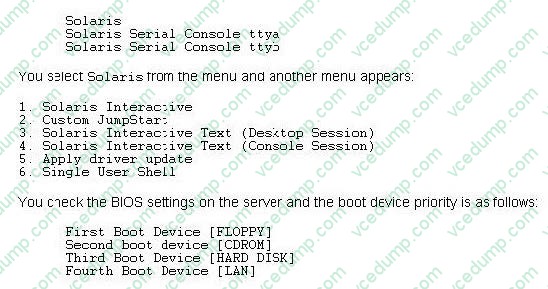
Which option can you use to fix the problem?
A. The boot device priority is fine, your hard drive must be faulty or the boot block is missing. Boot to CDROM, open a shell and run fsck on the Hard Disk.
B. Change the boot device priority so that the CDROM is the third boot device and the HARD DISK is second.
C. Make the First boot device = LAN, Second boot device= CDROM, Third boot device = HARD DISK, remove the fourth boot device.
D. You did not set the fdisk boot partition to ACTIVE and the system cannot boot to the hard disk. Boot from CDROM, open a shell and use fdisk to set the partition to ACTIVE.
E. The GRUB menu is not correct and Solaris is not pointing to the hard disk that you installed the Solaris OS on. Edit the GRUB menu and. The GRUB menu is not correct and Solaris is not pointing to the hard disk that you have installed the Solaris OS on. Edit the GRUB menu and modify the default boot device so that it points to the correct boot drive. -
Question 238:
The operating system that is installed on the company's server and that runs the invoicing software needs to be upgraded to Solaris 10 OS. The work must be completed with minimal downtime. You have a week to prepare for the upgrade. Which method results in the least system downtime?
A. upgrade using the Solaris Live Upgrade software
B. perform a Solaris Flash install
C. boot the server from the install CD and upgrade
D. re-install the OS and applications -
Question 239:
You have a SPARC-based system with a graphical monitor, but you want to install the OS in text mode. What is the correct command to start the interactive install?
A. boot
B. boot cdrom
C. boot cdrom -text
D. boot cdrom -nowin -
Question 240:
Up to now, your users have been allowed to use cron for their own use. Because some users have abused the system, you want to block the use of cron by all users, except root. The following files exist on your system:
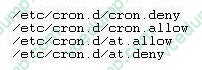
What should you do to block all users, except root, from creating and running cron jobs?
A. Remove the crontabs associated with each user in the /var/spool/cron/crontabs directory.
B. Write protect the crontabs associated with each user in the /var/spool/cron/crontabs directory.
C. Remove the crontabs associated with each offending user in the /var/spool/cron/crontabs directory.
Related Exams:
-
1Z0-020
Oracle8i: New Features for Administrators -
1Z0-023
Architecture and Administration -
1Z0-024
Performance Tuning -
1Z0-025
Backup and Recovery -
1Z0-026
Network Administration -
1Z0-034
Upgrade Oracle9i/10g OCA to Oracle Database OCP -
1Z0-036
Managing Oracle9i on Linux -
1Z0-041
Oracle Database 10g: DBA Assessment -
1Z0-052
Oracle Database 11g: Administration Workshop I -
1Z0-053
Oracle Database 11g: Administration II
Tips on How to Prepare for the Exams
Nowadays, the certification exams become more and more important and required by more and more enterprises when applying for a job. But how to prepare for the exam effectively? How to prepare for the exam in a short time with less efforts? How to get a ideal result and how to find the most reliable resources? Here on Vcedump.com, you will find all the answers. Vcedump.com provide not only Oracle exam questions, answers and explanations but also complete assistance on your exam preparation and certification application. If you are confused on your 1Z0-877 exam preparations and Oracle certification application, do not hesitate to visit our Vcedump.com to find your solutions here.