1Z0-869 Exam Details
-
Exam Code
:1Z0-869 -
Exam Name
:Java Mobile Edition 1 Mobile Application Developer Certified Professional -
Certification
:Oracle Certifications -
Vendor
:Oracle -
Total Questions
:340 Q&As -
Last Updated
:Jun 20, 2026
Oracle 1Z0-869 Online Questions & Answers
-
Question 211:
Which three dimensions of a standard-size application does the JTWI 1.0 specification define? (Choose three.)
A. JAR size
B. heap size
C. RMS data size
D. screen size
E. JAD size -
Question 212:
Given:
14.
Canvas canvas;
15.
// ...
24.
canvas.repaint(10,10,20,20);
25.
canvas.serviceRepaints();
What occurs when serviceRepaints() is called?
A. The application blocks until the repaint() method returns.
B. The application immediately calls the paint() method.
C. The application immediately calls the repaint() method.
D. The application blocks until the paint() method returns. -
Question 213:
Click the Exhibit button.
Which two are true assuming this method is in a MIDlet? (Choose two.)
A. Compilation fails due to a problem with code related to event handling.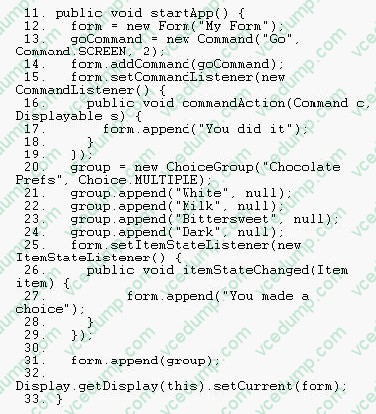
B. An exception occurs at runtime due to a problem related to the event handling code.
C. The Chocolate Prefs choice is never displayed to the user.
D. The text "You made a choice" is displayed immediately after the user makes a selection.
E. Anonymous inner classes must NOT be used as event handlers within a MIDlet.
F. The user can select more than one type of chocolate. -
Question 214:
Which two are true regarding error handling for classes that exist in both CLDC and J2SE? (Choose two.)
A. The set of error classes is essentially the same in CLDC and J2SE.
B. The set of error classes is much reduced in CLDC to help reduce the overhead of the JVM.
C. If a class throws an error in CLDC, it should throw the same error as in J2SE or its nearest superclass.
D. There is no correspondence between the errors defined by CLDC and J2SE because the needs of CLDC and J2SE are so different. -
Question 215:
Which is false about untrusted MIDlet suites?
A. An untrusted MIDlet suite does not request permissions explicitly in the JAR manifest or the application descriptor.
B. Untrusted MIDlet suites may access protected APIs or functions if given explicit user permission.
C. JTWI devices must treat all MIDP 2.0 suites as trusted.
D. JTWI devices must treat all MIDP 1.0 suites as untrusted. -
Question 216:
Given:
15.
String addr = "sms://+14155557296";
16.
MessageConnection conn
17.
= (MessageConnection) Connector.open(addr);
18.
// insert code here
19.
message.setPayloadData(imageBytes);
Assume imageBytes is a valid byte array.
Which statement, inserted at line 18, causes the rest of the code fragment to compile correctly?
A. BinaryMessage message = new BinaryMessage();
B. Message message = conn.newMessage(MessageConnection.BINARY_MESSAGE);
C. Message message = new BinaryMessage();
D. BinaryMessage message = (BinaryMessage) conn.newMessage(MessageConnection.BINARY_MESSAGE); -
Question 217:
Which is true regarding Timer objects?
A. Multiple threads can share a single Timer object only by using external synchronization.
B. A thread CANNOT stop a Timer object if it is executing a task.
C. Multiple threads can never share a single Timer object.
D. Multiple threads can share a single Timer object without using external synchronization. -
Question 218:
A game running on a J2ME device supporting MMAPI needs to play tones in the background of the game. It intermittently needs to play sounds of explosions.
The code has created two Player objects: one for tones and one for WAV audio.
How does the developer know if both audio streams can be heard simultaneously?
A. The developer can query the system using System.getProperty("supports.mixing");.
B. Playing audio streams simultaneously is only a request. The device determines whether to do so.
C. Playing audio streams simultaneously is NOT possible with any MMAPI implementation.
D. The developer knows playing audio streams simultaneously is supported because two Player objects have been created. -
Question 219:
Which two are true about sockets and datagrams? (Choose two.)
A. Closing a SocketConnection automatically closes any associated input or output streams.
B. Datagrams are used to send packets of data over a SocketConnection.
C. Data sent over a TCP/IP socket is received in the same order that it was sent.
D. Both datagrams and sockets use streams as the basis for their communication.
E. Datagrams are guaranteed to reach their intended destination.
F. A datagram is an independent, self-contained message sent over the network. -
Question 220:
A Player plays a sound after start() is called. Which is the most efficient way to pause the playback so that it may be started as soon as possible when required?
A. call close() on the player
B. call System.gc() to collect those resources marked for garbage collection
C. call stop() on the player
D. call setRate(0) on the player
Related Exams:
-
1Z0-020
Oracle8i: New Features for Administrators -
1Z0-023
Architecture and Administration -
1Z0-024
Performance Tuning -
1Z0-025
Backup and Recovery -
1Z0-026
Network Administration -
1Z0-034
Upgrade Oracle9i/10g OCA to Oracle Database OCP -
1Z0-036
Managing Oracle9i on Linux -
1Z0-041
Oracle Database 10g: DBA Assessment -
1Z0-052
Oracle Database 11g: Administration Workshop I -
1Z0-053
Oracle Database 11g: Administration II
Tips on How to Prepare for the Exams
Nowadays, the certification exams become more and more important and required by more and more enterprises when applying for a job. But how to prepare for the exam effectively? How to prepare for the exam in a short time with less efforts? How to get a ideal result and how to find the most reliable resources? Here on Vcedump.com, you will find all the answers. Vcedump.com provide not only Oracle exam questions, answers and explanations but also complete assistance on your exam preparation and certification application. If you are confused on your 1Z0-869 exam preparations and Oracle certification application, do not hesitate to visit our Vcedump.com to find your solutions here.