1Z0-860 Exam Details
-
Exam Code
:1Z0-860 -
Exam Name
:Java Enterprise Edition 5 Business Component Developer Certified Professional -
Certification
:Oracle Certifications -
Vendor
:Oracle -
Total Questions
:305 Q&As -
Last Updated
:May 25, 2026
Oracle 1Z0-860 Online Questions & Answers
-
Question 241:
DRAG DROP
Click the Task button.
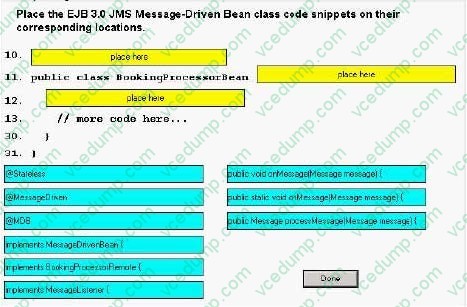
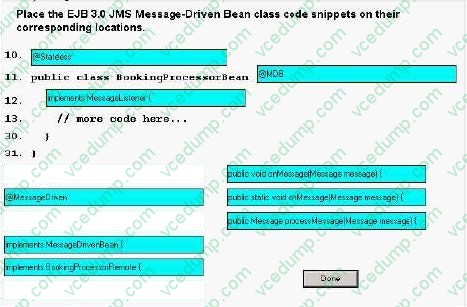
Place the EJB 3.0 JMS Message-Driven Bean class code snippets on their corresponding locations.
Select and Place:
-
Question 242:
A developer maps the abstract entityclass Account with concrete entity sub- classes CreditCardAccount and SavingsAccount using the single table per class hierarchy strategy. Which two statements are true? (Choose two.)
A. Instances of CreditCardAccount and SavingsAccountarestoredinthe sametable.
B. Allcolumns that correspondtofields declared inAccountmust bedefined asnullable in the database.
C. The fields declared in Accountare storedin adifferent tablethan the ones declared in CreditCardAccount and SavingsAccount.
D. All columns that correspond to fields declared in CreditCardAccount or SavingsAccount must be defined as nullable in the database. -
Question 243:
Giventhefollowing statements about an EJB deploymentdescriptor for whichthe metadatacomplete attribute is not specified:
I. The EJB deployment descriptor can provide additional metadata to bean class annotations.
II. The EJB deployment descriptor can partially override bean class annotations.
III.
The EJB deployment descriptor can entirely override bean class annotations. Which is true?
A. OnlystatementI is correct.
B. Only statementIIis correct.
C. Only statement III is correct.
D. Both statementsIand II are correct.
E. Both statementsIandIIIare correct.
I. The EJB deployment descriptor can provide additional metadata to bean class annotations. II. The EJB deployment descriptor can partially override bean class annotations. III. The EJB deployment descriptor can entirely override bean class annotations. Which is true? -
Question 244:
Bean A is using bean-managed transaction demarcation and has invoked the foo method of bean B. When the foo method returns, bean A needs to determine if the transaction has been set to rollback. Which must be true?
A. It is NOT possible for bean A to determine if the transaction has been set to rollback.
B. Bean A must invoke the getStatus method on the UserTransaclion that it began.
C. For this to be possible, bean B must also use bean-managed transaction demarcation.
D. Bean A must invoke the setRollbackOnly method on the UserTransaction that it began.
E. Bean A must invoke the getRollbackOnly method on the UserTransaction that it began. -
Question 245:
A developer writes a stateless session bean FooBean with one remote business interface FooRemote containing one business method foo. Method foo takes a single parameter of application-defined type MyData.
11.
public class MyData implements Java. io.Serializablej
12.
int a; 13.}
Method foo is implemented within the FooBean class as:
11.
public void foo(MyData data) {
12.
data.a = 2; 13.}
Another session bean within the same application has a reference to FooRemote in variable fooRef and calls method foo with the following code:
11.
MyData data = new MyDatafJ;
12.
data.a = 1;
13.
fooRef.foo(data);
14.
System, out. println(data. a);
What is the value of data, a when control reaches Line 14 of the client ?
B. 1
C. 2
D. either1or 2 -
Question 246:
Which two statements are correct about EJB 3.0 stateful session beans and stateless session beans? (Choose two.)
A. Both can have multiple remote and local business interfaces.
B. Both can be passivated by the EJB container to preserve resources.
C. Both can choose to implement the javax.ejb.SessionSynchronization interface.
D. Only the stateful session bean class is required to implement java.io.Serializable.
E. Both bean classes can have the field injection of javax. persistence. EntityManager. -
Question 247:
Which three statements are true about EJB 3.0 containers? (Choose three.)
A. Remote argument passing semantics conform to Java RMI-IIOP.
B. The JAXB 2.0 API is guaranteed to be available for all bean types.
C. The Java 2D API is guaranteed to be available for session beans.
D. javax. naming. InitialContext is guaranteed to provide a JNDI name space.
E. The Java Telephony API is guaranteed to be available for session and message beans.
F. javax.transaction. UserTransaction cannot be used by beans when bean- managed transaction demarcation is used. -
Question 248:
You have been asked to develop business methods for an enterprise bean to fulfill the following objective:
If the JDBC connection is NOT available, the current state of the shopping cart session must be serialized. A serialized state must be written to a text file using a java.io.PrintWriter. Data must be shared with a Web services end point. Logging
information must be displayed in ajavax.swing.JPanel component.
Which is true?
A. The requirements can be fullfilled only in sessionbeans.
B. Therequirementscan befulfilled only in message-driven beans.
C. Allof the requirements can be fulfilled using either session beans or message-driven beans.
D. None of the requirements can be fulfilled using either session beans or message-driven beans.
E. Bothsession beansandmessage-driven beans canfulfillsomebutnotalloftherequirements. -
Question 249:
Which two class types must be implicitly or explicitly denoted in the persistence.xml descriptor as managed persistence classes to be included within a persistence unit?(Choose two.)
A. Entity classes
B. Interceptor classes
C. Embedded classes
D. Entity listener classes -
Question 250:
Which statement is true about the Timer service in an EJB 3.0 stateless session bean?
A. The timeout callback method contains the business logic that handles the timeout event.
B. The timeout callback method must be declared as a business method in business interfaces.
C. The timeout callback method can throw application exceptions to report business logic failures.
D. A bean class can implement multiple timeout callback methods, each associated with a different timer.
Related Exams:
-
1Z0-020
Oracle8i: New Features for Administrators -
1Z0-023
Architecture and Administration -
1Z0-024
Performance Tuning -
1Z0-025
Backup and Recovery -
1Z0-026
Network Administration -
1Z0-034
Upgrade Oracle9i/10g OCA to Oracle Database OCP -
1Z0-036
Managing Oracle9i on Linux -
1Z0-041
Oracle Database 10g: DBA Assessment -
1Z0-052
Oracle Database 11g: Administration Workshop I -
1Z0-053
Oracle Database 11g: Administration II
Tips on How to Prepare for the Exams
Nowadays, the certification exams become more and more important and required by more and more enterprises when applying for a job. But how to prepare for the exam effectively? How to prepare for the exam in a short time with less efforts? How to get a ideal result and how to find the most reliable resources? Here on Vcedump.com, you will find all the answers. Vcedump.com provide not only Oracle exam questions, answers and explanations but also complete assistance on your exam preparation and certification application. If you are confused on your 1Z0-860 exam preparations and Oracle certification application, do not hesitate to visit our Vcedump.com to find your solutions here.