1Z0-851 Exam Details
-
Exam Code
:1Z0-851 -
Exam Name
:Oracle Solaris 11 System Administration -
Certification
:Oracle Certifications -
Vendor
:Oracle -
Total Questions
:290 Q&As -
Last Updated
:Dec 10, 2021
Oracle 1Z0-851 Online Questions & Answers
-
Question 251:
Click the Exhibit button. Given the fully-qualified class names: com.foo.bar.Dog com.foo.bar.blatz.Book com.bar.Car com.bar.blatz.Sun Which graph represents the correct directory structure for a JAR file from which those classes can be used by the compiler and JVM?
A. Jar A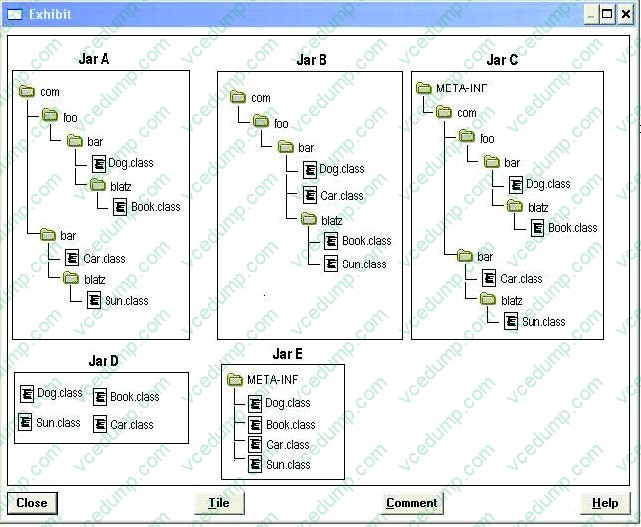
B. Jar B
C. Jar C
D. Jar D
E. Jar E -
Question 252:
Given:
10.
interface A { void x(); }
11.
class B implements A { public void x() {} public void y() {} }
12.
class C extends B { public void x() {} } And:
20.
java.util.List list = new java.util.ArrayList();
21.
list.add(new B());
22.
list.add(new C());
23.
for (A a : list) {
24.
a.x();
25.
a.y();
26.
}
What is the result?
A. The code runs with no output.
B. An exception is thrown at runtime.
C. Compilation fails because of an error in line 20.
D. Compilation fails because of an error in line 21.
E. Compilation fails because of an error in line 23.
F. Compilation fails because of an error in line 25. -
Question 253:
Given:
10 interface Foo { int bar(); }
11 public class Sprite {
12 public int fubar( Foo foo ) { return foo.bar(); } 13 public void testFoo() {
14 fubar(
15 // insert code here
16 );
17 }
18 }
Which code, inserted at line 15, allows the class Sprite to compile?
A. Foo { public int bar() { return 1; }
B. new Foo { public int bar() { return 1; }
C. new Foo() { public int bar() { return 1; }
D. new class Foo { public int bar() { return 1; } -
Question 254:
Given:
1.
public class A {
2.
public void doit() {
3.
}
4.
public String doit() {
5.
return "a";
6.
}
7.
public double doit(int x) {
8.
return 1.0;
9.
}
10.
}
What is the result?
A. An exception is thrown at runtime.
B. Compilation fails because of an error in line 7.
C. Compilation fails because of an error in line 4.
D. Compilation succeeds and no runtime errors with class A occur. -
Question 255:
Given that t1 is a reference to a live thread, which is true?
A. The Thread.sleep() method can take t1 as an argument.
B. The Object.notify() method can take t1 as an argument.
C. The Thread.yield() method can take t1 as an argument.
D. The Thread.setPriority() method can take t1 as an argument.
E. The Object.notify() method arbitrarily chooses which thread to notify. -
Question 256:
Given:
1.
public class Breaker2 {
2.
static String o = "";
3.
public static void main(String[] args) {
4.
z:
5.
for(int x = 2; x < 7; x++) {
6.
if(x==3) continue;
7.
if(x==5) break z;
8.
o = o + x;
9.
}
10.
System.out.println(o);
11.
}
12.
}
What is the result?
A. 2
B. 24
C. 234
D. 246
E. 2346
F. Compilation fails. -
Question 257:
Given:
10.
public class SuperCalc {
11.
protected static int multiply(int a, int b) { return a * b;}
12.
} and:
20.
public class SubCalc extends SuperCalc{
21.
public static int multiply(int a, int b) {
22.
int c = super.multiply(a, b);
23.
return c;
24.
}
25.
} and:
30.
SubCalc sc = new SubCalc ();
31.
System.out.println(sc.multiply(3,4));
32.
System.out.println(SubCalc.multiply(2,2));
What is the result?
A. 124
B. The code runs with no output.
C. An exception is thrown at runtime.
D. Compilation fails because of an error in line 21.
E. Compilation fails because of an error in line 22.
F. Compilation fails because of an error in line 31. -
Question 258:
Given classes defined in two different files:
1. package util;
2. public class BitUtils {
3. private static void process(byte[] b) {}
4. }
1. package app;
2. public class SomeApp {
3. public static void main(String[] args) {
4.
byte[] bytes = new byte[256];
5.
// insert code here
6.
}
7.
}
What is required at line 5 in class SomeApp to use the process method of BitUtils?
A. process(bytes);
B. BitUtils.process(bytes);
C. app.BitUtils.process(bytes);
D. util.BitUtils.process(bytes);
E. import util.BitUtils.*; process(bytes);
F. SomeApp cannot use the process method in BitUtils. -
Question 259:
Given:
10: public class Hello {
11: String title;
12: int value;
13: public Hello() {
14: title += " World";
15: }
16: public Hello(int value) {
17: this.value = value;
18: title = "Hello";
19: Hello();
20: }
21: } and:
30: Hello c = new Hello(5);
31: System.out.println(c.title);
What is the result?
A. Hello
B. Hello World
C. Compilation fails.
D. Hello World 5
E. The code runs with no output.
F. An exception is thrown at runtime. -
Question 260:
Given:
1.
class TestException extends Exception { }
2.
class A {
3.
public String sayHello(String name) throws TestException {
4.
if(name == null) throw new TestException();
5.
return "Hello " + name;
6.
}
7.
}
8.
public class TestA {
9.
public static void main(String[] args) {
10.
new A().sayHello("Aiko");
11.
}
12.
}
Which statement is true?
A. Compilation succeeds.
B. Class A does not compile.
C. The method declared on line 9 cannot be modified to throw TestException.
D. TestA compiles if line 10 is enclosed in a try/catch block that catches TestException.
Related Exams:
-
1Z0-020
Oracle8i: New Features for Administrators -
1Z0-023
Architecture and Administration -
1Z0-024
Performance Tuning -
1Z0-025
Backup and Recovery -
1Z0-026
Network Administration -
1Z0-034
Upgrade Oracle9i/10g OCA to Oracle Database OCP -
1Z0-036
Managing Oracle9i on Linux -
1Z0-041
Oracle Database 10g: DBA Assessment -
1Z0-052
Oracle Database 11g: Administration Workshop I -
1Z0-053
Oracle Database 11g: Administration II
Tips on How to Prepare for the Exams
Nowadays, the certification exams become more and more important and required by more and more enterprises when applying for a job. But how to prepare for the exam effectively? How to prepare for the exam in a short time with less efforts? How to get a ideal result and how to find the most reliable resources? Here on Vcedump.com, you will find all the answers. Vcedump.com provide not only Oracle exam questions, answers and explanations but also complete assistance on your exam preparation and certification application. If you are confused on your 1Z0-851 exam preparations and Oracle certification application, do not hesitate to visit our Vcedump.com to find your solutions here.