1Z0-554 Exam Details
-
Exam Code
:1Z0-554 -
Exam Name
:Oracle Application Development Framework Essentials -
Certification
:Oracle Certifications -
Vendor
:Oracle -
Total Questions
:88 Q&As -
Last Updated
:Aug 23, 2021
Oracle 1Z0-554 Online Questions & Answers
-
Question 31:
In which two places do you configure managed beans?
A. In the page definition file
B. In the task flow definition files
C. In the adfc-config.xml file
D. In the Property Inspector
E. In the task flow definition files -
Question 32:
What two statements are true about a "root" application module?
A. the lowest-level application module in a hierarchy of nested application modules
B. an application module that delegates a separate database connection to any modules that it contains
C. an application module that contains nested application modules
D. a nested application module
E. an application module that manages the transaction context for any nested application modules -
Question 33:
Identify five things that you can do with the declarative validation features of ADF Business Components?
A. Define declarative validation rules at an attribute level and an entity level.
B. Define whether a validation rule is either an error or a warning.
C. Define whether the validation rule fires on the UI or business service tier.
D. Define the order of execution of validation rules.
E. Conditionally execute a validation rule based on an expression.
F. Parameterize validation messages to reference ADF Business Components control hints, such as labels. -
Question 34:
In a JSF view, the user completes a form and clicks a Submit button. The Submit button should call the commit operation on the application module, as well as the loginsert method defined in the-ationModuleimpl .Java. Finally, the Submit button should navigate to the rowinserted navigation case in the task flow. How would this functionality be accomplished?
A. Bind the button's Action property to a backing bean that contains accessors for the button. In the getter for the button, return "rowinserted"
B. Bind the button's Action property to a managed bean that calls the Commit operation and loginsert methods, and create a managed property with a value set to "rowinserted"
C. Bind the button's Action Listener property to # {bindings. Comnit. execute}, define a session- scoped managed bean that calls the loginsert method, and modify the loginsert method to return a String value of "rowinsertec
D. Bind the button's Action property to # {bindings. loginsert. execute} and define a session- scoped managed bean that calls the Commit operation and returns "rowinserted"
E. Bind the button's Action property to a managed bean that calls the Commit operation and loginsert methods via OperationBinding, and return "rowinserted"
F. Bind the button's Action Listener property to # {bindings. Commit. execute} andand # {bindings, loginsert. execute) and set the Action property to "rowInserted # {bindings.Commit.execute} -
Question 35:
For a newly added item, you want to ensure that unit price for that order item is not less than the minimum price as defined in the ProductInformation entity object. You must also ensure that the validation checks for any changes to the ProductInformation entity object that are not yet committed in the current transaction. Which ADF Business Component declarative validation on the UnitPrice attribute would achieve this functionality?
A. a list validation where unitprice is in the query result: SELECT min_price fromProduct_information
B. a list validation where unitprice is in ProductInformationViewObject (MinPrice)
C. a compare validation where unitprice product_information is greater than the query result SELECT min_price
D. a compare validation where unitprice ProductInformation.MinPrice is greater than the expression
E. a key exits validation with target entity object ProductInformation .MinPric -
Question 36:
Choose two ways you could employ a bounded task flow as a region.
A. Drag a bounded task flow definition from the Application Navigator to the page definition onunbounded task flow.
B. Drag a bounded task flow definition from the Application Navigator to the page and choose Create Region.
C. Drag a bounded task flow definition from the Application Navigator to the page and choose Create Dynamic Region.
D. Drag a bounded task flow definition from the data control palette to the page and choose Create Region.
E. Drag a region from the Application Navigator to the page and choose Create Dynamic Region. F. Drag a bounded task flow definition from the Application Navigator to the page definition on a bounded task flow. -
Question 37:
Where do you register the resource bundles for an application?
A. in the adfc-config.xmlfile for the application
B. in the Resource Palette
C. in the ViewController project for the application
D. in the faces-config.xml file for the application
E. in the Resource Catalog -
Question 38:
You have a page that shows employees, the department they work in, and their manager. When you assign an employee to a manager, you want to make sure the only managers you show are people who work in the same department as the employee. You can accomplish this task with a dependent list of values. In order to accomplish this task you need to create a view criteria on the employee's view. Which attribute from the employee's view should you use in view criteria?
A. EmployeeId
B. DepartmentId
C. DepartmentName
D. ManagerId -
Question 39:
You want to display a calculation of the total compensation for an employee. The total compensation is the salary plus the salary multiplied by any commission percentage. The salary and commission percentage are stored in the database, but the total compensation is not. A transient attribute has been defined in the employee entity object to display the total compensation. What would be the transient attribute's value if it was written in Groovy?
A. (Salary!=null ? Salary: 0) + (Salary* (CommissionPct ! =null : CommissionPct ? 0))
B. (Salary! =null ? Salary : 0) +- (Salary* (CommissionPct:) )
C. (Salary! =null : Salary*? 0) + (Salary* (CommissionPct !=null ? CommissionPct : 0) )
D. (Saiary!=null ? Salary: 0) +(Salary* (CommissionPct ==null ? CommissionPct : 0) )
E. (Salary !=null 7 Salary: 0) + (Salary* (CommissionPct !=null ? CommissionPct ; 0)) -
Question 40:
Which component is providing the following functionality on this graph?
A. dvt: referenceobject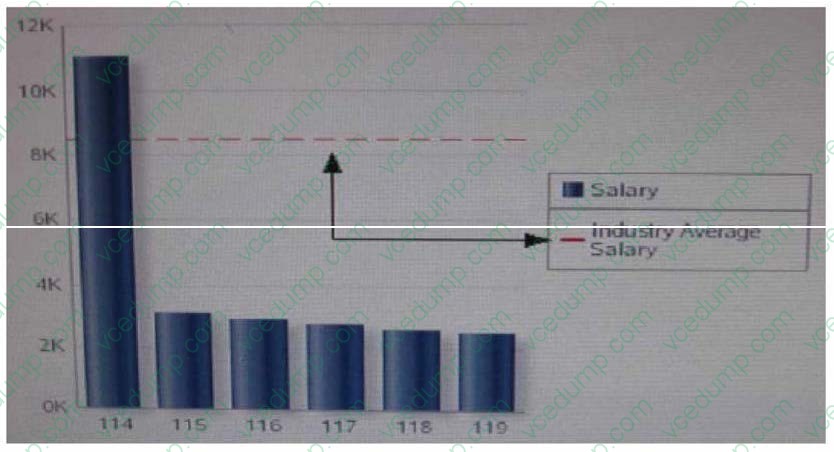
B. dvt: series
C. dvt: seriesSet
D. dvt: annotation
E. dvt: y1Axis
Related Exams:
-
1Z0-020
Oracle8i: New Features for Administrators -
1Z0-023
Architecture and Administration -
1Z0-024
Performance Tuning -
1Z0-025
Backup and Recovery -
1Z0-026
Network Administration -
1Z0-034
Upgrade Oracle9i/10g OCA to Oracle Database OCP -
1Z0-036
Managing Oracle9i on Linux -
1Z0-041
Oracle Database 10g: DBA Assessment -
1Z0-052
Oracle Database 11g: Administration Workshop I -
1Z0-053
Oracle Database 11g: Administration II
Tips on How to Prepare for the Exams
Nowadays, the certification exams become more and more important and required by more and more enterprises when applying for a job. But how to prepare for the exam effectively? How to prepare for the exam in a short time with less efforts? How to get a ideal result and how to find the most reliable resources? Here on Vcedump.com, you will find all the answers. Vcedump.com provide not only Oracle exam questions, answers and explanations but also complete assistance on your exam preparation and certification application. If you are confused on your 1Z0-554 exam preparations and Oracle certification application, do not hesitate to visit our Vcedump.com to find your solutions here.