1Z0-533 Exam Details
-
Exam Code
:1Z0-533 -
Exam Name
:Oracle Hyperion Planning 11 Essentials -
Certification
:Oracle Certifications -
Vendor
:Oracle -
Total Questions
:69 Q&As -
Last Updated
:Jul 12, 2026
Oracle 1Z0-533 Online Questions & Answers
-
Question 41:
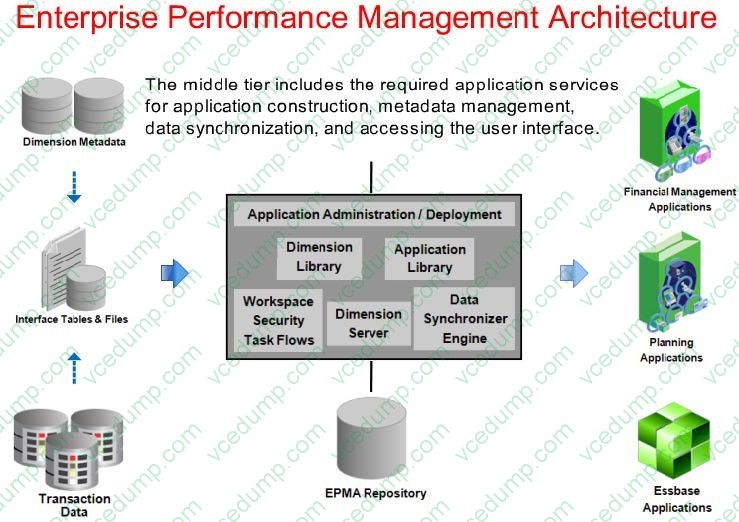
Identify the two true statements about Enterprise performance Management Architect.
A. If you decide to implement EPMA, all Planning applications must be EPMA-deployed applications.
B. EPMA-deployed applications may either use EAS Business Rules or Calculation Manager in 11.1.1.3.
C. You can create Planning, TM, Essbase, and FDM applications in EPMA.
D. Data can be shared from a Planning application to an FM application within EPMA.
E. EPMA can be used by end users to manage and update member properties such as hierarchies and aliases.
F. In the Dimension Library, you can maintain one full dimension (for example. Account) but filter portions of the dimension for different applications (for example, Revenue accounts. Balance Sheet) -
Question 42:
Management dictates a major reorganization of the company structure, meaning you need to rebuild the Entity dimension from the beginning. You need to delete members in the Entity dimension. Identify the three true statements about deleting members from a Planning application.
A. You must delete members one by one.
B. You must delete a reference to a member from all data forms before deleting it from the dimension.
C. In a data form definition, you selected @IDescendants(IT) for the entity dimension in the page section. The IT member will remain but 2 of its 10 cost centers are being removed. You must remove the reference to "IT" in this data form.
D. You should back up all data for the deleted entity members; after a member is deleted, the data is not retained.
E. A database refresh is required after deleting members from the Entity dimension. -
Question 43:
Identify the three characteristics of the Scenarios dimension.
A. Security can be assigned to members of the Scenario dimension.
B. It allows the administrator to assign valid periods for data entry
C. It allows bottoms up or target planning
D. Exchange rate tables are tied to the Scenario dimension.
E. One member in the scenario dimension may be valid for Plan Type. -
Question 44:
Given the following:
Measures (Dense): 40 stored members, 50 total members
Time (Dense): 17 stored members, 17 total members Scenario (Dense): 2 stored members, 5 total members
Market (Sparse): 100 stored members, 100 total members
Product(Sparse): 500 stored members, 550 total members
What is the block size in bytes?
A. Block size = 40 * 17 * 2
B. Block size = 40 * 17 * 2 * 8
C. Block size = 50 * 17 * 5 * 8
D. Block size = 50 * 17 * 5
E. Block size = 100 * 500 * 8
F. Block size = 100 * 500 -
Question 45:
What are the three supported methods to create and update a member and its properties ming Classic or non-Classic Planning applications)?
A. Planning Web Client
B. EAS
C. EPMA
D. DRM
E. Outline Load Utility -
Question 46:
Based on the following design: Plan type 1: Summary Plan type with all Accounts by Entity Plan type 2: Sales Plan type with Sales by Product by Entity Plan type 3: Salary Plan type with Salary Expense by Employee by Entity You need to get Sales data to the Summary plan type. Identify the two true statements about
sharing revenue data between the sales plan type and the summary plan type.
A. Planning will build in @XREF calculations in a calc script by default to share data between plan types.
B. A replicated partition could be created to replicate data from the sales plan type to the summary plan type and this would be done if we wanted to store the sales data in the summary plan type.
C. A transparent partition and @XREF calculations could have performance issues for retrievals because data is not stored; it is dynamically calculated.
D. A calc export script on the source database with the DATAEXPORT command could be used to export data out of the revenue plan type and calc import script on the target database with the DATAIMPORT command could be used to import the data file to the summary plan type.
E. To disable the building of @XREF, update the HSPProperties file for the application before you click Create during the application creation process. -
Question 47:
Identify the two statements about the Planning Import security utility.
A. Imports Planning application access for users and groups
B. Imports users and groups into Planning
C. Requires the source text file to be named PLANSECFILE.txt
D. Can be scheduled to run nightly using an encrypted password
E. Clears existing security definitions by default before the import takes place -
Question 48:
You need to calculate benefit expense in your Planning application using the following logic:
Benefit expense is equal to the Total Salary of the Organization multiplied by a factor data loaded to each cost center.
Given the following components, what is the correct order of calculation:
1-Custom calculation (Total Salary * Factor)
2-Aggregate benefits
3-Aggregate salaries
A. 1, 2, 3
B. 3, 2, 1
C. 2, 3, 1
D. 3, 1, 2 -
Question 49:
What differentiates a user-defined custom dimension from the Entity and Account dimensions?
A. You can only add custom attributes to user-defined custom dimensions.
B. You assign valid plan types for the user-defined custom dimension at the dimension level.
C. You assign data types for the user-defined custom dimension at the dimension level.
D. You cannot: assign security for user-defined custom dimensions.
E. You can easily delete a user-defined custom dimension in Planning but you cannot delete an Entity dimension. -
Question 50:
Identify the one Planning component that is not accessible over the Web.
A. Dimension Editor for Planning
B. Shared Services
C. Exchange Rates Definition
D. Planning Utilities
E. Create and Manage Database Options
F. Create Data Sources
Related Exams:
-
1Z0-020
Oracle8i: New Features for Administrators -
1Z0-023
Architecture and Administration -
1Z0-024
Performance Tuning -
1Z0-025
Backup and Recovery -
1Z0-026
Network Administration -
1Z0-034
Upgrade Oracle9i/10g OCA to Oracle Database OCP -
1Z0-036
Managing Oracle9i on Linux -
1Z0-041
Oracle Database 10g: DBA Assessment -
1Z0-052
Oracle Database 11g: Administration Workshop I -
1Z0-053
Oracle Database 11g: Administration II
Tips on How to Prepare for the Exams
Nowadays, the certification exams become more and more important and required by more and more enterprises when applying for a job. But how to prepare for the exam effectively? How to prepare for the exam in a short time with less efforts? How to get a ideal result and how to find the most reliable resources? Here on Vcedump.com, you will find all the answers. Vcedump.com provide not only Oracle exam questions, answers and explanations but also complete assistance on your exam preparation and certification application. If you are confused on your 1Z0-533 exam preparations and Oracle certification application, do not hesitate to visit our Vcedump.com to find your solutions here.