
1Z0-511 Real Exam Questions

Oracle E-Business Suite (EBS) R12 Project Essentials

70 questions available · Page 1 of 7

Updated Exam DumpsVerified AnswersPass Guarantee

Get Complete Exam Dumps
Question 1 Single choice

An organization uses Oracle Projects and has fully installed Oracle Human Resources.

Which statement does not apply to this scenario?

  1. A

    Employees can be entered and maintainedin Oracle Projects.

  2. B

    Jobs can be setup in Oracle Projects.

  3. C

    Organizations can be defined In Oracle Projects.

  4. D

    Organization Hierarchiescan be defined in Oracle Projects.

  5. E

    WorkerAssignments can be viewed in Oracle Projects.

Show answer and explanation

Correct answer: D

Explanation

Note:
*Oracle Projects fully integrates with Oracle Human Resources to keep track of employees and information relevant to them, such as bill rates and mailing address.
Question 2 Multiple choice

You implement Project Manufacturing along with Project Costing for manufacturing company. You define various expenditure types in which few are specific to Project Manufacturing. Identify the three setups that are required to have an expenditure type specific to Project Manufacturing.

  1. A

    Rate Required is enabled for theExpenditureType.

  2. B

    "Work In Process" class is associated with the Expenditure Type.

  3. C

    "Miscellaneous transactions" classis associated with the Expenditure Type.

  4. D

    "Inventory" class is associated with the ExpenditureType.

  5. E

    Rate Required Is not enabled for the Expenditure Type.

Show answer and explanation

Correct answers: A, B, D

Explanation

B:Work In Process - This expenditure type class is used for Project Manufacturing WIP transactions that are interfaced from Manufacturing to Oracle Projects. You can also use this expenditure type class when you import other manufacturing costs via Transaction Import or when you enter transactions via pre-approved batch entry.
D:Inventory - This expenditure type class is used for the following transactions: Project Manufacturing transactions that are interfaced from Manufacturing or Inventory to Oracle Projects.
Oracle Inventory Issues and Receipts that are interfaced from Oracle Inventory to Oracle Projects in a manufacturing or non-manufacturing installation. You can also use this expenditure type class when you import other manufacturing costs via Transaction Import or when you enter transactions via pre-approved batch entry.

Note:
*If the Rate Required option for the selected expenditure type is enabled in Oracle Projects, then you must enter a quantity. When you interface the invoice distribution toOracle Projects, Oracle Projects copies the quantity and amount to the expenditure item and calculates the rate. If Rate Required option for the selected expenditure type is disabled, then the quantity of the expenditure item is set to the amount you enter in Oracle Payables.

Question 3 Single choice

What type of project will a company require to use Organization Forecasting?

  1. A

    contract project

  2. B

    Administration Project

  3. C

    Organization Planning Project

  4. D

    capital project

  5. E

    multi-function project

Show answer and explanation

Correct answer: A

Explanation

Note:
*Compute Forecast Labor Revenue

This process calculates the potential revenue of labor expenditure items based on established bill rates and markups. The expenditure items that the process selects are billable labor expenditure items charged to contract projects that have not yet been processed by the Generate Draft Revenue process. The items do not have to be approved to be processed for forecast revenue.

Question 4 Single choice

A new contract project is created for work for a customer by using event-based billing. A decision has been made to give a discount to the customer on a particular invoice. You want to apply this discount and reduce the invoice without affecting revenue.

Which event type should be used to achieve this?

  1. A

    Manual

  2. B

    Invoice Reduction

  3. C

    Deferred Revenue

  4. D

    Automatic

  5. E

    ScheduledPayment

Show answer and explanation

Correct answer: D

Explanation

Event Type Classification is: Scheduled Payment, Deferred Revenue, Invoice Reduction, Manual, or Automatic (for billing events only)

Question 5 Single choice

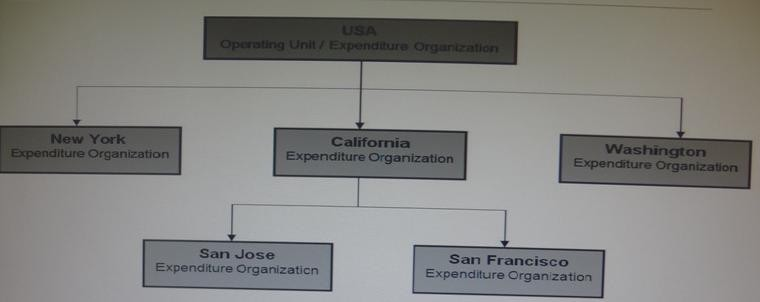
Refer to the exhibit.

In your company's Expenditure/Event Organization Hierarchy, organization labor costing rules are assigned to all organizations except San Jose.

What happens when you run the "PRC: Distribute labor costs" program for a timecard transaction entered by an employee from the San Jose organization?

  1. A

    Therule assignedfor SanFranciscotakes precedence and the transaction will hesuccessfully a distributed.

  2. B

    The rule assigned for USA takes precedence and thetransaction will he successfully cost distributed.

  3. C

    The rule assigned for California takes precedence and the transaction will be successfullycostdistributed.

  4. D

    The program ignores this transaction, because no labor costing ruleis assigned for San Jose.andcompletesnormally.

  5. E

    The program completes normally. However, the output will have this transaction under the exceptions sectionwith a message "No Labor costing rule assigned for organization."

Show answer and explanation

Correct answer: C

Question 6 Single choice

Which types of rate schedules should be defined to allow rates to be used to generate financial plans?

  1. A

    Job Labor Rates ScheduleNon Labor Rate Schedule

  2. B

    Resource Class SchedulePlanning Rate ScheduleLabor Rates Schedule

  3. C

    Resource Class ScheduleLabor Rates ScheduleNon Labor Rate Schedule

  4. D

    ResourceClass SchedulePlanning Rate ScheduleNon LaborRates Schedule

Show answer and explanation

Correct answer: C

Explanation

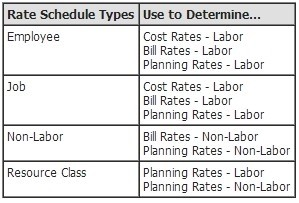
Defining Rate Schedules
You can define four types of rate schedules. The following table lists the four types of rate schedules and indicates how you can use each rate schedule type in Oracle Projects.

Note:
*If you select the option to use planning rates, then you can choose the cost and revenue rate schedules to use to generate amounts. If you do not select the option to use planning rates, then Oracle Projects automatically chooses the rate schedules that are used to calculate actual cost and revenue (bill) amounts.

Question 7 Single choice

Your client has expressed a desire to produce and summarize invoice lines for Non-Labor transactions by type of expenditure based on high level tasks of the project.

Which invoice formal grouping should he used to achieve this?

  1. A

    TopTask,ExpenditureType

  2. B

    TopTask,Employee

  3. C

    Revenue Category,Expenditure Category, Top Task

  4. D

    TopTask,Expenditure Category

  5. E

    TopTask, Revenue Category, Expenditure Category,Expenditure Type

Show answer and explanation

Correct answer: A

Explanation

Note:
*Oracle Projects processes tasks based on their position in the structure. The three distinct positions are:

Top Task: A task whose parent is the project

Mid Task: A task that is not a top task or a lowest task

Lowest Task: A task that is at the bottom of the structure, without any child tasks

*You can configure transaction controls by the following:

Expenditure Category
Employee
Expenditure Type
Non-Labor Resource

Question 8 Single choice

A customer has gone into bankruptcy and is unable to pay their bills. This means that the project revenue is now overstated.

How can the customer reduce the revenue on the project to accurately reflect the amount of collectable revenue?

  1. A

    Create a revenue write-off event forthe uncollectable element andinterface to General Ledger.

  2. B

    Create a negative funding line and assign to the project thus reducing its revenue.

  3. C

    Createacost adjustment on the project using preapproved batches.

  4. D

    Createa credit memo in Oracle Projects and interface to Accounts Receivable.

  5. E

    Entera transaction control against the expendituretypes and regenerate the draft invoice.

Show answer and explanation

Correct answer: A

Question 9 Single choice

A customer enables transaction controls at the Project level. Oracle Project Costing checks the control when the customer ________.

  1. A

    transfers an expenditure item to another task of the same project

  2. B

    runs the PRC: Distribute Labor Costs concurrent program

  3. C

    runsthe PRC: Transaction Import concurrent program

  4. D

    entersaproject-related invoice distributionin Oracle Payables

  5. E

    enters an online or preapproved expenditureitem

Show answer and explanation

Correct answer: E

Explanation

Expenditure Item Validation

When you enter expenditure items, you are charging cost to a project and a task. Oracle Projects validates expenditure items against predefined criteria and any transaction controls and transaction control client extensions that you set up during the implementation.

Question 10 Multiple choice

In which two circumstances would it be appropriate to deselect the "Interface Revenue to GL" option in System Implementation Options, before you run the Interface to GC?

  1. A

    During data migration ifRevenue is already in General Ledger

  2. B

    When Revenueis handled in Accounts Receivable

  3. C

    WhenAutoAccounting isincorrect and the Revenue interfacing to GeneralLedger needs to be puton hold.

  4. D

    When Financewants to reconcile Unbilled Receivables/Unearned Revenue

  5. E

    When Revenuewas generated in errorforallprojects in Released status, and needs to becorrected.

Show answer and explanation

Correct answers: A, B

Explanation

A: If the revenue amounts are already interfaced to General Ledger (GL) through a different interface, then uncheck the `Interface Revenue to GL' option in the implementation options and run the `Interface
Revenue to GL' process in Oracle projects. This will turn the flags in the revenue records as accepted in GL, though it is not interfaced. Once this is done, revert back the implementation option back to its original state.